Sayed Mohammed Adnan – författare
2 974 kr
Skickas inom 5-8 vardagar
3 291 kr
Läs direkt efter köp
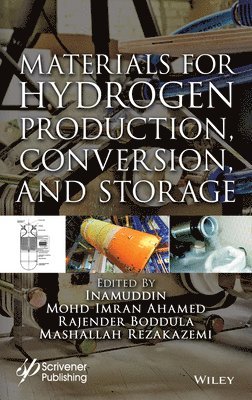
Edited by one of the most well-respected and prolific engineers in the world and his team, this book provides a comprehensive overview of hydrogen production, conversion, and storage, offering the scientific literature a comprehensive coverage of this important fuel.
Continually growing environmental concerns are driving every, or almost every, country on the planet towards cleaner and greener energy production. This ultimately leaves no option other than using hydrogen as a fuel that has almost no adverse environmental impact. But hydrogen poses several hazards in terms of human safety as its mixture of air is prone to potential detonations and fires. In addition, the permeability of cryogenic storage can induce frostbite as it leaks through metal pipes. In short, there are many challenges at every step to strive for emission-free fuel. In addition to these challenges, there are many emerging technologies in this area. For example, as the density of hydrogen is very low, efficient methods are being developed and engineered to store it in small volumes.
This groundbreaking new volume describes the production of hydrogen from various sources along with the protagonist materials involved. Further, the extensive and novel materials involved in conversion technologies are discussed. Also covered here are the details of the storage materials of hydrogen for both physical and chemical systems. Both renewal and non-renewal sources are examined as feedstocks for the production of hydrogen. The non-renewal feedstocks, mainly petroleum, are the major contributor to date but there is a future perspective in a renewal source comprising mainly of water splitting via electrolysis, radiolysis, thermolysis, photocatalytic water splitting, and biohydrogen routes. Whether for the student, veteran engineer, new hire, or other industry professionals, this is a must-have for any library.
3 291 kr
Läs direkt efter köp
Edited by one of the most well-respected and prolific engineers in the world and his team, this book provides a comprehensive overview of hydrogen production, conversion, and storage, offering the scientific literature a comprehensive coverage of this important fuel.
Continually growing environmental concerns are driving every, or almost every, country on the planet towards cleaner and greener energy production. This ultimately leaves no option other than using hydrogen as a fuel that has almost no adverse environmental impact. But hydrogen poses several hazards in terms of human safety as its mixture of air is prone to potential detonations and fires. In addition, the permeability of cryogenic storage can induce frostbite as it leaks through metal pipes. In short, there are many challenges at every step to strive for emission-free fuel. In addition to these challenges, there are many emerging technologies in this area. For example, as the density of hydrogen is very low, efficient methods are being developed and engineered to store it in small volumes.
This groundbreaking new volume describes the production of hydrogen from various sources along with the protagonist materials involved. Further, the extensive and novel materials involved in conversion technologies are discussed. Also covered here are the details of the storage materials of hydrogen for both physical and chemical systems. Both renewal and non-renewal sources are examined as feedstocks for the production of hydrogen. The non-renewal feedstocks, mainly petroleum, are the major contributor to date but there is a future perspective in a renewal source comprising mainly of water splitting via electrolysis, radiolysis, thermolysis, photocatalytic water splitting, and biohydrogen routes. Whether for the student, veteran engineer, new hire, or other industry professionals, this is a must-have for any library.
2 112 kr
Skickas inom 5-8 vardagar
2 452 kr
Läs direkt efter köp
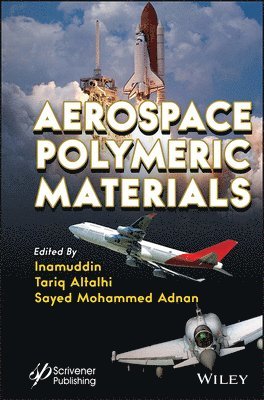
This book discusses polymeric and composite materials for aerospace industries and discusses some general qualities of aviation materials, e.g., strength, density, malleability, ductility, elasticity, toughness, brittleness, fusibility, conductivity, and thermal expansion.
Metals and alloys have so far been best able to utilize their qualities almost to the maximum. The latest advancements in polymers and composites have opened up a new area of conjecture about how to modify airplanes and shuttles to be more polymeric and less metallic. Polymeric materials have been the focus of exploration due to their high strength-to-weight ratio, low cost, and a greater degree of freedom in strengthening the needed qualities. Strength, density, malleability, ductility, elasticity, toughness, brittleness, fusibility, conductivity, and thermal expansion are some of the general qualities of aviation materials that are taken into account.
Aerospace Polymeric Materials discusses a wide range of methods with an outline of polymeric and composite materials for aerospace applications. Among the range of topics discussed are aerogel properties; polymeric welding; polymeric reinforcement, their properties, and manufacturing; conducting polymer composites; electroactive polymeric composites; and polymer nanocomposite dielectrics. In addition, a summary of self-healing materials is also presented, including their significance, manufacturing methods, properties, and applications.
Audience
This is a useful guide for engineers, materials scientists, researchers, and postgraduate students from industry, academia, and laboratories that are linked to polymeric composites.
2 452 kr
Läs direkt efter köp
This book discusses polymeric and composite materials for aerospace industries and discusses some general qualities of aviation materials, e.g., strength, density, malleability, ductility, elasticity, toughness, brittleness, fusibility, conductivity, and thermal expansion.
Metals and alloys have so far been best able to utilize their qualities almost to the maximum. The latest advancements in polymers and composites have opened up a new area of conjecture about how to modify airplanes and shuttles to be more polymeric and less metallic. Polymeric materials have been the focus of exploration due to their high strength-to-weight ratio, low cost, and a greater degree of freedom in strengthening the needed qualities. Strength, density, malleability, ductility, elasticity, toughness, brittleness, fusibility, conductivity, and thermal expansion are some of the general qualities of aviation materials that are taken into account.
Aerospace Polymeric Materials discusses a wide range of methods with an outline of polymeric and composite materials for aerospace applications. Among the range of topics discussed are aerogel properties; polymeric welding; polymeric reinforcement, their properties, and manufacturing; conducting polymer composites; electroactive polymeric composites; and polymer nanocomposite dielectrics. In addition, a summary of self-healing materials is also presented, including their significance, manufacturing methods, properties, and applications.
Audience
This is a useful guide for engineers, materials scientists, researchers, and postgraduate students from industry, academia, and laboratories that are linked to polymeric composites.
2 430 kr
Skickas inom 5-8 vardagar
2 112 kr
Skickas inom 5-8 vardagar
2 690 kr
Läs direkt efter köp
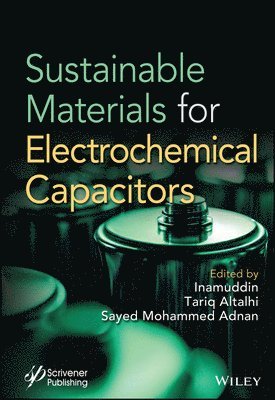
The book highlights the properties of sustainable materials for the production of commercial electrochemical capacitors.
Sustainable Materials for Electrochemical Capacitors details the progress in the usage of ubiquitous environmentally sustainable materials. Due to their cost effectiveness, flexible forms, frequent accessibility, and environmentally friendly nature, electrochemical capacitors with significant surface areas of their carbon components are quite common. Many novel ways for using bio-derived components in highly efficient electrochemical capacitors are being established as a consequence of current research, and this book provides details of all these developments.
The book provides:
A broad overview of properties explored for the development of electrochemical capacitors; Introduces potential applications of electrochemical capacitors; Highlights sustainable materials exploited for the production of electrochemical capacitors; Presents commercial potential of electrochemical capacitors.Audience
This is a useful guide for engineers, materials scientists, physicists, and innovators, who are linked to the development and applications of electrochemical capacitors.
2 690 kr
Läs direkt efter köp
The book highlights the properties of sustainable materials for the production of commercial electrochemical capacitors.
Sustainable Materials for Electrochemical Capacitors details the progress in the usage of ubiquitous environmentally sustainable materials. Due to their cost effectiveness, flexible forms, frequent accessibility, and environmentally friendly nature, electrochemical capacitors with significant surface areas of their carbon components are quite common. Many novel ways for using bio-derived components in highly efficient electrochemical capacitors are being established as a consequence of current research, and this book provides details of all these developments.
The book provides:
A broad overview of properties explored for the development of electrochemical capacitors; Introduces potential applications of electrochemical capacitors; Highlights sustainable materials exploited for the production of electrochemical capacitors; Presents commercial potential of electrochemical capacitors.Audience
This is a useful guide for engineers, materials scientists, physicists, and innovators, who are linked to the development and applications of electrochemical capacitors.
2 468 kr
Läs direkt efter köp
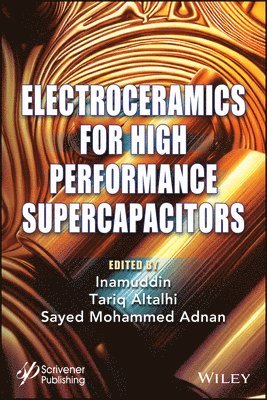
The book describes the state-of-the-art analyses of high-density supercapacitors.
In the near future, high-energy density materials will be required to accommodate the increased demand for gadgets, hybrid cars, and massive electrical energy storage systems. Fuel cells, supercapacitors, and batteries have the highest energy densities, but traditional capacitors have gained attention for intermittent energy harvesting owing to their high energy transfer rate and quick charging/discharging capability. The large amount of electric breakdown strength and modest remnant polarization are keys to the high energy density in dielectric capacitors. Above 100??C or 212??F, polymer dielectric capacitors become unstable and begin to suffer a dielectric breakdown. Hence, dielectric ceramics are the sole viable option for high-temperature applications.
This book provides a basic understanding of dielectric-based energy harvesting. After a detailed analysis of the state-of-the-art, it proceeds to explain the specific strategies to enhance energy storage features, including managing the local structure and phases assembly, raising the dielectric width, and enhancing microstructure and electrical uniformity. Also discussed is the need for novel materials with applications in high-density supercapacitors.
Audience
The book is designed for engineers, industrialists, physicists, scientists, and researchers who work on the applications of high-density supercapacitors.
2 468 kr
Läs direkt efter köp
The book describes the state-of-the-art analyses of high-density supercapacitors.
In the near future, high-energy density materials will be required to accommodate the increased demand for gadgets, hybrid cars, and massive electrical energy storage systems. Fuel cells, supercapacitors, and batteries have the highest energy densities, but traditional capacitors have gained attention for intermittent energy harvesting owing to their high energy transfer rate and quick charging/discharging capability. The large amount of electric breakdown strength and modest remnant polarization are keys to the high energy density in dielectric capacitors. Above 100??C or 212??F, polymer dielectric capacitors become unstable and begin to suffer a dielectric breakdown. Hence, dielectric ceramics are the sole viable option for high-temperature applications.
This book provides a basic understanding of dielectric-based energy harvesting. After a detailed analysis of the state-of-the-art, it proceeds to explain the specific strategies to enhance energy storage features, including managing the local structure and phases assembly, raising the dielectric width, and enhancing microstructure and electrical uniformity. Also discussed is the need for novel materials with applications in high-density supercapacitors.
Audience
The book is designed for engineers, industrialists, physicists, scientists, and researchers who work on the applications of high-density supercapacitors.