Serge Tabachnikov – författare
Visar alla böcker från författaren Serge Tabachnikov. Handla med fri frakt och snabb leverans.
6 produkter
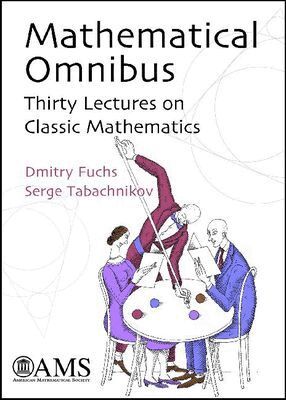
Mathematical Omnibus
Thirty Lectures on Classic Mathematics
Av Dmitry Fuchs, Serge Tabachnikov
Inbunden, 2007
832 kr
Lägg i varukorg
The book consists of thirty lectures on diverse topics, covering much of the mathematical landscape rather than focusing on one area. The reader will learn numerous results that often belong to neither the standard undergraduate nor graduate curriculum and will discover connections between …
Geometry and Billiards
Häftad, 2005
720 kr
Lägg i varukorg
Mathematical billiards describe the motion of a mass point in a domain with elastic reflections off the boundary or, equivalently, the behavior of rays of light in a domain with ideally reflecting boundary. From the point of view of differential geometry, the billiard flow is the geodesic flow on a …
Ein Schaubild der Mathematik
30 Vorlesungen über klassische Mathematik
Av Dmitry Fuchs, Serge Tabachnikov
Inbunden, 2011
240 kr
Lägg i varukorg
Das Buch enthält dreißig Vorlesungen über unterschiedliche Themen, die einen Großteil der mathematischen Landschaft abdecken. Klar und verständlich wird der Leser auf zahlreiche Resultate geführt, die oft weder in der mathematischen Grundausbildung noch im akademischen Curriculum vorkommen. So kann …
Ein Schaubild der Mathematik
30 Vorlesungen über klassische Mathematik
Av Serge Tabachnikov, Dmitry Fuchs
E-bok, 2011
136 kr
Lägg i varukorg
Das Buch enthält dreißig Vorlesungen über unterschiedliche Themen, die einen Großteil der mathematischen Landschaft abdecken. Klar und verständlich wird der Leser auf zahlreiche Resultate geführt, die oft weder in der mathematischen Grundausbildung noch im akademischen Curriculum vorkommen. So kann …
Geometrie und Billard
Häftad, 2013
313 kr
Lägg i varukorg
Wie bewegt sich ein Massenpunkt in einem Gebiet, an dessen Rand er elastisch zurückprallt? Welchen Weg nimmt ein Lichtstrahl in einem Gebiet mit ideal reflektierenden Rändern? Anhand dieser und ähnlicher Fragen stellt das vorliegende Buch Zusammenhänge zwischen Billard und Differentialgeometrie, …
Geometrie und Billard
E-bok, 2013
326 kr
Lägg i varukorg
Wie bewegt sich ein Massenpunkt in einem Gebiet, an dessen Rand er elastisch zurückprallt? Welchen Weg nimmt ein Lichtstrahl in einem Gebiet mit ideal reflektierenden Rändern? Anhand dieser und ähnlicher Fragen stellt das vorliegende Buch Zusammenhänge zwischen Billard und Differentialgeometrie, …