Sergey Fedoroff – författare
Visar alla böcker från författaren Sergey Fedoroff. Handla med fri frakt och snabb leverans.
13 produkter
13 produkter
Inbunden, Engelska, 1991
872 kr
Skickas inom 10-15 vardagar
Inbunden, Engelska, 1993
2 171 kr
Skickas inom 10-15 vardagar
This volume is made up of papers presented at the Second International Altschul Symposium: Biology and Pathology of Astrocyte-Neuron Interactions. The symposium was held in Saskatoon, Canada at the University of Saskatchewn in May, 1992 in memory of Rudolf Altschul, a graduate of the University of Prague and a pioneer in the fields of the biology of the vascular and nervous systems. Dr. Altschul was Professor and Head of the Department of Anatomy at the University of Saskatchewan from 1955 to 1963. The Altschul Symposia were made possible by an endowment left by Anni Altschul and by other contributions. The symposia are held biennially. One of the greatest challenges for present day scientists is to uncover the mechanisms of brain function. Although cellular anatomy of the nervous system has already been well outlined and indeed was delineated by the beginning of the century, experimental analysis of the function of the brain is relatively recent. The framework of the brain is made up of stellate cells, the astrocytes, which are interconnected by means of their processes, thus presenting a meshwork through which the neurons send their axons, accompanied by oligodendrocytes. Microglia are distributed throughout the brain.
Del 1 - Altschul Symposia Series
Atherosclerosis
Cellular and Molecular Interactions in the Artery Wall
Häftad, Engelska, 2012
548 kr
Skickas inom 10-15 vardagar
This volume contains the papers which were presented at the First Altschul Symposium, Atherosclerosis: Cellular and Molecular Interactions in the Artery Wall. The symposium was held in Saskatoon, at the University of Saskatchewan in May 1990 in memory of Dr. Rudolph Altschul, a pioneer in the field of vascular biology and the prevention of atherosclerosis. Dr. Altschul was Professor and Head of the Department of Anatomy at the University of Saskatchewan from 1955 to 1963. The challenge for biomedical scientists is to unravel the multifactorial etiology of atherosclerosis. For the last hundred and sixty years, anatomical pathologists have carefully studied the morphological changes of the human vascular wall during the initiation and evolution of the fibrofatty atherosclerotic plaque. Based on these elegant morphological observations, theories on atherogenesis were put forth by pathologists in the 1840's. Rudolf Virchow suggested that the movement of substances from the blood into the vessel wall was important for atherogenesis while Carl von Rokitansky felt that the deposition of substances on the lumenal surface of the artery resulted in the formation of atherosclerotic plaque. Since these original theories, it has become apparent that the pathogenesis of atherosclerosis is multifactorial and the disease evolves in stages. It is also likely that not all plaques arise through the same sequence of events and that many steps are involved in the development of each plaque. Today, our understanding of the complicated processes of atherogenesis is still incomplete.
E-bok
PDF, Engelska, 2012693 kr
Läs direkt efter köp
This volume contains the papers which were presented at the First Altschul Symposium, Atherosclerosis: Cellular and Molecular Interactions in the Artery Wall. The symposium was held in Saskatoon, at the University of Saskatchewan in May 1990 in memory of Dr. Rudolph Altschul, a pioneer in the field of vascular biology and the prevention of atherosclerosis. Dr. Altschul was Professor and Head of the Department of Anatomy at the University of Saskatchewan from 1955 to 1963. The challenge for biomedical scientists is to unravel the multifactorial etiology of atherosclerosis. For the last hundred and sixty years, anatomical pathologists have carefully studied the morphological changes of the human vascular wall during the initiation and evolution of the fibrofatty atherosclerotic plaque. Based on these elegant morphological observations, theories on atherogenesis were put forth by pathologists in the 1840''s. Rudolf Virchow suggested that the movement of substances from the blood into the vessel wall was important for atherogenesis while Carl von Rokitansky felt that the deposition of substances on the lumenal surface of the artery resulted in the formation of atherosclerotic plaque. Since these original theories, it has become apparent that the pathogenesis of atherosclerosis is multifactorial and the disease evolves in stages. It is also likely that not all plaques arise through the same sequence of events and that many steps are involved in the development of each plaque. Today, our understanding of the complicated processes of atherogenesis is still incomplete.
E-bok
PDF, Engelska, 20131 100 kr
Läs direkt efter köp
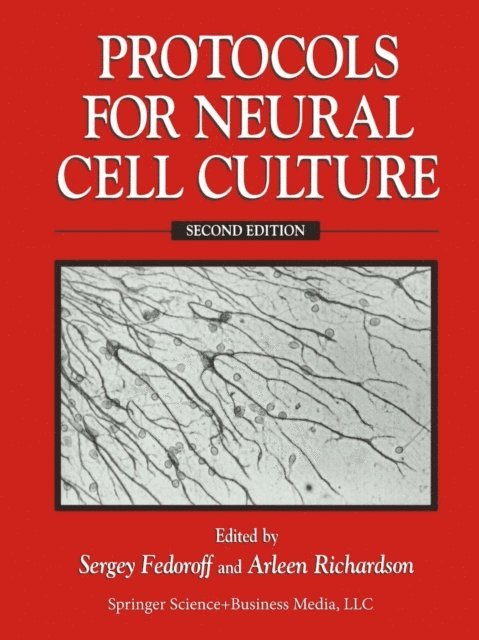
This volume is designed to be kept close at hand as a ready reference and a guide to laboratory procedures. It is based on tissue culture manuals used for a number of years at international courses on tissue culture at the University of Saskatchewan, made possible by the generous support of the Canadian Council of Animal Care and the Medical Research Council of Canada. Sergey Fedoroff Arleen Richardson The second edition of Protocols for Neural Cell Culture adheres to the prin ciples enunciated in the first edition, but the content has been extensively revised and expanded. Two new chapters have been added to reflect the increased interest in the development and differentiation of the nervous system and in the reconstruction of its circuitry in tissue culture. One chapter deals with slice cul tures in which the organization of the nervous system is preserved. When slice cultures are combined with explant cultures, afferent and efferent projections can be reconstructed. The other chapter deals with aggregating neural cell cul tures, in which "minibrains" can form. Theses are small, uniformly sized spheres of nervous tissue, usually having nerve cells in the center and astrocytes, oligo dendrocytes, and microglia in the periphery. Such cultures can be used to study neutral cell interactions in an organized milieu and for qualitative as well as quantitative studies at biochemical and molecular levels.
E-bok
PDF, Engelska, 20132 741 kr
Läs direkt efter köp
This volume is made up of papers presented at the Second International Altschul Symposium: Biology and Pathology of Astrocyte-Neuron Interactions. The symposium was held in Saskatoon, Canada at the University of Saskatchewn in May, 1992 in memory of Rudolf Altschul, a graduate of the University of Prague and a pioneer in the fields of the biology of the vascular and nervous systems. Dr. Altschul was Professor and Head of the Department of Anatomy at the University of Saskatchewan from 1955 to 1963. The Altschul Symposia were made possible by an endowment left by Anni Altschul and by other contributions. The symposia are held biennially. One of the greatest challenges for present day scientists is to uncover the mechanisms of brain function. Although cellular anatomy of the nervous system has already been well outlined and indeed was delineated by the beginning of the century, experimental analysis of the function of the brain is relatively recent. The framework of the brain is made up of stellate cells, the astrocytes, which are interconnected by means of their processes, thus presenting a meshwork through which the neurons send their axons, accompanied by oligodendrocytes. Microglia are distributed throughout the brain.
Häftad, Engelska, 2013
2 171 kr
Skickas inom 10-15 vardagar
This volume is made up of papers presented at the Second International Altschul Symposium: Biology and Pathology of Astrocyte-Neuron Interactions. The symposium was held in Saskatoon, Canada at the University of Saskatchewn in May, 1992 in memory of Rudolf Altschul, a graduate of the University of Prague and a pioneer in the fields of the biology of the vascular and nervous systems. Dr. Altschul was Professor and Head of the Department of Anatomy at the University of Saskatchewan from 1955 to 1963. The Altschul Symposia were made possible by an endowment left by Anni Altschul and by other contributions. The symposia are held biennially. One of the greatest challenges for present day scientists is to uncover the mechanisms of brain function. Although cellular anatomy of the nervous system has already been well outlined and indeed was delineated by the beginning of the century, experimental analysis of the function of the brain is relatively recent. The framework of the brain is made up of stellate cells, the astrocytes, which are interconnected by means of their processes, thus presenting a meshwork through which the neurons send their axons, accompanied by oligodendrocytes. Microglia are distributed throughout the brain.
E-bok
Engelska, 2013756 kr
Läs direkt efter köp
Advances in Cellular Neurobiology, Volume 5 focuses on cellular neurobiology, drawing on some aspects of biochemistry, endocrinology, embryology, morphology, genetics, pharmacology, pathology, and physiology. This book deals with humoral influences on brain development. Organized into three sections encompassing 10 chapters, this volume begins with an overview of the proposed functions for neurohumoral agents, including cell division, neural tube closure, palate formation, myoblast differentiation, and regulation of cell movements. This text then examines how growth factors regulate autonomic nerve development. Other chapters consider the morphology, physiology, and biochemistry of the neuronal cytoskeleton. This book discusses as well the connective tissue components in the normal peripheral nervous system and in two pathological conditions. The final chapter deals with the advantages and preparation of monoclonal antibodies in the identification of neurons. This book is a valuable resource for neurobiologists and researchers. Scientists in all fields of life sciences will also find this book useful.
E-bok
Engelska, 2013763 kr
Läs direkt efter köp
Advances in Cellular Neurobiology, Volume 3 discusses the anatomy and functional relation of the brain and spinal cord. This book is divided into three main sections—cell differentiation and interaction, aging and pathology, and methodologies. The topics discussed include Schwann cells, an in vitro perspective; molecular and cell biological aspects of learning toward a theory of memory; and aging of autonomic synapses. The axonal elongation in peripheral and central nervous system transplants; isolation and characterization of the cells of the cerebral microvessels; and PCI2 pheochromocytoma cultures in neurobiological research are also deliberated in this text. This publication is intended for neurologists, but is also beneficial to students researching on the central nervous system.
E-bok
Engelska, 2013756 kr
Läs direkt efter köp
Advances in Cellular Neurobiology, Volume 1 discusses the topographical anatomy and functional relation of the brain and spinal cord. This book is divided into three main sections—cell differentiation and interaction, aging and pathology, and methodologies. The topics discussed include specializations of non-neuronal cell membranes in the vertebrate nervous system; effects of neurohormones on glial cells; cerebellar granule cells in normal and neurological mutants of mice; and age-related changes in neuronal and glial enzyme activities. The glial fibrillary acidic (GFA) protein in normal neural cells and in pathological conditions; in vitro behavior of isolated oligodendrocytes; and biochemical mapping of specific neuronal pathways are also deliberated in this text. This publication is intended for neurologists, but is also beneficial to students researching on the central nervous system.
E-bok
Engelska, 2013979 kr
Läs direkt efter köp
Advances in Cellular Neurobiology, Volume 2 discusses the central nervous system, focusing on the structure and function of the brain and spinal cord at cellular level and higher brain functions such as learning, memory, and intelligence. This book is divided into three main sections— cell differentiation and interaction, aging and pathology, and methodologies. The topics discussed include APUD cells and paraneurons: embryonic origin; trophic and specifying factors directed to neuronal cells; and cellular aspects of human brain tumors (gliomas). The astrocyte in liver disease; radioenzymatic methods for analysis of neurotransmitters; and application of immunofluorescence in studies of cytoskeletal antigens are also deliberated in this text. This publication is intended for neurologists, but is also beneficial to students researching on the topographical anatomy and functional relation of the brain and spinal cord.
E-bok
Engelska, 2013756 kr
Läs direkt efter köp
Advances in Cellular Neurobiology, Volume 4 focuses on the central nervous system. This book is divided into three main sections—cell differentiation and interaction, aging and pathology, and methodologies. The topics discussed include advances in the neurobiology of oligodendroglia; neuronal differentiation in reaggregate cell cultures; and morphological aspects of brain edema. The cell biological aspects of Down''s syndrome; isolation and culture of cells of the dorsal root ganglia; and growth requirements of neural cells in vitro are also deliberated in this text. This publication is intended for neurologists, but is also beneficial to students researching on the anatomy and functional relation of the brain and spinal cord.
E-bok
PDF, Engelska, 20081 100 kr
Läs direkt efter köp
The first edition of Protocols for Neural Cell Culture was published in 1992 and the second edition in 1997. Originally, the publication grew outofprotocols used in the Tissue Culture Course given at the University of Saskatchewan. The course was patterned on those given by the Tissue CultureAssociation, first in Toronto, Canada, in 1948, then in Cooperstown, NY, then Denver, CO, and finally in Madison, WI, where the course ended in 1964. The course in Saskatchewan began in 1963 as a month-long international course that included both animal and plant tissue cultures. Over the years the course underwent specialization, first being limited to animal tissue culture, then to an intensive one-week general course. This led to one-week courses especially designed for tissue culture for the study of cancer or of the cardiovascular or the nervous system. In 1989, the Saskatchewan course became part of the Tissue Culture Training Facility of the Neuroscience Network of the Canadian Network of Centres of Excellence. The course and the Training Facility ceased to exist in 1997. The faculty for the Saskatchewan course was drawn from the best labora tories in the world and laboratory protocols from those centers were thoroughly tested in a student laboratory setting for many years.