Seung Hee Lee – författare
Visar alla böcker från författaren Seung Hee Lee. Handla med fri frakt och snabb leverans.
4 produkter
4 produkter
1 726 kr
Skickas inom 5-8 vardagar
LIQUID CRYSTAL DISPLAYS THE NEW EDITION OF THE GOLD-STANDARD IN TEACHING AND REFERENCING THE FUNDAMENTALS OF LCD TECHNOLOGIES This book presents an up-to-date view of modern LCD technology. Offering balanced coverage of all major aspects of the field, this comprehensive volume provides the theoretical and practical information required for the development and manufacture of high-performance, energy-efficient LCDs. The third edition incorporates new technologies and applications throughout. Several brand-new chapters discuss topics such as the application of Oxide TFTs and high mobility circuits, high-mobility TFT-semiconductors in LCD addressing, liquid crystal displays in automotive instrument clusters and touch-screen systems, and the use of ultra-high-resolution LCD panels in augmented reality (AR) and virtual reality (VR) displays. This practical reference and guide: Provides a complete account of commercially relevant LCD technologies, including their physics, mathematical descriptions, and electronic addressingFeatures extensively revised and expanded information, including more than 150 pages of new materialIncludes the addition of Oxide Transistors and their increased mobilities, the advances of fringe field switching and an overview of automotive displaysPresents quantitative results with full equation sets, their derivation, and tabular summaries of related information sets
287 kr
Skickas inom 5-8 vardagar
The backbone of Korean cookery, jang, has a flavour that can’t be found anywhere else in the world. The cuisine is uniquely delicious, yet there are few resources for those who wish to enjoy it at home. Until now. These recipes, packed with Korean flavours and cooking techniques, will open the door for readers unfamiliar with the cuisine. Everyday Korean is the ultimate guide to a unique and delicious cuisine.
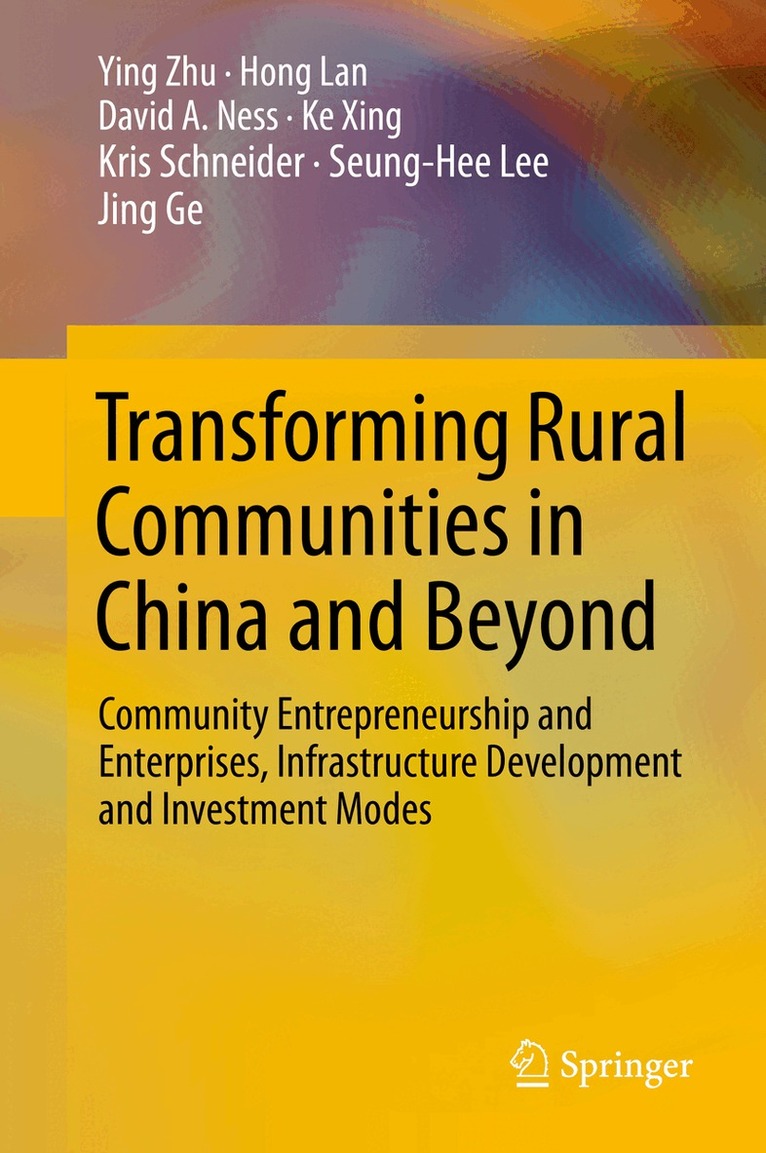
Transforming Rural Communities in China and Beyond
Community Entrepreneurship and Enterprises, Infrastructure Development and Investment Modes
Inbunden, Engelska, 2014
535 kr
Skickas inom 10-15 vardagar
This book represents one of the first attempts by a multidisciplinary research team, encompassing the social sciences, business, architecture and planning, engineering, and finance and economics, to help rural communities discover sustainable and self-reliant paths to development and transformation.The opening chapter outlines the background of the research, its importance in the context of China and other countries, the rationale for choosing the case study communities in rural China, and the composition of the research team. Chapter 2 explores key issues in the role of social entrepreneurship and leadership in rural community development. Chapter 3 analyses a green platform for a pilot transaction of China forest carbon sinks led by the Huadong Forestry Exchange. The fourth chapter examines carbon trade, forestry land rights, and the livelihoods of farmers in rural Chinese communities. Chapter 5 explores alternative energy development in rural Chinese communities, where the poor are often disproportionately dependent on fuel wood and solid biomass, causing environmental degradation, reduced productivity and the decline of income generating opportunities. Chapter 6 examines and tests the proposition that stronger communities will result from ‘connected up’, holistic, synergistic and inclusive planning of services and supporting infrastructure. Chapter 7 analyzes information and communications technology (ICT) based service innovations for supporting rural community enterprises. Chapter 8 highlights key elements of stronger rural communities, drawing together the themes and proposals of preceding chapters and constructing an integrated model.The authors demonstrate that interconnected community enterprises based on clean forest products, forest carbon and ecotourism can be underpinned by local infrastructure enterprises such as renewable energy, water, waste management, ICT and transport, and financial mechanisms like carbon finance, allinvolving skills development, leadership and social entrepreneurship coupled with corporate and investment partnerships. Such interconnected approaches are expected to generate increased employment and prosperity, improve social livelihoods, and benefit the environment.
Transforming Rural Communities in China and Beyond
Community Entrepreneurship and Enterprises, Infrastructure Development and Investment Modes
Häftad, Engelska, 2016
551 kr
Skickas inom 10-15 vardagar
This book represents one of the first attempts by a multidisciplinary research team, encompassing the social sciences, business, architecture and planning, engineering, and finance and economics, to help rural communities discover sustainable and self-reliant paths to development and transformation.The opening chapter outlines the background of the research, its importance in the context of China and other countries, the rationale for choosing the case study communities in rural China, and the composition of the research team. Chapter 2 explores key issues in the role of social entrepreneurship and leadership in rural community development. Chapter 3 analyses a green platform for a pilot transaction of China forest carbon sinks led by the Huadong Forestry Exchange. The fourth chapter examines carbon trade, forestry land rights, and the livelihoods of farmers in rural Chinese communities. Chapter 5 explores alternative energy development in rural Chinese communities, where the poor are often disproportionately dependent on fuel wood and solid biomass, causing environmental degradation, reduced productivity and the decline of income generating opportunities. Chapter 6 examines and tests the proposition that stronger communities will result from ‘connected up’, holistic, synergistic and inclusive planning of services and supporting infrastructure. Chapter 7 analyzes information and communications technology (ICT) based service innovations for supporting rural community enterprises. Chapter 8 highlights key elements of stronger rural communities, drawing together the themes and proposals of preceding chapters and constructing an integrated model.The authors demonstrate that interconnected community enterprises based on clean forest products, forest carbon and ecotourism can be underpinned by local infrastructure enterprises such as renewable energy, water, waste management, ICT and transport, and financial mechanisms like carbon finance, allinvolving skills development, leadership and social entrepreneurship coupled with corporate and investment partnerships. Such interconnected approaches are expected to generate increased employment and prosperity, improve social livelihoods, and benefit the environment.