Sevasti Trubeta – författare
Visar alla böcker från författaren Sevasti Trubeta. Handla med fri frakt och snabb leverans.
5 produkter
5 produkter
1 264 kr
Skickas inom 5-8 vardagar
The research of pandemics, epidemics, and pathogens like COVID-19 reaches far beyond the scope of biomedicine. It is not only an objective for the health, political and social sciences, but epidemics and pandemics are a matter of geography: foci and vectors of communicable diseases continue to test the efficacy of medical control at state borders.This volume illuminates these issues from various disciplinary viewpoints. It starts by exploring historical models of quarantine, spatial isolation and detention as precautionary means against the dissemination of disease and contagion by border crossers, migrants and refugees. Besides the patterns of prejudice with which these groups are confronted, the book also deals with various kinds of fear of contamination from outside of the nation state. The contributors address the implementation of medical techniques at state borders in the twentieth and early twenty-first centuries, as well as the presently practiced measures of medical and biometric screening of migrants and refugees. Uniquely, this volume shows that the current border security regimes of Western states exhibit a high share of medicalised techniques of power, which originate both in European modernity and in the medical and biological disciplines developed during the last quarter of the millennium.Drawing on the collective expertise of a network of international researchers, this interdisciplinary volume is essential reading for those wishing to understand the medicalisation of borders across the globe, from the early eighteenth century up to the present day.
230 kr
Skickas
The research of pandemics, epidemics, and pathogens like COVID-19 reaches far beyond the scope of biomedicine. It is not only an objective for the health, political and social sciences, but epidemics and pandemics are a matter of geography: foci and vectors of communicable diseases continue to test the efficacy of medical control at state borders.This volume illuminates these issues from various disciplinary viewpoints. It starts by exploring historical models of quarantine, spatial isolation and detention as precautionary means against the dissemination of disease and contagion by border crossers, migrants and refugees. Besides the patterns of prejudice with which these groups are confronted, the book also deals with various kinds of fear of contamination from outside of the nation state. The contributors address the implementation of medical techniques at state borders in the twentieth and early twenty-first centuries, as well as the presently practiced measures of medical and biometric screening of migrants and refugees. Uniquely, this volume shows that the current border security regimes of Western states exhibit a high share of medicalised techniques of power, which originate both in European modernity and in the medical and biological disciplines developed during the last quarter of the millennium.Drawing on the collective expertise of a network of international researchers, this interdisciplinary volume is essential reading for those wishing to understand the medicalisation of borders across the globe, from the early eighteenth century up to the present day.
Del 334 - Europaeische Hochschulschriften / European University Studie
Konstitution Von Minderheiten Und Die Ethnisierung Sozialer Und Politischer Konflikte
Eine Untersuchung Am Beispiel Der Im Griechischen Thrakien Ansaessigen Moslemischen Minderheit
Häftad, Tyska, 1999
661 kr
Tillfälligt slut
Del 11 - Balkan Studies Library
Physical Anthropology, Race and Eugenics in Greece (1880s–1970s)
Inbunden, Engelska, 2013
2 551 kr
Skickas inom 3-6 vardagar
Before it became established as an academic discipline, physical anthropology emerged as a contested notion of reference to the cosmological views associated with the Darwinian theory of evolution and its implementation by the natural sciences. However, its subsequent development points to a science which made holistic claims regarding its ability to explore humankind in its entirety and to influence society, with its involvement in politics, as well as racial and eugenic concepts serving as the vehicle for doing so. This book explores the emergence of physical anthropology in the modern Greek state and its development over a period of one century from the viewpoint of the proclaimed intention of its representatives to influence societal developments. The book is the first to subject Greek racial and eugenic discourse to detailed research.
2 126 kr
Skickas inom 10-15 vardagar
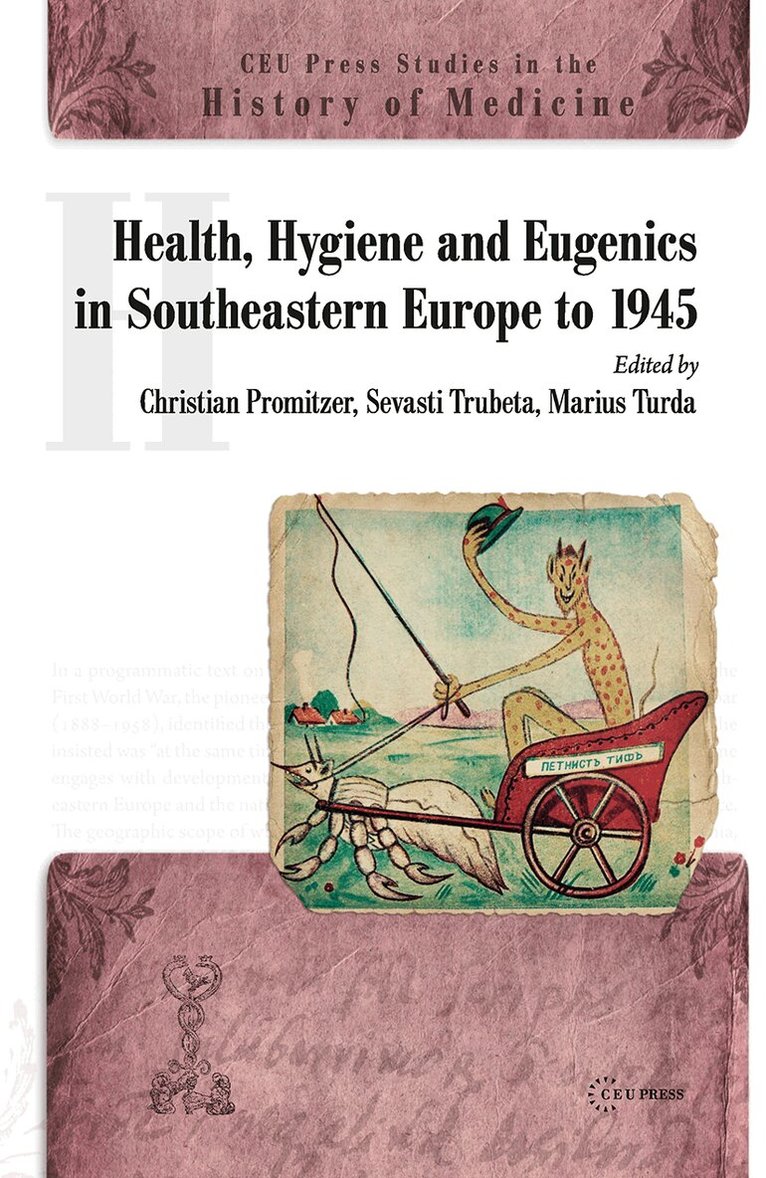
This volume is a collection of chapters that deal with issues of health, hygiene and eugenics in Southeastern Europe to 1945, specifically, in Bosnia-Herzegovina, Bulgaria, Croatia, Greece and Romania. Its major concern is to examine the transfer of medical ideas to society via local, national and international agencies and to show in how far developments in public health, preventive medicine, social hygiene, welfare, gender relations and eugenics followed a regional pattern. This volume provides insights into a region that has to date been marginal to scholarship of the social history of medicine.