Shafiqul Islam - Böcker
Visar alla böcker från författaren Shafiqul Islam. Handla med fri frakt och snabb leverans.
11 produkter
11 produkter
935 kr
Skickas inom 10-15 vardagar
The theory and applications of random dynamical systems (RDS) are at the cutting edge of research in mathematics and economics, particularly in modeling the long-run evolution of economic systems subject to exogenous random shocks. Despite this interest, there are no books available that solely focus on RDS in finance and economics. Exploring this emerging area, Random Dynamical Systems in Finance shows how to model RDS in financial applications.Through numerous examples, the book explains how the theory of RDS can describe the asymptotic and qualitative behavior of systems of random and stochastic differential/difference equations in terms of stability, invariant manifolds, and attractors. The authors present many models of RDS and develop techniques for implementing RDS as approximations to financial models and option pricing formulas. For example, they approximate geometric Markov renewal processes in ergodic, merged, double-averaged, diffusion, normal deviation, and Poisson cases and apply the obtained results to option pricing formulas.With references at the end of each chapter, this book provides a variety of RDS for approximating financial models, presents numerous option pricing formulas for these models, and studies the stability and optimal control of RDS. The book is useful for researchers, academics, and graduate students in RDS and mathematical finance as well as practitioners working in the financial industry.
3 288 kr
Skickas inom 10-15 vardagar
The Routledge Handbook of Water Diplomacy is a comprehensive guide to understanding and practicing water diplomacy – a framework for building relationships, negotiating shared interests, and managing complex water challenges across physical, political, and societal boundaries.In an era marked by rising scarcity, deepening uncertainty, and growing geopolitical tension, this timely volume offers actionable insights for negotiated problem-solving grounded in both scientific understanding and diplomatic skill. Moving beyond abstract theory and technical fixes, the Handbook introduces a dual-pathway structure designed to meet the diverse needs of its users. The “Working Together” pathway invites readers to engage with water diplomacy through the lens of their roles, whether as professionals, decision-makers, funders, researchers, or affected communities. The “What Matters and Why” pathway highlights key thematic dimensions, including process design, adaptive learning, trust-building, divergent worldviews, and the management of uncertainty. Together, these pathways guide readers through a wide range of case studies, from transboundary river basins to subnational disputes and community-scale water systems, demonstrating how water diplomacy can resolve conflict, enable cooperation, and support adaptive, context-sensitive 'learning by doing' under conditions of complexity and change. Whether addressing a transboundary dispute or a local allocation challenge, this book provides guiding principles, practical tools, and real-world cases to support water solutions that are scientifically credible, socially inclusive, and politically feasible.The Routledge Handbook of Water Diplomacy serves as an essential reference volume for students and scholars of water diplomacy, water governance and water resource management, as well as for policymakers and water professionals who are seeking actionable insights into the nuanced challenges they encounter as they work to promote a more sustainable and equitable water future.The Open Access version of this book, available at http://www.taylorfrancis.com, has been made available under a Creative Commons Attribution- NonCommercial- ShareAlike 4.0 International (CC BY- NC- SA) license.
Interdisciplinary Collaboration for Water Diplomacy
A Principled and Pragmatic Approach
Häftad, Engelska, 2021
617 kr
Skickas inom 10-15 vardagar
This book introduces the concept of Water Diplomacy as a principled and pragmatic approach to problem-driven interdisciplinary collaboration, which has been developed as a response to pressing contemporary water challenges arising from the coupling of natural and human systems. The findings of the book are the result of a decade-long interdisciplinary experiment in conceiving, developing, and implementing an interdisciplinary graduate program on Water Diplomacy at Tufts University, USA. This has led to the development of the Water Diplomacy Framework, a shared framework for understanding, diagnosing, and communicating about complex water issues across disciplinary boundaries. This framework clarifies important distinctions between water systems - simple, complicated, or complex - and the attributes that these distinctions imply for how these problems can be addressed. In this book, the focus is on complex water issues and how they require a problem-driven rather than a theory-driven approach to interdisciplinary collaboration. Moreover, it is argued that conception of interdisciplinarity needs to go beyond collaboration among experts, because complex water problems demand inclusive stakeholder engagement, such as in fact-value deliberation, joint fact finding, collective decision making, and adaptive management. Water professionals working in such environments need to operate with both principles and pragmatism in order to achieve actionable, sustainable, and equitable outcomes. This book explores these ideas in more detail and demonstrates their efficacy through a diverse range of case studies. Reflections on the program are also included, from conceptualization through implementation and evaluation. This book offers critical lessons and case studies for researchers and practitioners working on complex water issues as well as important lessons for those looking to initiate, implement, or evaluate interdisciplinary programs to address other complex problems in any setting.
Interdisciplinary Collaboration for Water Diplomacy
A Principled and Pragmatic Approach
Inbunden, Engelska, 2019
2 088 kr
Skickas inom 10-15 vardagar
This book introduces the concept of Water Diplomacy as a principled and pragmatic approach to problem-driven interdisciplinary collaboration, which has been developed as a response to pressing contemporary water challenges arising from the coupling of natural and human systems. The findings of the book are the result of a decade-long interdisciplinary experiment in conceiving, developing, and implementing an interdisciplinary graduate program on Water Diplomacy at Tufts University, USA. This has led to the development of the Water Diplomacy Framework, a shared framework for understanding, diagnosing, and communicating about complex water issues across disciplinary boundaries. This framework clarifies important distinctions between water systems - simple, complicated, or complex - and the attributes that these distinctions imply for how these problems can be addressed. In this book, the focus is on complex water issues and how they require a problem-driven rather than a theory-driven approach to interdisciplinary collaboration. Moreover, it is argued that conception of interdisciplinarity needs to go beyond collaboration among experts, because complex water problems demand inclusive stakeholder engagement, such as in fact-value deliberation, joint fact finding, collective decision making, and adaptive management. Water professionals working in such environments need to operate with both principles and pragmatism in order to achieve actionable, sustainable, and equitable outcomes. This book explores these ideas in more detail and demonstrates their efficacy through a diverse range of case studies. Reflections on the program are also included, from conceptualization through implementation and evaluation. This book offers critical lessons and case studies for researchers and practitioners working on complex water issues as well as important lessons for those looking to initiate, implement, or evaluate interdisciplinary programs to address other complex problems in any setting.
2 088 kr
Skickas inom 10-15 vardagar
The theory and applications of random dynamical systems (RDS) are at the cutting edge of research in mathematics and economics, particularly in modeling the long-run evolution of economic systems subject to exogenous random shocks. Despite this interest, there are no books available that solely focus on RDS in finance and economics. Exploring this emerging area, Random Dynamical Systems in Finance shows how to model RDS in financial applications.Through numerous examples, the book explains how the theory of RDS can describe the asymptotic and qualitative behavior of systems of random and stochastic differential/difference equations in terms of stability, invariant manifolds, and attractors. The authors present many models of RDS and develop techniques for implementing RDS as approximations to financial models and option pricing formulas. For example, they approximate geometric Markov renewal processes in ergodic, merged, double-averaged, diffusion, normal deviation, and Poisson cases and apply the obtained results to option pricing formulas.With references at the end of each chapter, this book provides a variety of RDS for approximating financial models, presents numerous option pricing formulas for these models, and studies the stability and optimal control of RDS. The book is useful for researchers, academics, and graduate students in RDS and mathematical finance as well as practitioners working in the financial industry.
1 954 kr
Skickas inom 10-15 vardagar
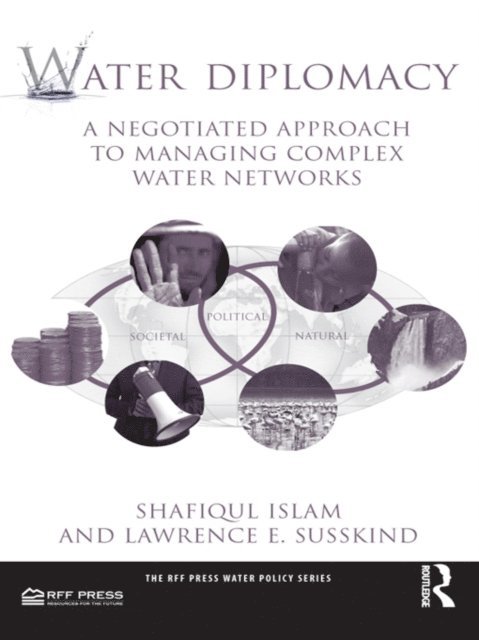
Water is the resource that will determine the wealth, welfare, and stability of many countries in the twenty-first century. This book offers a new approach to managing water that will overcome the conflicts that emerge when the interactions among natural, societal, and political forces are overlooked. At the heart of these conflicts are complex water networks. In managing them, science alone is insufficient and so is policy-making that doesn't take science into account. Solutions will only emerge if a negotiated or diplomatic approach that blends science, policy, and politics is used to manage water networks. The authors show how open and constantly changing water networks can be managed successfully using collaborative adaptive techniques to build informed agreements among disciplinary experts, water users with conflicting interests, and governmental bodies with countervailing claims. Shafiqul Islam is an engineer with over twenty-five years of practical experience in addressing water issues. Lawrence Susskind is founder of MIT's Environmental Policy and Planning Program and a leader of the Program on Negotiation at Harvard Law School. Together they have developed a text that is relevant for students and experienced professionals working in a variety of engineering, science, and applied social science fields. They show how new thinking about water conflict can replace the zero-sum battles that pit experts, politicians, and stakeholders against each other in counter-productive ways. Their volume not only presents the key elements of a theory of water diplomacy; it includes excerpts and commentary from more than two dozen seminal readings as well as practice exercises that challenge readers to apply what they have learned.
549 kr
Skickas inom 10-15 vardagar
Water is the resource that will determine the wealth, welfare, and stability of many countries in the twenty-first century. This book offers a new approach to managing water that will overcome the conflicts that emerge when the interactions among natural, societal, and political forces are overlooked. At the heart of these conflicts are complex water networks. In managing them, science alone is insufficient and so is policy-making that doesn't take science into account. Solutions will only emerge if a negotiated or diplomatic approach that blends science, policy, and politics is used to manage water networks. The authors show how open and constantly changing water networks can be managed successfully using collaborative adaptive techniques to build informed agreements among disciplinary experts, water users with conflicting interests, and governmental bodies with countervailing claims. Shafiqul Islam is an engineer with over twenty-five years of practical experience in addressing water issues. Lawrence Susskind is founder of MIT's Environmental Policy and Planning Program and a leader of the Program on Negotiation at Harvard Law School. Together they have developed a text that is relevant for students and experienced professionals working in a variety of engineering, science, and applied social science fields. They show how new thinking about water conflict can replace the zero-sum battles that pit experts, politicians, and stakeholders against each other in counter-productive ways. Their volume not only presents the key elements of a theory of water diplomacy; it includes excerpts and commentary from more than two dozen seminal readings as well as practice exercises that challenge readers to apply what they have learned.
Del 1 - Anthem Environment and Sustainability Initiative
Water Diplomacy in Action
Contingent Approaches to Managing Complex Water Problems
Inbunden, Engelska, 2017
1 331 kr
Skickas inom 5-8 vardagar
Complex water problems cannot be resolved by numbers or narratives. Contingent and negotiated approaches are necessary for actionable outcome. In the face of a constantly changing array of interconnected water issues that cross multiple boundaries, the challenge is how to translate solutions that emerge from science and technology into the context of real-world policy and politics. Water Diplomacy in Action addresses this task by synthesizing two emerging ideas––complexity science and negotiation theory––to understand and manage risks and opportunities for an uncertain water future. Rooted in the ideas of complexity science and mutual gains negotiation, this edited volume shows why traditional systems engineering approaches may not work for complex problems, what emerging tools and techniques are needed and how these are used to resolve complex water problems.
Del 1 - Anthem Environment and Sustainability Initiative
Water Diplomacy in Action
Contingent Approaches to Managing Complex Water Problems
Häftad, Engelska, 2017
370 kr
Skickas inom 5-8 vardagar
Complex water problems cannot be resolved by numbers or narratives. Contingent and negotiated approaches are necessary for actionable outcome. In the face of a constantly changing array of interconnected water issues that cross multiple boundaries, the challenge is how to translate solutions that emerge from science and technology into the context of real-world policy and politics. Water Diplomacy in Action addresses this task by synthesizing two emerging ideas––complexity science and negotiation theory––to understand and manage risks and opportunities for an uncertain water future. Rooted in the ideas of complexity science and mutual gains negotiation, this edited volume shows why traditional systems engineering approaches may not work for complex problems, what emerging tools and techniques are needed and how these are used to resolve complex water problems.
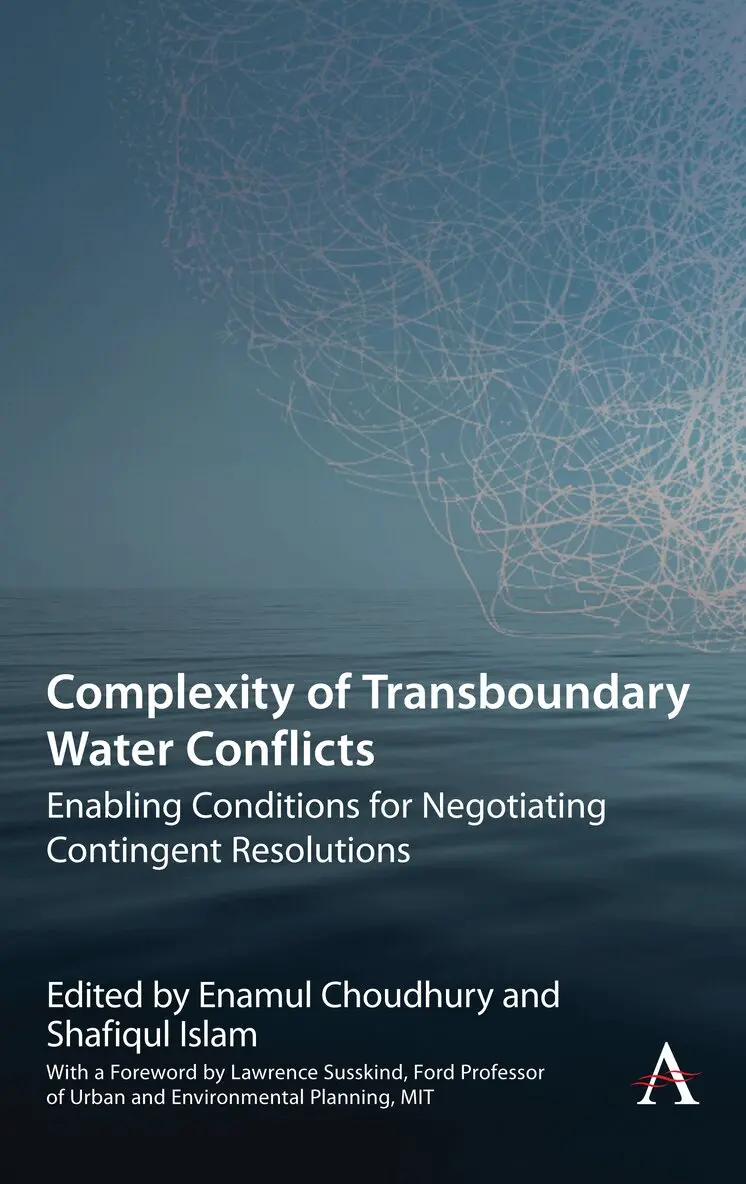
Complexity of Transboundary Water Conflicts
Enabling Conditions for Negotiating Contingent Resolutions
Inbunden, Engelska, 2018
1 099 kr
Skickas inom 5-8 vardagar
‘Complexity of Transboundary Water Conflicts’ seeks to understand transboundary water issues as complex systems with contingent conditions and possibilities. To address those conditions and leverage the possibilities it introduces the concept of enabling conditions as a pragmatic way to identify and act on the emergent possibilities to resolve transboundary water issues. Based on this theoretical frame, the book applies the ideas and tools from complexity science, contingency and enabling conditions to account for events in the formulation of treaties/agreements between disputing riparian states in river basins across the world (Indus, Jordan, Nile, Ganges, Brahmaputra, Colorado, Danube, Senegal and Zayandehrud). It also includes a section with scholars’ reflections on the relevance and weakness of the theoretical framework.
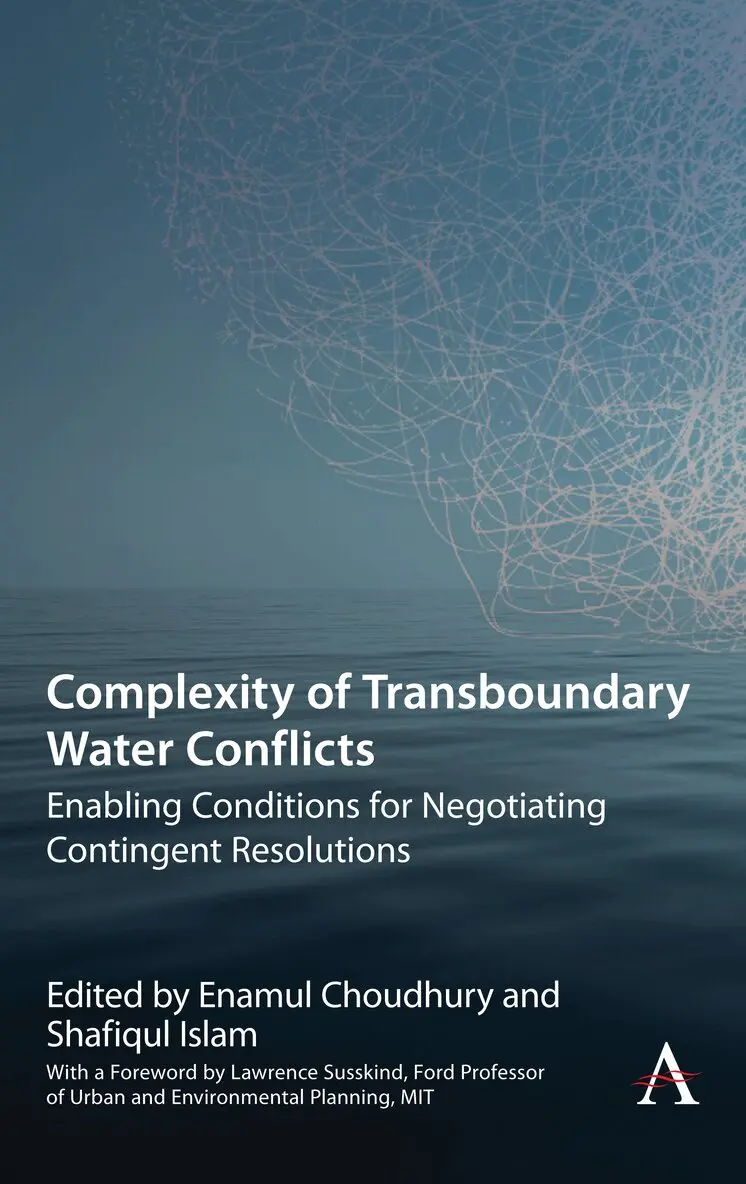
Complexity of Transboundary Water Conflicts
Enabling Conditions for Negotiating Contingent Resolutions
Häftad, Engelska, 2020
402 kr
Skickas inom 5-8 vardagar
‘Complexity of Transboundary Water Conflicts’ seeks to understand transboundary water issues as complex systems with contingent conditions and possibilities. To address those conditions and leverage the possibilities it introduces the concept of enabling conditions as a pragmatic way to identify and act on the emergent possibilities to resolve transboundary water issues. Based on this theoretical frame, the book applies the ideas and tools from complexity science, contingency and enabling conditions to account for events in the formulation of treaties/agreements between disputing riparian states in river basins across the world (Indus, Jordan, Nile, Ganges, Brahmaputra, Colorado, Danube, Senegal and Zayandehrud). It also includes a section with scholars’ reflections on the relevance and weakness of the theoretical framework.