Sherry B. Ortner – författare
Fate of Culture
Geertz and Beyond
349 kr
Skickas inom 5-8 vardagar
630 kr
Skickas inom 7-10 vardagar
317 kr
Skickas inom 7-10 vardagar
535 kr
Skickas inom 5-8 vardagar
451 kr
Skickas inom 5-8 vardagar
401 kr
Skickas inom 5-8 vardagar
551 kr
Läs direkt efter köp
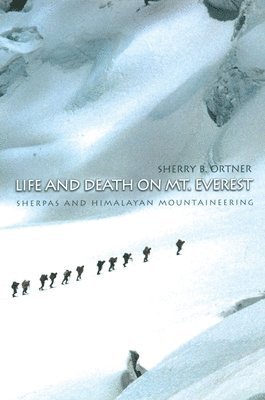
The Sherpas were dead, two more victims of an attempt to scale Mt. Everest. Members of a French climbing expedition, sensitive perhaps about leaving the bodies where they could not be recovered, rolled them off a steep mountain face. One body, however, crashed to a stop near Sherpas on a separate expedition far below. They stared at the frozen corpse, stunned. They said nothing, but an American climber observing the scene interpreted their thoughts: Nobody would throw the body of a white climber off Mt. Everest. For more than a century, climbers from around the world have journ-eyed to test themselves on Everest''s treacherous slopes, enlisting the expert aid of the Sherpas who live in the area. Drawing on years of field research in the Himalayas, renowned anthropologist Sherry Ortner presents a compelling account of the evolving relationship between the mountaineers and the Sherpas, a relationship of mutual dependence and cultural conflict played out in an environment of mortal risk. Ortner explores this relationship partly through gripping accounts of expeditions--often in the climbers'' own words--ranging from nineteenth-century forays by the British through the historic ascent of Hillary and Tenzing to the disasters described in Jon Krakauer''s Into Thin Air. She reveals the climbers, or "sahibs," to use the Sherpas'' phrase, as countercultural romantics, seeking to transcend the vulgarity and materialism of modernity through the rigor and beauty of mountaineering. She shows how climbers'' behavior toward the Sherpas has ranged from kindness to cruelty, from cultural sensitivity to derision. Ortner traces the political and economic factors that led the Sherpas to join expeditions and examines the impact of climbing on their traditional culture, religion, and identity. She examines Sherpas'' attitude toward death, the implications of the shared masculinity of Sherpas and sahibs, and the relationship between Sherpas and the increasing number of women climbers. Ortner also tackles debates about whether the Sherpas have been "spoiled" by mountaineering and whether climbing itself has been spoiled by commercialism.
602 kr
Läs direkt efter köp
An eminent anthropologist examines the foundings of the first celibate Buddhist monasteries among the Sherpas of Nepal in the early twentieth century--a religious development that was a major departure from "folk" or "popular" Buddhism. Sherry Ortner is the first to integrate social scientific and historical modes of analysis in a study of the Sherpa monasteries and one of the very few to attempt such an account for Buddhist monasteries anywhere. Combining ethnographic and oral-historical methods, she scrutinizes the interplay of political and cultural factors in the events culminating in the foundings. Her work constitutes a major advance both in our knowledge of Sherpa Buddhism and in the integration of anthropological and historical modes of analysis. At the theoretical level, the book contributes to an emerging theory of "practice," an explanation of the relationship between human intentions and actions on the one hand, and the structures of society and culture that emerge from and feed back upon those intentions and actions on the other. It will appeal not only to the increasing number of anthropologists working on similar problems but also to historians anxious to discover what anthropology has to offer to historical analysis. In addition, it will be essential reading for those interested in Nepal, Tibet, the Sherpa, or Buddhism in general.
695 kr
Läs direkt efter köp
The intellectual radicalism of the 1960s spawned a new set of questions about the role and nature of "the political" in social life, questions that have since revolutionized nearly every field of thought, from literary criticism through anthropology to the philosophy of science. Michel Foucault in particular made us aware that whatever our functionally defined "roles" in society, we are constantly negotiating questions of authority and the control of the definitions of reality. Such insights have led theorists to challenge concepts that have long formed the very underpinnings of their disciplines. By exploring some of the most debated of these concepts--"culture," "power," and "history"--this reader offers an enriching perspective on social theory in the contemporary moment. Organized around these three concepts, Culture/ Power/History brings together both classic and new essays that address Foucault''s "new economy of power relations" in a number of different, contestatory directions. Representing innovative work from various disciplines and sites of study, from taxidermy to Madonna, the book seeks to affirm the creative possibilities available in a time marked by growing uncertainty about established disciplinary forms of knowledge and by the increasing fluidity of the boundaries between them. The book is introduced by a major synthetic essay by the editors, which calls attention to the most significant issues enlivening theoretical discourse today. The editors seek not only to encourage scholars to reflect anew on the course of social theory, but also to orient newcomers to this area of inquiry. The essays are contributed by Linda Alcoff ("Cultural Feminism versus Post-Structuralism"), Sally Alexander ("Women, Class, and Sexual Differences in the 1830s and 1840s"), Tony Bennett ("The Exhibitionary Complex"), Pierre Bourdieu ("Structures, Habitus, Power"), Nicholas B. Dirks ("Ritual and Resistance"), Geoff Eley ("Nations, Publics, and Political Cultures"), Michel Foucault (Two Lectures), Henry Louis Gates, Jr. ("Authority, [White] Power and the [Black] Critic"), Stephen Greenblatt ("The Circulation of Social Energy"), Ranajit Guha ("The Prose of Counter-Insurgency"), Stuart Hall ("Cultural Studies: Two Paradigms"), Susan Harding ("The Born-Again Telescandals"), Donna Haraway ("Teddy Bear Patriarchy"), Dick Hebdige ("After the Masses"), Susan McClary ("Living to Tell: Madonna''s Resurrection of the Fleshly"), Sherry B. Ortner ("Theory in Anthropology since the Sixties"), Marshall Sahlins ("Cosmologies of Capitalism"), Elizabeth G. Traube ("Secrets of Success in Postmodern Society"), Raymond Williams (selections from Marxism and Literature), and Judith Williamson ("Family, Education, Photography").
325 kr
Skickas inom 5-8 vardagar
429 kr
Skickas inom 5-8 vardagar
1 205 kr
Skickas inom 5-8 vardagar
305 kr
Skickas
1 287 kr
Skickas inom 5-8 vardagar
429 kr
Skickas inom 5-8 vardagar
610 kr
Läs direkt efter köp
Ortner tracked down nearly all 304 of her classmates. She interviewedabout 100 in person and spoke with most of the rest by phone, recording her classmates’ vivid memories of time, place, and identity. Ortner shows how social class affected people’s livesin many hidden and unexamined ways. She also demonstrates that the Class of ‘58’s extreme upward mobility must be understood in relation to the major identity movements of the twentieth century—the campaign against anti-Semitism, the Civil Rights movement, and feminism.
A multisited study combining field research with an interdisciplinary analytical framework, New Jersey Dreaming is a masterly integration of developments at the vanguard of contemporary anthropology. Engaging excerpts from Ortner''s field notes are interspersed throughout the book. Whether recording the difficulties and pleasures of studying one''s own peer group, the cultures of driving in different parts of the country, or the contrasting experiences of appointment-making in Los Angeles and New York, they provide a rare glimpse into the actual doing of ethnographic research.
473 kr
Läs direkt efter köp
Some of the essays reflect explicitly on theoretical concerns: the relationship between agency and power, the problematic quality of ethnographic studies of resistance, and the possibility of producing an anthropology of subjectivity. Others are ethnographic studies that apply Ortner’s theoretical framework. In these, she investigates aspects of social class, looking at the relationship between race and middle-class identity in the United States, the often invisible nature of class as a cultural identity and as an analytical category in social inquiry, and the role that public culture and media play in the creation of the class anxieties of Generation X. Written with Ortner’s characteristic lucidity, these essays constitute a major statement about the future of social theory from one of the leading anthropologists of our time.
610 kr
Läs direkt efter köp
703 kr
Skickas
252 kr
Skickas inom 5-8 vardagar
366 kr
Läs direkt efter köp
31 kr
Läs direkt efter köp