Shi-Kuo Chang – författare
Visar alla böcker från författaren . Handla med fri frakt och snabb leverans.
18 produkter
18 produkter
E-bok
PDF, Engelska, 19961 057 kr
Läs direkt efter köp
Information systems with an abundance of graphics data are growing rapidly due to advances in data storage technology, the development of multimedia communications across networks, and the fact that parallel computers are leading to faster image processing systems.This book addresses image information retrieval and spatial reasoning using an approach called Symbolic Projection, which supports descriptions of the image content on the basis of the spatial relationships between the pictorial objects. Image information systems have a wide variety of applications, including information retrieval on the World Wide Web, medical pictorial archiving, computer-aided design, robotics, and geographical information systems, and this book is comprehensively illustrated with examples from these areas.Symbolic Projection now forms the basis of an enormous number and range of information retrieval algorithms, and also supports query-by-picture and qualitative spatial reasoning. Both authors are international experts in the field, and the book will serve as an excellent source for those working in multimedia systems and image information systems who wish to find out more about this exciting area.- An all-inclusive source to the field--all you need to know- S-K. Chang is the leading authority in this field, which he pioneered- Includes a wide variety of applications, including information retrieval on the World Wide Web, computer-aided design, and geographical information systems
Inbunden, Engelska, 1986
1 580 kr
Skickas inom 10-15 vardagar
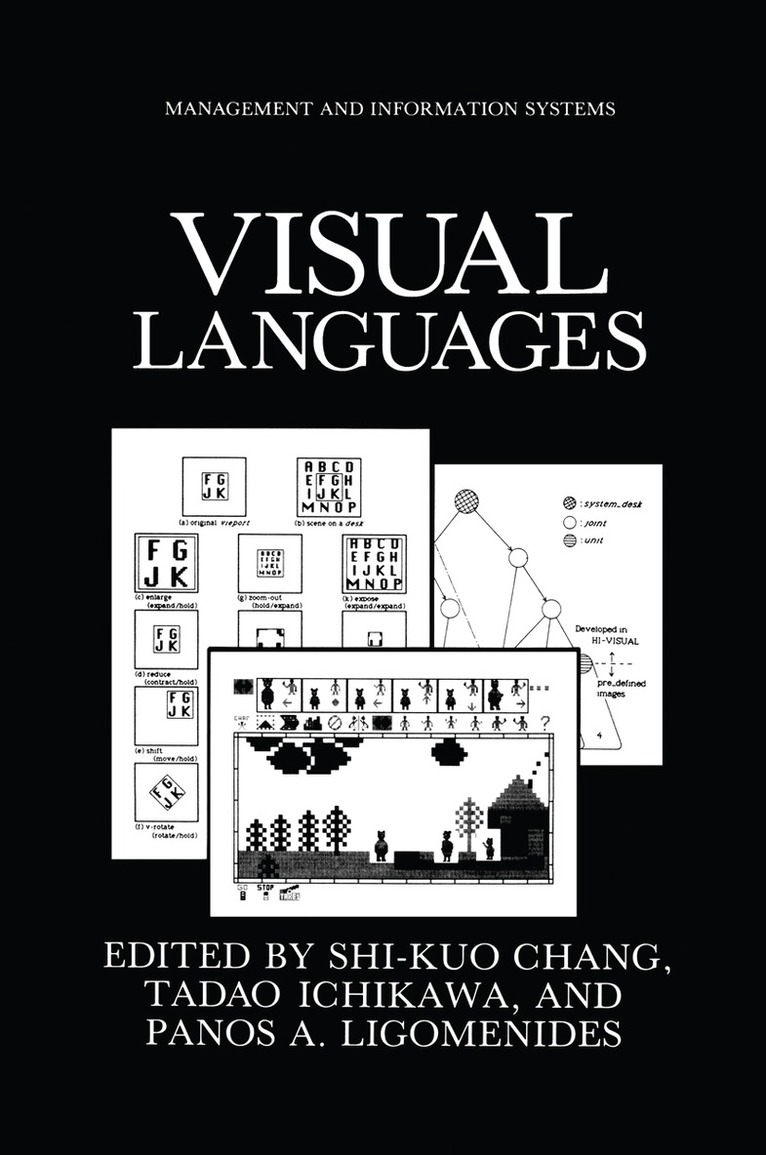
This book is intended as both an introduction to the state-of-the-art in visual languages, as well as an exposition of the frontiers of research in advanced visual languages. It is for computer scientists, computer engi neers, information scientists, application programmers, and technical managers responsible for software development projects who are inter ested in the methodology and manifold applications of visual languages and visual programming. The contents of this book are drawn from invited papers, as well as selected papers from two workshops: the 1985 IEEE Workshop on Lan guages for Automation-Cognitive Aspects in Information Processing, which was held in Mallorca, Spain, June 28-30, 1985; and the 1984 IEEE Workshop on Visual Languages, which was held in Hiroshima, Japan, December 7-9, 1984. Panos Ligomenides and I organized the technical program of LFA '85, and Tadao Ichikawa and I organized the techni cal program of VL '84. Both workshops have now become successful annual events in their own right. The intersecting area of visual languages and visual programming especially has become a fascinating new research area. It is hoped that this book will focus the reader's attention on some of the interesting research issues as well as the potential for future applications. After reading this book, the reader will undoubtedly get an impression that visual languages and the concept of generalized icons can be studied fruitfully from many different perspectives, including computer graphics, formal language theory, educational methodology, cognitive psychology and visual design.
Inbunden, Engelska, 2000
1 675 kr
Skickas inom 10-15 vardagar
Multimedia has two fundamental characteristics that can be expressed by the following formula: multimedia = multiple media + hypermedia. How can software engineering take advantage of these two characteristics? Will these two characteristics pose problems in multimedia systems design? These are some of the issues to be explored in this book. The first two chapters should be of interest to managers, software engineers, programmers, and people interested in gaining an overall understanding of multimedia software engineering. The next six chapters present multimedia software engineering according to the conceptual framework introduced in Chapter One. This is of particular use to practitioners, system developers, multimedia application designers, programmers, and people interested in prototyping multimedia applications. The next three chapters are more research-oriented and are mainly intended for researchers working on the specification, modelling, and analysis of distributed multimedia systems, but will also be relevant to scientists, researchers, and software engineers interested in the systems and theoretical aspects of multimedia software engineering.The text can be used as a textbook in a graduate course on multimedia software engineering or in an undergraduate course on software design where the emphasis is on multimedia applications. It is especially suitable for a project-oriented course.
Inbunden, Engelska, 1999
1 119 kr
Skickas inom 10-15 vardagar
In the past five years, the field of electrostatic discharge (ESD) control has under gone some notable changes. Industry standards have multiplied, though not all of these, in our view, are realistic and meaningful. Increasing importance has been ascribed to the Charged Device Model (CDM) versus the Human Body Model (HBM) as a cause of device damage and, presumably, premature (latent) failure. Packaging materials have significantly evolved. Air ionization techniques have improved, and usage has grown. Finally, and importantly, the government has ceased imposing MIL-STD-1686 on all new contracts, leaving companies on their own to formulate an ESD-control policy and write implementing documents. All these changes are dealt with in five new chapters and ten new reprinted papers added to this revised edition of ESD from A to Z. Also, the original chapters have been augmented with new material such as more troubleshooting examples in Chapter 8 and a 20-question multiple-choice test for certifying operators in Chapter 9. More than ever, the book seeks to provide advice, guidance, and practical ex amples, not just a jumble of facts and generalizations. For instance, the added tailored versions of the model specifications for ESD-safe handling and packaging are actually in use at medium-sized corporations and could serve as patterns for many readers.
Häftad, Engelska, 2011
1 580 kr
Skickas inom 10-15 vardagar
This book is intended as both an introduction to the state-of-the-art in visual languages, as well as an exposition of the frontiers of research in advanced visual languages. It is for computer scientists, computer engi neers, information scientists, application programmers, and technical managers responsible for software development projects who are inter ested in the methodology and manifold applications of visual languages and visual programming. The contents of this book are drawn from invited papers, as well as selected papers from two workshops: the 1985 IEEE Workshop on Lan guages for Automation-Cognitive Aspects in Information Processing, which was held in Mallorca, Spain, June 28-30, 1985; and the 1984 IEEE Workshop on Visual Languages, which was held in Hiroshima, Japan, December 7-9, 1984. Panos Ligomenides and I organized the technical program of LFA '85, and Tadao Ichikawa and I organized the techni cal program of VL '84. Both workshops have now become successful annual events in their own right. The intersecting area of visual languages and visual programming especially has become a fascinating new research area. It is hoped that this book will focus the reader's attention on some of the interesting research issues as well as the potential for future applications. After reading this book, the reader will undoubtedly get an impression that visual languages and the concept of generalized icons can be studied fruitfully from many different perspectives, including computer graphics, formal language theory, educational methodology, cognitive psychology and visual design.
Häftad, Engelska, 2011
563 kr
Skickas inom 10-15 vardagar
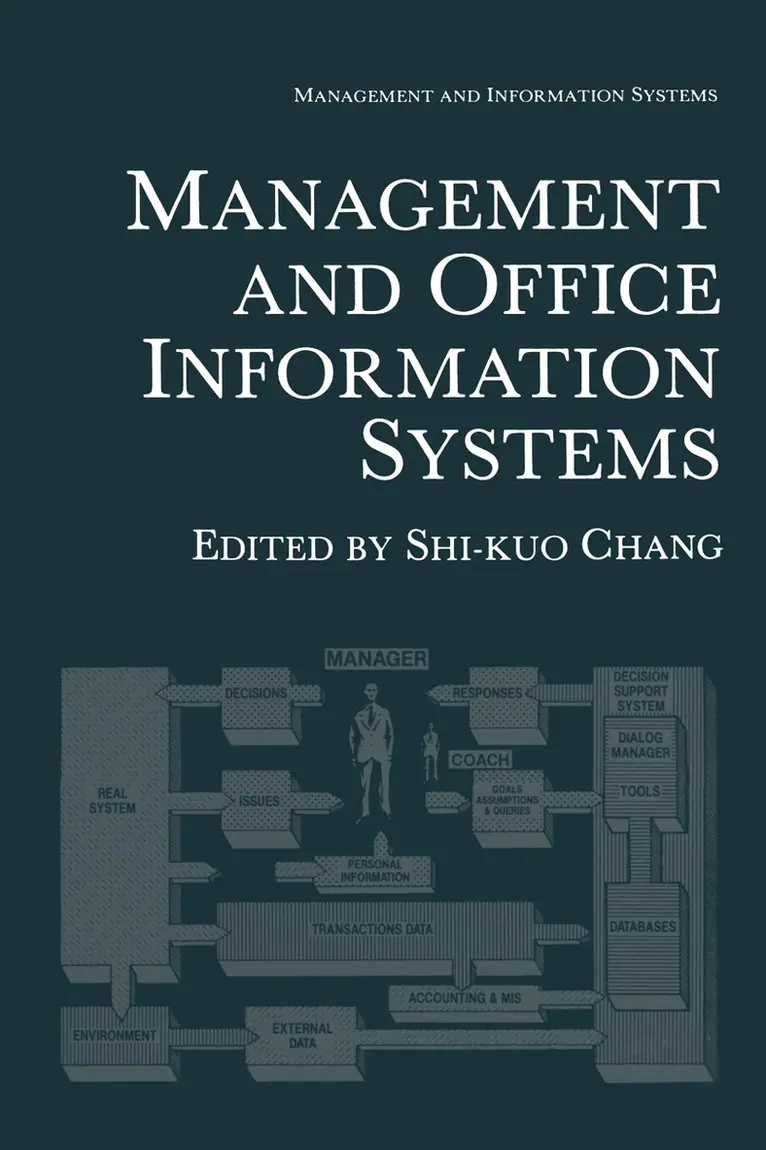
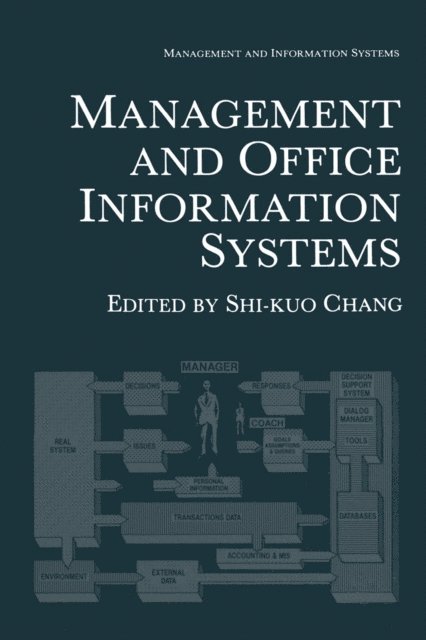
Decision making is a very complex phenomenon. Modern decision makers must deal with very complex problems which are constantly changing and often ill structured, making modeling and analysis difficult. In order to provide support for the decision makers, computer-based information systems are designed to collect, store, process, and transport information. Recent advances in computer technol ogy, data communications, database systems, office automation, and knowledge engineering have made possible the design of very sophisticated information sys tems. However, rapid technological advances also create many problems, not the least of which is the lack of integration among the various disciplines in infor mation system design. Without such integration, a costly computer-based infor mation system is at best partially useful and at worst totally useless. The aim of this book, therefore, is to examine the various issues involved in designing man agement information systems, decision support systems, and office information systems for increasing productivity and providing decision support. This book is the outcome of the Workshop on Management and Office Infor mation Systems, which was organized by the Knowledge Systems Institute and held at Chicago, Illinois, from June 28 to 30, 1982. Twenty-seven papers from the working papers presented at that workshop were selected for inclusion in the present volume, which is organized into five parts: (I) organization structures and management, (II) decision support systems, (III) database systems, (IV) office information systems, and (V) systems and applications.
E-bok
PDF, Engelska, 20121 986 kr
Läs direkt efter köp
This book is intended as both an introduction to the state-of-the-art in visual languages, as well as an exposition of the frontiers of research in advanced visual languages. It is for computer scientists, computer engi neers, information scientists, application programmers, and technical managers responsible for software development projects who are inter ested in the methodology and manifold applications of visual languages and visual programming. The contents of this book are drawn from invited papers, as well as selected papers from two workshops: the 1985 IEEE Workshop on Lan guages for Automation-Cognitive Aspects in Information Processing, which was held in Mallorca, Spain, June 28-30, 1985; and the 1984 IEEE Workshop on Visual Languages, which was held in Hiroshima, Japan, December 7-9, 1984. Panos Ligomenides and I organized the technical program of LFA ''85, and Tadao Ichikawa and I organized the techni cal program of VL ''84. Both workshops have now become successful annual events in their own right. The intersecting area of visual languages and visual programming especially has become a fascinating new research area. It is hoped that this book will focus the reader''s attention on some of the interesting research issues as well as the potential for future applications. After reading this book, the reader will undoubtedly get an impression that visual languages and the concept of generalized icons can be studied fruitfully from many different perspectives, including computer graphics, formal language theory, educational methodology, cognitive psychology and visual design.
E-bok
PDF, Engelska, 2012732 kr
Läs direkt efter köp
Decision making is a very complex phenomenon. Modern decision makers must deal with very complex problems which are constantly changing and often ill structured, making modeling and analysis difficult. In order to provide support for the decision makers, computer-based information systems are designed to collect, store, process, and transport information. Recent advances in computer technol ogy, data communications, database systems, office automation, and knowledge engineering have made possible the design of very sophisticated information sys tems. However, rapid technological advances also create many problems, not the least of which is the lack of integration among the various disciplines in infor mation system design. Without such integration, a costly computer-based infor mation system is at best partially useful and at worst totally useless. The aim of this book, therefore, is to examine the various issues involved in designing man agement information systems, decision support systems, and office information systems for increasing productivity and providing decision support. This book is the outcome of the Workshop on Management and Office Infor mation Systems, which was organized by the Knowledge Systems Institute and held at Chicago, Illinois, from June 28 to 30, 1982. Twenty-seven papers from the working papers presented at that workshop were selected for inclusion in the present volume, which is organized into five parts: (I) organization structures and management, (II) decision support systems, (III) database systems, (IV) office information systems, and (V) systems and applications.
Häftad, Engelska, 2012
1 675 kr
Skickas inom 10-15 vardagar
Multimedia has two fundamental characteristics that can be expressed by the following formula: Multimedia = Multiple Media + Hypermedia. How can software engineering take advantage of these two characteristics? Will these two characteristics pose problems in multimedia systems design? These are some of the issues to be explored in this book. The first two chapters will be of interest to managers, software engineers, programmers, and people interested in gaining an overall understanding of multimedia software engineering. The next six chapters present multimedia software engineering according to the conceptual framework introduced in Chapter One. This is of particular use to practitioners, system developers, multimedia application designers, programmers, and people interested in prototyping multimedia applications. The next three chapters are more research-oriented and are mainly intended for researchers working on the specification, modeling, and analysis of distributed multimedia systems, but will also be relevant to scientists, researchers, and software engineers interested in the systems and theoretical aspects of multimedia software engineering.Multimedia Software Engineering can be used as a textbook in a graduate course on multimedia software engineering or in an undergraduate course on software design where the emphasis is on multimedia applications. It is especially suitable for a project-oriented course.
Del 503 - Springer International Series in Engineering and Computer Science
Content-Based Access to Multimedia Information
From Technology Trends to State of the Art
Häftad, Engelska, 2012
1 119 kr
Skickas inom 10-15 vardagar
In the past five years, the field of electrostatic discharge (ESD) control has under gone some notable changes. Industry standards have multiplied, though not all of these, in our view, are realistic and meaningful. Increasing importance has been ascribed to the Charged Device Model (CDM) versus the Human Body Model (HBM) as a cause of device damage and, presumably, premature (latent) failure. Packaging materials have significantly evolved. Air ionization techniques have improved, and usage has grown. Finally, and importantly, the government has ceased imposing MIL-STD-1686 on all new contracts, leaving companies on their own to formulate an ESD-control policy and write implementing documents. All these changes are dealt with in five new chapters and ten new reprinted papers added to this revised edition of ESD from A to Z. Also, the original chapters have been augmented with new material such as more troubleshooting examples in Chapter 8 and a 20-question multiple-choice test for certifying operators in Chapter 9. More than ever, the book seeks to provide advice, guidance, and practical ex amples, not just a jumble of facts and generalizations. For instance, the added tailored versions of the model specifications for ESD-safe handling and packaging are actually in use at medium-sized corporations and could serve as patterns for many readers.
E-bok
PDF, Engelska, 20122 105 kr
Läs direkt efter köp
Multimedia has two fundamental characteristics that can be expressed by the following formula: Multimedia = Multiple Media + Hypermedia. How can software engineering take advantage of these two characteristics? Will these two characteristics pose problems in multimedia systems design? These are some of the issues to be explored in this book. The first two chapters will be of interest to managers, software engineers, programmers, and people interested in gaining an overall understanding of multimedia software engineering. The next six chapters present multimedia software engineering according to the conceptual framework introduced in Chapter One. This is of particular use to practitioners, system developers, multimedia application designers, programmers, and people interested in prototyping multimedia applications. The next three chapters are more research-oriented and are mainly intended for researchers working on the specification, modeling, and analysis of distributed multimedia systems, but will also be relevant to scientists, researchers, and software engineers interested in the systems and theoretical aspects of multimedia software engineering. Multimedia Software Engineering can be used as a textbook in a graduate course on multimedia software engineering or in an undergraduate course on software design where the emphasis is on multimedia applications. It is especially suitable for a project-oriented course.
E-bok
PDF, Engelska, 20131 455 kr
Läs direkt efter köp
In the past five years, the field of electrostatic discharge (ESD) control has under gone some notable changes. Industry standards have multiplied, though not all of these, in our view, are realistic and meaningful. Increasing importance has been ascribed to the Charged Device Model (CDM) versus the Human Body Model (HBM) as a cause of device damage and, presumably, premature (latent) failure. Packaging materials have significantly evolved. Air ionization techniques have improved, and usage has grown. Finally, and importantly, the government has ceased imposing MIL-STD-1686 on all new contracts, leaving companies on their own to formulate an ESD-control policy and write implementing documents. All these changes are dealt with in five new chapters and ten new reprinted papers added to this revised edition of ESD from A to Z. Also, the original chapters have been augmented with new material such as more troubleshooting examples in Chapter 8 and a 20-question multiple-choice test for certifying operators in Chapter 9. More than ever, the book seeks to provide advice, guidance, and practical ex amples, not just a jumble of facts and generalizations. For instance, the added tailored versions of the model specifications for ESD-safe handling and packaging are actually in use at medium-sized corporations and could serve as patterns for many readers.
E-bok
PDF, Engelska, 2013710 kr
Läs direkt efter köp
Two central ideas in the movement toward advanced automation systems are the office-of-the-future (or office automation system), and the factory of-the-future (or factory automation system). An office automation system is an integrated system with diversified office equipment, communication devices, intelligent terminals, intelligent copiers, etc., for providing information management and control in a dis tributed office environment. A factory automation system is also an inte grated system with programmable machine tools, robots, and other pro cess equipment such as new "peripherals," for providing manufacturing information management and control. Such advanced automation systems can be regarded as the response to the demand for greater variety, greater flexibility, customized designs, rapid response, and ''Just-in-time" delivery of office services or manufac tured goods. The economy of scope, which allows the production of a vari ety of similar products in random order, gradually replaces the economy of scale derived from overall volume of operations. In other words, we are gradually switching from the production of large volumes of standard products to systems for the production of a wide variety of similar products in small batches. This is the phenomenon of "demassification" of the marketplace, as described by Alvin Toffier in The Third Wave.
Häftad, Engelska, 2013
547 kr
Skickas inom 10-15 vardagar
Two central ideas in the movement toward advanced automation systems are the office-of-the-future (or office automation system), and the factory of-the-future (or factory automation system). An office automation system is an integrated system with diversified office equipment, communication devices, intelligent terminals, intelligent copiers, etc., for providing information management and control in a dis tributed office environment. A factory automation system is also an inte grated system with programmable machine tools, robots, and other pro cess equipment such as new "peripherals," for providing manufacturing information management and control. Such advanced automation systems can be regarded as the response to the demand for greater variety, greater flexibility, customized designs, rapid response, and 'Just-in-time" delivery of office services or manufac tured goods. The economy of scope, which allows the production of a vari ety of similar products in random order, gradually replaces the economy of scale derived from overall volume of operations. In other words, we are gradually switching from the production of large volumes of standard products to systems for the production of a wide variety of similar products in small batches. This is the phenomenon of "demassification" of the marketplace, as described by Alvin Toffier in The Third Wave.
Häftad, Engelska, 2002
563 kr
Skickas inom 10-15 vardagar
Visualinformationsystemsareinformationsystemsforvisualcomputing.Visual computing is computing on visual objects. Some visual objects such as images are inherently visual in the sense that their primary representation is the visual representation.Somevisualobjectssuchasdatastructuresarederivativelyvisual in the sense that their primary representation is not the visual representation, but can be transformed into a visual representation. Images and data structures are the two extremes. Other visual objects such as maps may fall somewhere in between the two. Visual computing often involves the transformation from one type of visual objects into another type of visual objects, or into the same type of visual objects, to accomplish certain objectives such as information reduction, object recognition, and so on. In visual information systems design it is also important to ask the foll- ing question: who performs the visual computing? The answer to this question determines the approach to visual computing. For instance it is possible that primarily the computer performs the visual computing and the human merely observes the results. It is also possible that primarily the human performs the visual computing and the computer plays a supporting role. Often the human and the computer are both involved as equal partners in visual computing and there are visual interactions. Formal or informal visual languages are usually needed to facilitate such visual interactions.
E-bok
PDF, Engelska, 2003732 kr
Läs direkt efter köp
Visualinformationsystemsareinformationsystemsforvisualcomputing.Visual computing is computing on visual objects. Some visual objects such as images are inherently visual in the sense that their primary representation is the visual representation.Somevisualobjectssuchasdatastructuresarederivativelyvisual in the sense that their primary representation is not the visual representation, but can be transformed into a visual representation. Images and data structures are the two extremes. Other visual objects such as maps may fall somewhere in between the two. Visual computing often involves the transformation from one type of visual objects into another type of visual objects, or into the same type of visual objects, to accomplish certain objectives such as information reduction, object recognition, and so on. In visual information systems design it is also important to ask the foll- ing question: who performs the visual computing? The answer to this question determines the approach to visual computing. For instance it is possible that primarily the computer performs the visual computing and the human merely observes the results. It is also possible that primarily the human performs the visual computing and the computer plays a supporting role. Often the human and the computer are both involved as equal partners in visual computing and there are visual interactions. Formal or informal visual languages are usually needed to facilitate such visual interactions.
Del 5 - SERIES ON SOFTWARE ENGINEERING AND KNOWLEDGE ENGINEERING
INTELLIGENT IMAGE DATABASE SYSTEMS
Inbunden, Engelska, 1996
1 678 kr
Tillfälligt slut
This book covers the principles and recent research results in intelligent image database systems design. Special emphasis is placed on spatial reasoning and the techniques for image indexing and retrieval, mainly based on the Theory of Symbolic Projection. In addition, applications of the theory and techniques to intelligent image database systems design are also discussed.
Del 13 - SERIES ON SOFTWARE ENGINEERING AND KNOWLEDGE ENGINEERING
DATA STRUCTURES AND ALGORITHMS
Inbunden, Engelska, 2003
2 799 kr
Tillfälligt slut
This is an excellent, up-to-date and easy-to-use text on data structures and algorithms that is intended for undergraduates in computer science and information science. The thirteen chapters, written by an international group of experienced teachers, cover the fundamental concepts of algorithms and most of the important data structures as well as the concept of interface design. The book contains many examples and diagrams. Whenever appropriate, program codes are included to facilitate learning.This book is supported by an international group of authors who are experts on data structures and algorithms, through its website at http://www.cs.pitt.edu/~jung/GrowingBook/, so that both teachers and students can benefit from their expertise.