Shiva Balaghi – författare
Visar alla böcker från författaren Shiva Balaghi. Handla med fri frakt och snabb leverans.
3 produkter
3 produkter
Inbunden, Engelska, 2005
612 kr
Skickas inom 10-15 vardagar
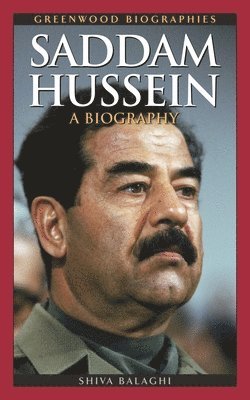
In July 1979, Saddam Hussein became the President of Iraq. His dictum was simply expressed—power through terror. During the first decade of his presidency, Saddam engaged in three wars: the Iran-Iraq War, the invasion of Kuwait, and the Gulf War of 1991. After September 11th, the war on terrorism led to the war against Iraq that began in March 2003 and the eventual capture of Sadddam Hussein effecitively ending his rule over the Iraqi people. On April 9, 2003, a handful of U.S. Marines helped a small crowd of Iraqis gathered in Firdos Square to tear down a statue of Saddam Hussein. Since his capture, Saddam has been transferred to Iraqi legal custody and awaits his trial for atrocities committed during his regime.This biography details Saddam's difficult childhood in Tikrit and his politically influential teenage years in Baghdad with his uncle. His involvement with the Iraqi Ba'ath Party led to his participation in an assassination attempt on then Prime Minister Qassem. In his early political life, Saddam retained the lessons of village life learned in his difficult Tikrit childhood, but they would become enmeshed with his discovery of Ba'athism and pan-Arabism. Once he became President of Iraq, Saddam often ruled with force and a carefully cultivated image throughout the use of visual imagery and books. Though Saddam no longer rules Iraq, the legacy of his reign will likely shape Iraqi history for years to come.
Häftad, Engelska, 2005
302 kr
Skickas inom 10-15 vardagar
In July 1979, Saddam Hussein became the President of Iraq. His dictum was simply expressed—power through terror. During the first decade of his presidency, Saddam engaged in three wars: the Iran-Iraq War, the invasion of Kuwait, and the Gulf War of 1991. After September 11th, the war on terrorism led to the war against Iraq that began in March 2003 and the eventual capture of Sadddam Hussein effecitively ending his rule over the Iraqi people. On April 9, 2003, a handful of U.S. Marines helped a small crowd of Iraqis gathered in Firdos Square to tear down a statue of Saddam Hussein. Since his capture, Saddam has been transferred to Iraqi legal custody and awaits his trial for atrocities committed during his regime.This biography details Saddam's difficult childhood in Tikrit and his politically influential teenage years in Baghdad with his uncle. His involvement with the Iraqi Ba'ath Party led to his participation in an assassination attempt on then Prime Minister Qassem. In his early political life, Saddam retained the lessons of village life learned in his difficult Tikrit childhood, but they would become enmeshed with his discovery of Ba'athism and pan-Arabism. Once he became President of Iraq, Saddam often ruled with force and a carefully cultivated image throughout the use of visual imagery and books. Though Saddam no longer rules Iraq, the legacy of his reign will likely shape Iraqi history for years to come.
Häftad, Engelska, 2002
479 kr
Skickas inom 10-15 vardagar
When asserting the history of 20th-century cultural forms, non-Western art can no longer remain relegated to the margins, viewed as derivative and imitative of canonical Western artistic modes. This assessment of modern Iranian visual culture from the 1960s and 1970s suggests that modernity in Iran was a creative, complex and contested process. The book examines the expression of Iranian modernity in a variety of media including painting, sculpture, photography, posters and graphic arts. It highlights new modes of artistic production within an expanding institutional context: developments in Iranian art criticism, exhibition apparatus, education and patronage. The contributors also address changes in the iconography of Iranian art and in the increasingly social role of the artist. Ultimately, these patterns of artistic production influenced the art that accompanied the Iranian Revolution of 1979. This work demonstrates that the visual arts serve as an important archival record of a critical period in Iranian history.