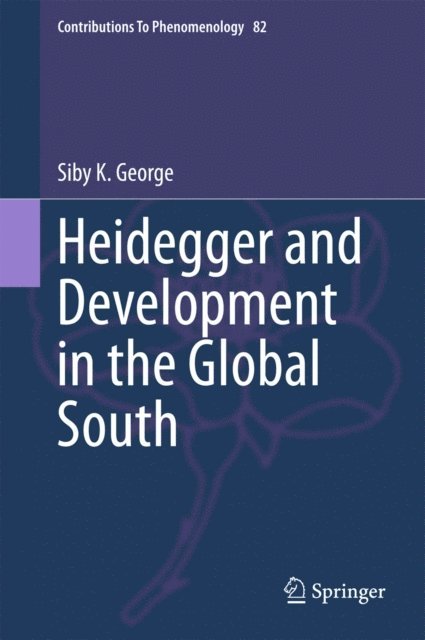
Heidegger and Development in the Global South
1 104 kr
Skickas inom 10-15 vardagar
1 104 kr
Skickas inom 10-15 vardagar
1 427 kr
Läs direkt efter köp
Taking the Heideggerian critical ontology of technology as its base, this volume looks at postcolonial modernization and development in the global south as the worldwide expansion of the western metaphysical understanding of reality. We live today in an increasingly globalizing technological society that Martin Heidegger described in the middle of the last century as ‘the planetary imperialism of technologically organized man.’ Consequent upon this cultural-intellectual globalization, the ahistorical, violent, individualistic, calculative and capitalistic logic of the metaphysics of technology is permeating the life-world, even of the world’s poorest peoples, in ways they could neither choose nor control.
This volume questions the political ethics and justice of post-war development discourse in the light of the egalitarian aims of modern societies, cultural freedom of communities and nations and the ecological limits of the planet. The final chapters discuss the alternative proposal of development as various conceptions of good life and equitable human flourishing amidst equally flourishing non-human life and non-living beings. This unique volume is the first book-length treatment of the ontology of modernization and development in the global south from a Heideggerian stance.
556 kr
Skickas inom 10-15 vardagar
710 kr
Läs direkt efter köp
The mainstream approach to the understanding of pain continues to be governed by the biomedical paradigm and the dualistic Cartesian ontology. This Volume brings together essays of scholars of literature, philosophy and history on the many enigmatic shades of pain-experience, mostly from an anti-Cartesian perspective of cultural ontology by scholars of literature, philosophy and history. A section of the essays is devoted to the socio-political dimensions of pain in the Indian context. The book offers a critical perspective on the reductive conceptions of pain and argue that non-substance ontology or cultural ontology supports a more humane and authentic understanding of pain.
The general ontological features of the self in pain and culturally imbued dimensions of pain-experience are, thus, brought together in a rare blend in this Volume. The essays dwell on the importance of understanding what cultural, social and political forces outside our control do to our pain-experience. They show why such understanding is necessary, both to humanely deal with pain, and to rectify erroneous approaches to pain-experience. They also explore the thoroughly ambivalent spaces between pain and pleasure, and the cathartic and productive dimensions of pain. The essays in this Volume investigate pain-experiences through the fresh lenses of history, gender, ethics, politics, death, illness, self-loss, torture, shame, dispossession and denial.
556 kr
Skickas inom 10-15 vardagar
1 104 kr
Skickas inom 10-15 vardagar
1 158 kr
Skickas inom 5-8 vardagar
This book considers teaching in modern institutional settings, among other things, as the ethical questioning and reversal of passively accepted prejudices, particularly in contexts of diversities and inequalities. Its thematic focus is the ethics of teacher-learner and learner-learner relationships within the democratic setup, and the possibilities of critique and transformation emerging out of such a relationship.The first theme of the book is diversity and pluralism, the second is the question of inequality in such contexts of radical diversity. With respect to this question, an unavoidable phenomenon of our times is the capitalisation of education and the reductionist view of learners as customers and consumers of knowledge. The approach to education that sees students merely as skilled human resources to be readied for the job market militates against critical thinking and do not respond appropriately to the questions of diversity and inequality. Thus, a significant focus of the book is the impact of inherited inequalities of caste and race on classroom ambience and teachers' interventions in the modern institutional context. The pertinent question is the increasing unwillingness of teachers to recognise and challenge discriminatory views and play their role in social transformation. In this regard, the teaching and learning of the humanities is also investigated. Teaching and the traditional classroom, it is often said, may not be required in the future as machines and remotely located teachers/explicators might claim their place. Hence, another question of focus is whether such a future would be hospitable to the critical task of education to cultivate young citizens of democracies.
1 260 kr
Läs direkt efter köp
1 247 kr
Läs direkt efter köp