Sihui (Echo) Ke - Böcker
Visar alla böcker från författaren Sihui (Echo) Ke. Handla med fri frakt och snabb leverans.
3 produkter
3 produkter
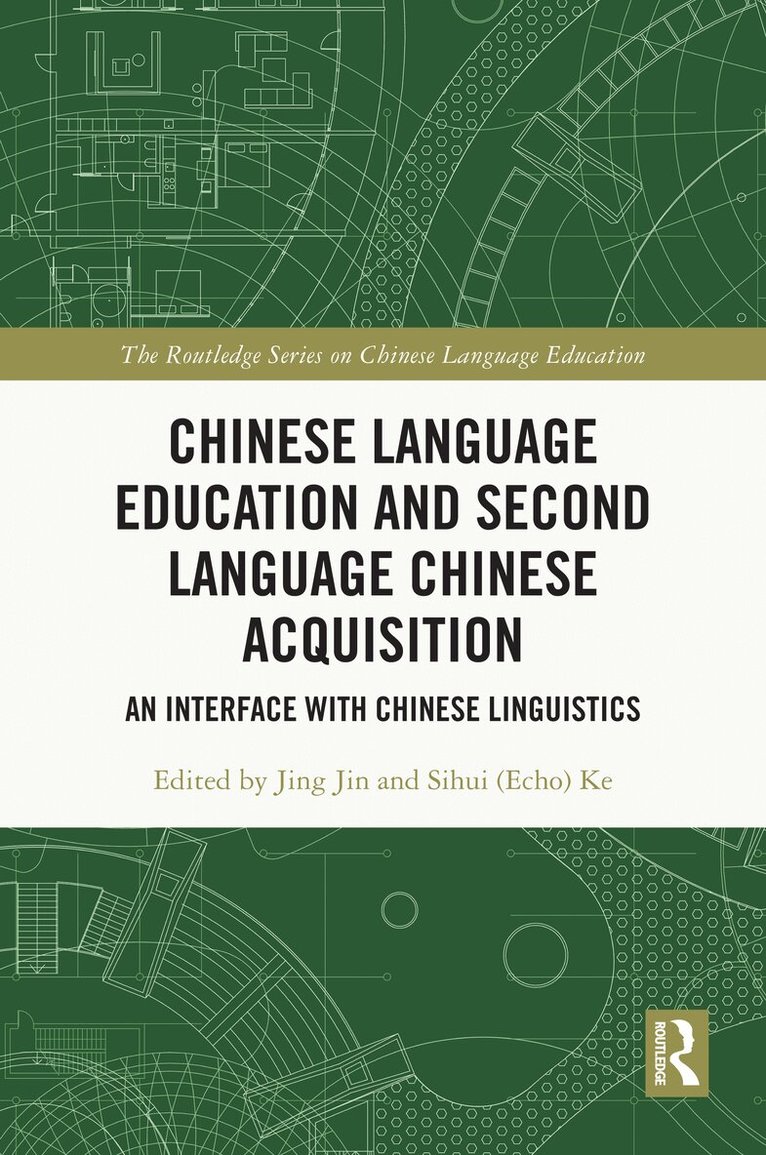
Chinese Language Education and Second Language Chinese Acquisition
An Interface with Chinese Linguistics
Inbunden, Engelska, 2025
2 166 kr
Skickas inom 10-15 vardagar
This edited volume presents the latest scholarly endeavors to synergize Chinese linguistics with Chinese language education and L2 Chinese acquisition, a direction of inquiry that has emerged as a rapidly developing area and attracted both teaching practitioners and linguists’ interests in recent years.The studies presented in the volume approach a diversity of issues, ranging over linguistics-informed Chinese language education in the contexts of Hong Kong, mainland China, and overseas countries; language pedagogies along various linguistic approaches; L2 Chinese development of different linguistic properties; bilingualism and multilingualism among adult and school learners; as well as linguistically grounded Chinese language learning and teaching via digital means. The volume offers to deepen the reader’s understanding of the existing theories on Chinese language education and L2 Chinese acquisition, and the linguistic theories regarding the nature, component modules, and development of the human language faculty. It also offers new pedagogical inspiration, based on cutting-edge empirical research, for Chinese language teaching in different educational settings.Of interest to scholars in the fields of Chinese language teaching and learning, second language acquisition, or applied linguistics, this volume contributes to the emerging field of educational applications of linguistics and presents an overarching framework that bridges a long-lasting division between language teaching practice and linguistic research.
Chinese Language Education and Second Language Chinese Acquisition
An Interface with Chinese Linguistics
Häftad, Engelska, 2026
680 kr
Kommande
This edited volume presents the latest scholarly endeavors to synergize Chinese linguistics with Chinese language education and L2 Chinese acquisition, a direction of inquiry that has emerged as a rapidly developing area and attracted both teaching practitioners and linguists’ interests in recent years.The studies presented in the volume approach a diversity of issues, ranging over linguistics-informed Chinese language education in the contexts of Hong Kong, mainland China, and overseas countries; language pedagogies along various linguistic approaches; L2 Chinese development of different linguistic properties; bilingualism and multilingualism among adult and school learners; as well as linguistically grounded Chinese language learning and teaching via digital means. The volume offers to deepen the reader’s understanding of the existing theories on Chinese language education and L2 Chinese acquisition, and the linguistic theories regarding the nature, component modules, and development of the human language faculty. It also offers new pedagogical inspiration, based on cutting-edge empirical research, for Chinese language teaching in different educational settings.Of interest to scholars in the fields of Chinese language teaching and learning, second language acquisition, or applied linguistics, this volume contributes to the emerging field of educational applications of linguistics and presents an overarching framework that bridges a long-lasting division between language teaching practice and linguistic research.
223 kr
Skickas
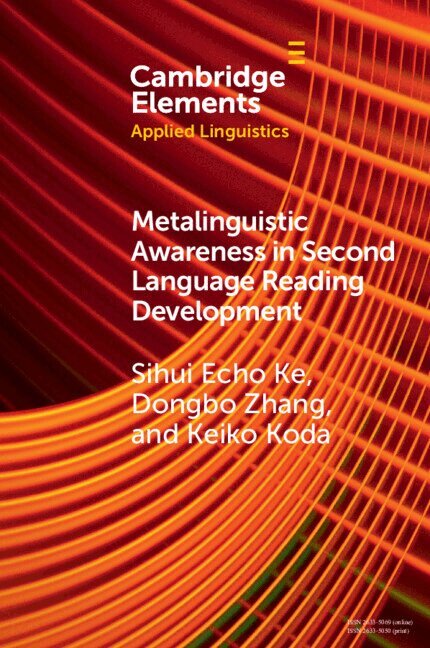
This Element aims to address the complexity of metalinguistic awareness to achieve a thorough account of its impacts on second language (L2) reading development and promote an in-depth understanding of the factors regulating the influence of first language (L1) metalinguistic awareness on L2 reading. It is guided by four questions: 1) To what extent do L1 phonological, orthographic, and morphological awareness correlate with L2 phonological, orthographic, and morphological awareness in L2 readers? 2) To what extent do phonological, orthographic, and morphological awareness correlate with word decoding intralingually in L2 readers? 3) To what extent do L1 phonological, orthographic, and morphological awareness correlate with L2 word decoding in L2 readers? 4) To what extent do the relations in questions 1-3 vary as a function of linguistic-, learner-, measurement-, and instruction-related factors? This Element is the first to systematically investigate the roles of distinct facets of metalinguistic awareness in L2 reading.