Silja Häusermann - Böcker
Visar alla böcker från författaren Silja Häusermann. Handla med fri frakt och snabb leverans.
6 produkter
6 produkter
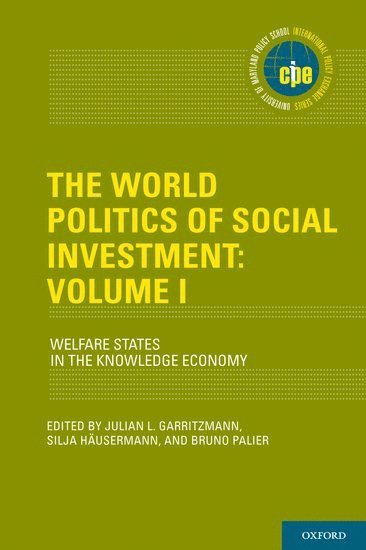
The World Politics of Social Investment: Volume I
Welfare States in the Knowledge Economy
Inbunden, Engelska, 2022
1 037 kr
Skickas inom 5-8 vardagar
Welfare states around the globe are changing, challenged by the development of knowledge economies. In many countries, policy-makers' main response has been to modernize welfare states by focusing on future-oriented social investment policies that focus on creating, mobilizing, and preserving human skills and capabilities. Yet, there is massive variance in the development of social investment strategies. The World Politics of Social Investment: Welfare States in the 21st Century is the first of two volumes of the World Politics of Social Investment (WOPSI) project, which systematically maps and explains different welfare reform strategies in democratic countries around the world. This volume develops a theory on the political and socio-economic conditions for the development of social investment policies around the globe, and studies the impact of the main explanatory factors on the empirical variety of social investment reforms (and non-social investment reforms). It also proposes a new typology of different welfare reform strategies, distinguishing nine types of social investment strategies depending on their functions (creating, mobilizing and preserving human skill and capabilities) and their distributive profiles (inclusive, stratified or targeted), and three types of non-social investment welfare strategies (market liberalism, social protectionism and basic income). The chapters of this volume are written by leading social policy scholars from different disciplines and countries, who apply the WOPSI global theoretical framework in a range of contexts and policy fields, shedding light on the scope conditions of social investment, as well as political demand- and supply-side drivers of social investment reforms. This volume on its own or in conjunction with the second volume is an invaluable resource on the state of modern welfare and social investment policies from around the globe.
The World Politics of Social Investment: Volume II
The Politics of Varying Social Investment Strategies
Inbunden, Engelska, 2022
1 010 kr
Skickas inom 5-8 vardagar
Welfare states around the globe are changing, challenged by the development of knowledge economies. In many countries, policy-makers' main response has been to modernize welfare states by focusing on future-oriented social investment policies that focus on creating, mobilizing, and preserving human skills and capabilities. Yet, there is massive variance in the development of social investment strategies. The World Politics of Social Investment: Political Dynamics of Reform is the second of two volumes of the World Politics of Social Investment (WOPSI) project, which systematically maps and explains different welfare reform strategies in democratic countries around the world. This volume traces the development of social investment reforms across the regions of Nordic, Continental, and Southern Europe, as well as Central and Eastern Europe, North and Latin America, and North East Asia. The chapters in this volume study the impact of different structural drivers for social investment (e.g., demographic, poverty, demand for skill, or lack of an available workforce), the salience of social investment in the public debates, and the different political coalitions that led to or prevented the adoption of social investment strategies. The chapters are written by leading social policy scholars from different world regions. They all apply a joint theoretical framework (developed in the first of the two volumes) to explain the politics of social investment in a range of contexts and policy fields. Jointly with the first volume, the WOPSI project offers the first worldwide analysis of social investment reforms around the globe.
The Politics of Welfare Reform in 21st-Century Western Europe
Inclusion or Segmentation
Inbunden, Engelska, 2026
1 303 kr
Kommande
This is an open access title available under the terms of a CC BY-NC-ND 4.0 International licence. It is free to read at Oxford Academic and offered as a free PDF download from OUP and selected open access locations.Which social policies should be adopted to address the social and economic challenges that Western European societies are facing in the 21st century? How much resource should be spent on correcting unequal market outcomes? Should the welfare state shield citizens from the risks of the emerging globalized knowledge economy, or help them adapt to these new realities? This book studies the political conflict that surrounds these questions, identifying structural and coalitional opportunities for reform across policy fields and regional contexts. The authors show that a point of debate for both voters and political parties is whether to expand the boundaries of welfare programs to address new social risks and to prioritize future economic opportunities - inclusion - or whether to target expenditure in ways that prioritize the current community and its income security - segmentation. To study politicization and reform opportunities in these different fields, the book draws on large amounts of new, specially-gathered data regarding the social policy positions and priorities of citizens and political parties in eight Western European countries. The findings show that the question of inclusion vs segmentation has become a deeply divisive partisan conflict line in European welfare politics, with the potential to internally divide both the political right and the left. It is the first book to systematically assess the implications of mass electoral realignment - including the rise of green and radical right parties - for the politics of European welfare states and opportunities for reform.
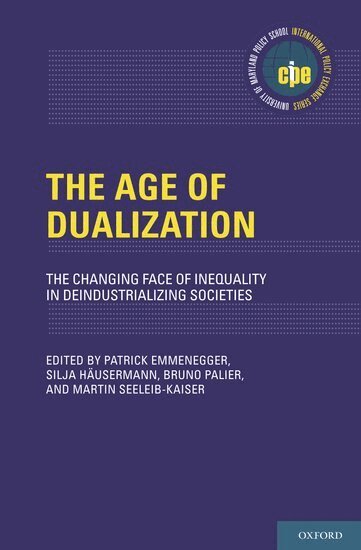
The Age of Dualization
The Changing Face of Inequality in Deindustrializing Societies
Inbunden, Engelska, 2012
764 kr
Skickas inom 5-8 vardagar
Poverty, increased inequality, and social exclusion are back on the political agenda in Western Europe, not only as a consequence of the Great Recession of 2008, but also because of a seemingly structural trend towards increased inequality in advanced industrial societies that has persisted since the 1970s. How can we explain this increase in inequalities? Policies in labor markets, social policy, and political representation are strongly linked in the creation, widening, and deepening of insider-outsider divides--a process known as dualization. While it is certainly not the only driver of increasing inequality, the encompassing nature of its development across multiple domains makes dualization one of the most important current trends affecting developed societies. However, the extent and forms of dualization vary greatly across countries. The comparative perspective of this book provides insights into why Nordic countries witness lower levels of insider-outsider divides, whereas in continental, liberal and southern welfare states, they are more likely to constitute a core characteristic of the political economy. Most importantly, the comparisons presented in this book point to the crucial importance of politics and political choice in driving and shaping the social outcomes of deindustrialization. While increased structural labor market divides can be found across all countries, governments have a strong responsibility in shaping the distributive consequences of these labor market changes. Insider-outsider divides are not a straightforward consequence of deindustrialization, but rather the result of political choice. A landmark publication, this volume is geared for faculty and graduate students of economics, political science, social policy, and sociology, as well as policymakers concerned with increasing inequality in a period of deep economic and social crisis.
Cleavage Formation in the 21st Century
How Social Identities Shape Voting Behavior in Contexts of Electoral Realignment
Häftad, Engelska, 2024
234 kr
Skickas inom 7-10 vardagar
Western Europe is experiencing growing levels of political polarization between parties of the New Left and the Far Right. The authors argue that this antagonism reflects the emergence of a social cleavage between universalism and particularism. To understand cleavage formation in the midst of party system fragmentation and the proliferation of new competitors, they emphasize the crucial role of group identities. Anchored in social structure, group identities help us understand why specific party appeals resonate with certain groups, thereby mediating the link between socio-structural change and broader party blocks defined by their distinctive ideologies along the new cleavage. Based on original survey data from France, Germany, Switzerland, and the UK, this Element presents evidence for the formation of a universalism–particularism cleavage across European party systems that diverge strongly on institutional and political characteristics. This title is also available as Open Access on Cambridge Core.
Cleavage Formation in the 21st Century
How Social Identities Shape Voting Behavior in Contexts of Electoral Realignment
Inbunden, Engelska, 2024
753 kr
Skickas inom 7-10 vardagar
Western Europe is experiencing growing levels of political polarization between parties of the New Left and the Far Right. The authors argue that this antagonism reflects the emergence of a social cleavage between universalism and particularism. To understand cleavage formation in the midst of party system fragmentation and the proliferation of new competitors, they emphasize the crucial role of group identities. Anchored in social structure, group identities help us understand why specific party appeals resonate with certain groups, thereby mediating the link between socio-structural change and broader party blocks defined by their distinctive ideologies along the new cleavage. Based on original survey data from France, Germany, Switzerland, and the UK, this Element presents evidence for the formation of a universalism–particularism cleavage across European party systems that diverge strongly on institutional and political characteristics. This title is also available as Open Access on Cambridge Core.