• Fri frakt över 249 kr
  • •
  • Snabba leveranser
  • •
  • Billiga böcker
Kundservice

Du är på sajten för privatpersoner.

Företag, bibliotek eller offentlig verksamhet?

Du handlar på classic.bokus.com, där alla dina funktioner finns intakta.
Till classic.bokus.com
Bokus logotyp. Gå till startsidan.
  • Erbjudanden
  • Nyheter
  • Student
  • Topplistor
  • Barn & ungdom
  • Bokus Play
  • E-böcker
  • Pocketböcker
  • Spel & pussel

10% studentrabatt med kod TERM26

Sidfot

Mina sidor

    Hjälp

    • Kundservice
    • Vanliga frågor och svar
    • Frakt och leverans
    • Retur vid ångerrätt
    • Reklamera vara
    • Betalning
    • Köpvillkor
    • Allmänna villkor
    • Information om webbplatsens tillgänglighet

    Om Bokus

    • Om oss
    • Pressrum
    • För studenter
    • För företag
    • För bibliotek och offentlig verksamhet
    • För leverantörer
    • Hållbarhet

    Populärt

    • Aktuella erbjudanden
    • Presentkort
    • Studentlitteratur
    • Nya böcker
    • Topplistor
    • Signerade böcker
    • Engelska böcker

    Inspiration

    • Boktips
    • BookTok
    • Populära bokserier
    • Barnbokskaraktärer
    • Populära författare
    Logotyp för Bokus
    Följ oss på Facebook (extern länk)Följ oss på Instagram (extern länk)Följ oss på YouTube (extern länk)Följ oss på TikTok (extern länk)
    bokus @ CookiesAnpassa cookiesIntegritetspolicyKöpvillkor
    Till Citymail hemsida (extern länk)Till Budbee hemsida (extern länk)Till Postnord hemsida (extern länk)Till Schenker hemsida (extern länk)Till Early Bird hemsida (extern länk)Till Walleys hemsida (extern länk)
    1. Ekonomi och Ledarskap
    2. Nationalekonomi
    3. Ekonomisk politik

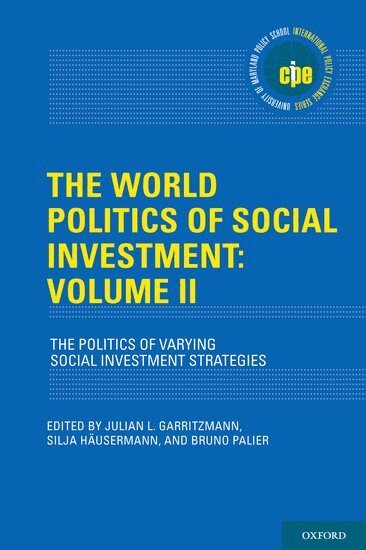
    The World Politics of Social Investment: Volume II

    The Politics of Varying Social Investment Strategies

    AvJulian L. Garritzmann,Silja Häusermann

    Inbunden, Engelska, 2022

    Del i serien International Policy Exchange

    1 084 kr

    Beställningsvara. Skickas inom 5-8 vardagar. Fri frakt över 249 kr.

    Beskrivning

    Welfare states around the globe are changing, challenged by the development of knowledge economies. In many countries, policy-makers' main response has been to modernize welfare states by focusing on future-oriented social investment policies that focus on creating, mobilizing, and preserving human skills and capabilities. Yet, there is massive variance in the development of social investment strategies. The World Politics of Social Investment: Political Dynamics of Reform is the second of two volumes of the World Politics of Social Investment (WOPSI) project, which systematically maps and explains different welfare reform strategies in democratic countries around the world. This volume traces the development of social investment reforms across the regions of Nordic, Continental, and Southern Europe, as well as Central and Eastern Europe, North and Latin America, and North East Asia. The chapters in this volume study the impact of different structural drivers for social investment (e.g., demographic, poverty, demand for skill, or lack of an available workforce), the salience of social investment in the public debates, and the different political coalitions that led to or prevented the adoption of social investment strategies. The chapters are written by leading social policy scholars from different world regions. They all apply a joint theoretical framework (developed in the first of the two volumes) to explain the politics of social investment in a range of contexts and policy fields. Jointly with the first volume, the WOPSI project offers the first worldwide analysis of social investment reforms around the globe.

    Produktinformation

    • Utgivningsdatum:2022-07-11
    • Mått:229 x 155 x 33 mm
    • Vikt:839 g
    • Format:Inbunden
    • Språk:Engelska
    • Serie:International Policy Exchange
    • Antal sidor:520
    • Förlag:OUP USA
    • ISBN:9780197601457

    Utforska kategorier

    • Ekonomisk politik inom Ekonomi och Ledarskap
    • Socialt arbete och välfärd inom Samhälle och politik

    Mer om författaren

    Julian L. Garritzmann is Professor of Political Science at the Goethe University Frankfurt. As a comparative political scientist, his research lies at the intersection of comparative political economy, political sociology, and comparative political institutions. He specializes in welfare state research, education and social investment policy, global social policy, party politics, and public opinion. Julian Garritzmann holds a PhD from the University of Konstanz, Germany. Before joining Frankfurt, he was Senior Researcher at the University of Zurich, Switzerland, and Max Weber Fellow at the European University Institute, Florence, Italy, and held Visiting Fellow positions at Harvard, Duke, and Rutgers. His publications include The Political Economy of Higher Education Finance (awarded the German Political Science Association's Dissertation Prize), and A Loud, but Noisy Signal? Public Opinion, Parties, and Interest Groups in the Politics of Education Reform in Western Europe (CambridgeUniversity Press) as well as several articles in journals such as the European Journal of Political Research, European Sociological Review, Journal of European Social Policy, Journal of European Public Policy, Journal of Legislative Studies and West European Politics. Homepage: https://sites.google.com/site/juliangarritzmann/ Silja Häusermann is Professor of Political Science at the University of Zurich. Her current research specializes in the fields of comparative welfare state research and comparative electoral research. She has been a Fellow at the Wissenschaftskolleg zu Berlin in 2018/2019 and directs the ERC-funded grant "welfarepriorities" (www.welfarepriorities.eu), which studies the transformation of distributive conflict in relation with the transformation of European mass politics. At the University of Zurich, she is the co-director of the University Research Priority Programme "Equality of Opportunities". She is the author of The Politics of Welfare State Reform inContinental Europe: Modernization in Hard Times (CUP, 2010), and a co-author of The Age of Dualization: The Changing Face of Inequality in Deindustrializing Countries (OUP, 2012), The Politics of Advanced Capitalism (CUP, 2015) and Contention in Times of Crisis: Recession and Political Protest in Thirty European Countries (CUP, 2020). Homepage: www.siljahaeusermann.orgBruno Palier is CNRS Research Director at Sciences Po, Centre d'études européennes et de politique comparée. Trained in social science, he has a PhD in political science, and is a former student of Ecole Normale Superieure. He was director of LIEPP (Laboratory for interdisciplinary Evaluation of Public Policies). He works on the comparative political economy of welfare state reforms. He was the scientific coordinator of a European Network of excellence RECWOWE (Reconciling Work and Welfare, involving 30 European research institutions or Universities, 190 researchers from 19 European countries). He was GuestProfessor at the University of Stockholm, Visiting Scholar at Northwestern University, at Center for European Studies from Harvard University in 2001 and Jean Monnet Fellow in the European University Institute in Florence in 1998-1999.

    Recensioner i media

    The detail analysis it offers about the interaction between the four sets of factors-ideas, socioeconomic structural factors, policy legacies, and actors' positions and coalitions-will be a great help for the policy advisors, who move between government and academia, of both developed and developing countries.

    Innehållsförteckning

    • Introduction 1. Structural Constraints, Institutional Legacies, and the Politics of Social Investment across World Regions Silja Häusermann, Julian L. Garritzmann, Bruno Palier Part I: Western Europe and North America 2. Legacies of Universalism: Origins and Persistence of the Broad Political Support for Inclusive Social Investment in Scandinavia Alexander Horn, Kees van Kersbergen 3. Loud, Noisy, or Quiet Politics? The Role of Public Opinion, Parties, and Interest Groups in Social Investment Reforms in Western Europe Marius R. Busemeyer, Julian L. Garritzmann 4. The Partisan Politics of Family and Labor Market Policy Reforms in Southern Europe Reto Bürgisser 5. Reforming without Investing: Explaining Non-social Investment Strategies in Italy Stefano Ronchi, Patrik Vesan 6. The Politics of Early Years and Family Policy Investments in North America Susan Prentice, Linda White Part II: Central and Eastern Europe 7. "Nation (Re)building through Social Investment? The Baltic Reform Trajectories" Anu Toots, Triin Lauri 8. Explaining the Weakness of Social Investment Policies in the Visegrád Countries: The Cases of Childcare and Active Labor Market Policies Dorota Szelewa, Michal Polakowski 9. Explaining the Contrasting Welfare Trajectories of the Baltic and Visegrád Countries: A Growth-Strategy Perspective Sonja Avlija%s Part III: North East Asia 10. The Politicization of Social Investment in the Media and Legislature in North East Asia Jaemin Shim 11. An Increasing but Diverse Support for Social investment: Public Opinion on Social Investment in the North East Asian Welfare Systems Ijin Hong, Chung-Yang Yeh, Jieun Lee, Jen-Der Lue 12. The Quiet Diffusion of Social Investment in Japan: Toward Stratification Mari Miura, Eriko Hamada 13. Politics of Social Investment in Post-industrial South Korea Sophia Seung-yoon Lee, Yeon-Myung Kim Part IV: Latin America 14. The Politicization of Social Investment in Latin America J. Salvador Peralta 15. Social Policy for Institutional Change: Bolivia, Brazil, and Peru Jane Jenson, Nora Nagels 16. The Politics of Conditionality in Latin America's Cash Transfer Reforms Cecilia Rossel, Florencia Antía, Pilar Manzi 17. How Democracies Transform their Welfare States: The Reform Trajectories and Political Coalitions of Inclusive, Stratified, and Targeted Social Investment Strategies Around the World Bruno Palier, Julian L. Garritzmann, Silja Häusermann, Francesco Fioritto