Simon Makuvaza - Böcker
Visar alla böcker från författaren Simon Makuvaza. Handla med fri frakt och snabb leverans.
4 produkter
4 produkter
Management Of Cultural World Heritage Sites and Development In Africa
History, nomination processes and representation on the World Heritage List
Häftad, Engelska, 2014
606 kr
Skickas inom 10-15 vardagar
Ever since the signing of the World Heritage Convention 40 years ago and ratified by 33 African countries, to date, only 43 cultural heritage sites have been successfully proclaimed as World Heritage Sites in Africa. These include archaeological and historical sites, religious monuments and cultural landscapes. This book is a re-evaluation of the nomination and management of cultural World Heritage sites in Africa from the late 1970s when the Island of Gorée of Senegal and the Rock-Hewn Churches of Ethiopia were first inscribed on the WHL until today. It considers whether a credible and well balanced WHL has been attained, especially in regards to the nomination of more sites in Africa. The book also examines the roles and contribution of various heritage organizations and African governments to the nomination and management of cultural World Heritage sites in Africa. Lastly, the volume also scrutinizes economic development, which may result from the nomination and successful management of cultural World Heritage sites in Africa.
Aspects of Management Planning for Cultural World Heritage Sites
Principles, Approaches and Practices
Inbunden, Engelska, 2017
1 096 kr
Skickas inom 10-15 vardagar
Every site that is inscribed on the World Heritage List (WHL) must have a management plan or some other management system. According to the UNESCO Operational Guidelines, the purpose of a management plan is to ensure the effective protection of the nominated property for present and future generations. This requirement was in part necessitated by the need to implement real systems of monitoring on the management of World Heritage Sites.Since its implementation in 2005, discussion on the function and the contents of management plans for World Heritage Sites has grown tremendously. The discussions have mainly been focused on the theoretical frameworks of World Heritage site management plans and proposals of practical guidelines for their implementation.This volume provides a platform for heritage practitioners, especially those working at Cultural World Heritage Sites, to put in writing their experiences and impressions about the implementation of site management plans at properties that are inscribed on the WHL. Cultural World Heritage Sites in this case refer to world heritage properties such as archaeological sites, cultural landscapes, religious sites and architectural structures. The book also seeks to examine the extent to which site management plans have been or are being implemented at Cultural World Heritage Sites.
Aspects of Management Planning for Cultural World Heritage Sites
Principles, Approaches and Practices
Häftad, Engelska, 2018
1 096 kr
Skickas inom 10-15 vardagar
Every site that is inscribed on the World Heritage List (WHL) must have a management plan or some other management system. According to the UNESCO Operational Guidelines, the purpose of a management plan is to ensure the effective protection of the nominated property for present and future generations. This requirement was in part necessitated by the need to implement real systems of monitoring on the management of World Heritage Sites.Since its implementation in 2005, discussion on the function and the contents of management plans for World Heritage Sites has grown tremendously. The discussions have mainly been focused on the theoretical frameworks of World Heritage site management plans and proposals of practical guidelines for their implementation.This volume provides a platform for heritage practitioners, especially those working at Cultural World Heritage Sites, to put in writing their experiences and impressions about the implementation of site management plans at properties that are inscribed on the WHL. Cultural World Heritage Sites in this case refer to world heritage properties such as archaeological sites, cultural landscapes, religious sites and architectural structures. The book also seeks to examine the extent to which site management plans have been or are being implemented at Cultural World Heritage Sites.
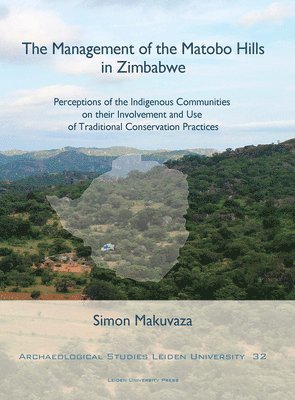
Management of the Matobo Hills in Zimbabwe
Perceptions of the Indigenous Communities on Their Involvement and Use of Traditional Conservation Practices
Häftad, Engelska, 2016
548 kr
Skickas inom 7-10 vardagar
Since 1992, when the World Heritage Committee established its category of "cultural landscapes", scholarly debates have ensued on how they could best be managed. One approach, which appears to have gained significance over the past two decades or so, considers using traditional conservation practices as well as engaging local indigenous communities in the stewardship of these exemplary sites. To examine the efficacy of this recent approach, this book explores the concept of indigenous communities, the nature of traditional conservancy in the Matobo Hills Cultural World Heritage Landscape where this study was conducted, as well as the management history of the area. Based on the perspectives of the indigenous people of the Matobo Hills, this investigation studies the extent to which both traditional conservation practices and local involvement can be germane to the administration of World Heritage Cultural Landscapes.