Sinan Ozdemir – författare
361 kr
Skickas inom 7-10 vardagar
The Practical, Step-by-Step Guide to Using LLMs at Scale in Projects and Products
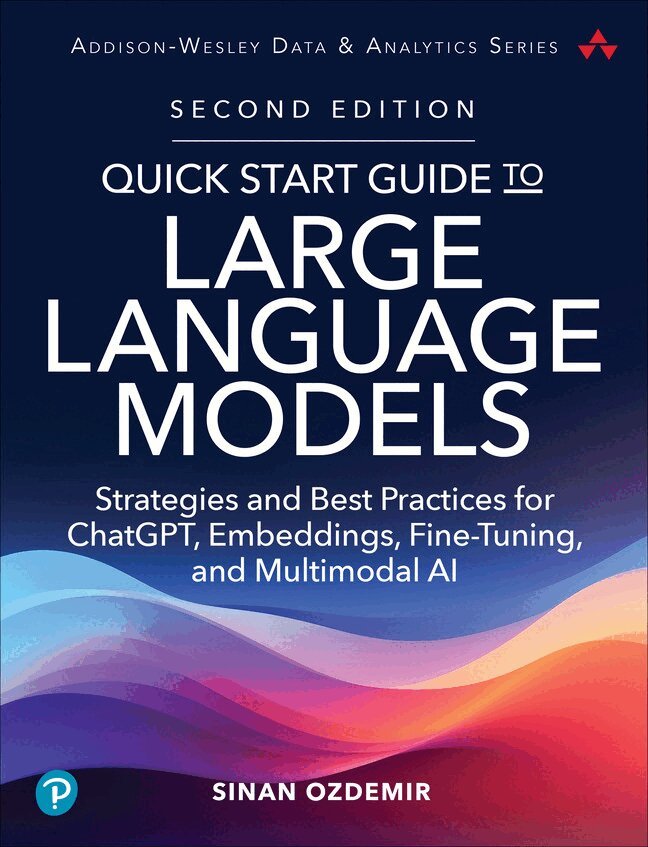
Large Language Models (LLMs) like Llama 3, Claude 3, and the GPT family are demonstrating breathtaking capabilities, but their size and complexity have deterred many practitioners from applying them. In Quick Start Guide to Large Language Models, Second Edition, pioneering data scientist and AI entrepreneur Sinan Ozdemir clears away those obstacles and provides a guide to working with, integrating, and deploying LLMs to solve practical problems.
Ozdemir brings together all you need to get started, even if you have no direct experience with LLMs: step-by-step instructions, best practices, real-world case studies, and hands-on exercises. Along the way, he shares insights into LLMs' inner workings to help you optimize model choice, data formats, prompting, fine-tuning, performance, and much more. The resources on the companion website include sample datasets and up-to-date code for working with open- and closed-source LLMs such as those from OpenAI (GPT-4 and GPT-3.5), Google (BERT, T5, and Gemini), X (Grok), Anthropic (the Claude family), Cohere (the Command family), and Meta (BART and the LLaMA family).
Learn key concepts: pre-training, transfer learning, fine-tuning, attention, embeddings, tokenization, and more Use APIs and Python to fine-tune and customize LLMs for your requirements Build a complete neural/semantic information retrieval system and attach to conversational LLMs for building retrieval-augmented generation (RAG) chatbots and AI Agents Master advanced prompt engineering techniques like output structuring, chain-of-thought prompting, and semantic few-shot prompting Customize LLM embeddings to build a complete recommendation engine from scratch with user data that outperforms out-of-the-box embeddings from OpenAI Construct and fine-tune multimodal Transformer architectures from scratch using open-source LLMs and large visual datasets Align LLMs using Reinforcement Learning from Human and AI Feedback (RLHF/RLAIF) to build conversational agents from open models like Llama 3 and FLAN-T5 Deploy prompts and custom fine-tuned LLMs to the cloud with scalability and evaluation pipelines in mind Diagnose and optimize LLMs for speed, memory, and performance with quantization, probing, benchmarking, and evaluation frameworks"A refreshing and inspiring resource. Jam-packed with practical guidance and clear explanations that leave you smarter about this incredible new field."--Pete Huang, author of The Neuron
Register your book for convenient access to downloads, updates, and/or corrections as they become available. See inside book for details.
549 kr
Skickas inom 7-10 vardagar
Transform Your Business with Intelligent AI to Drive Outcomes
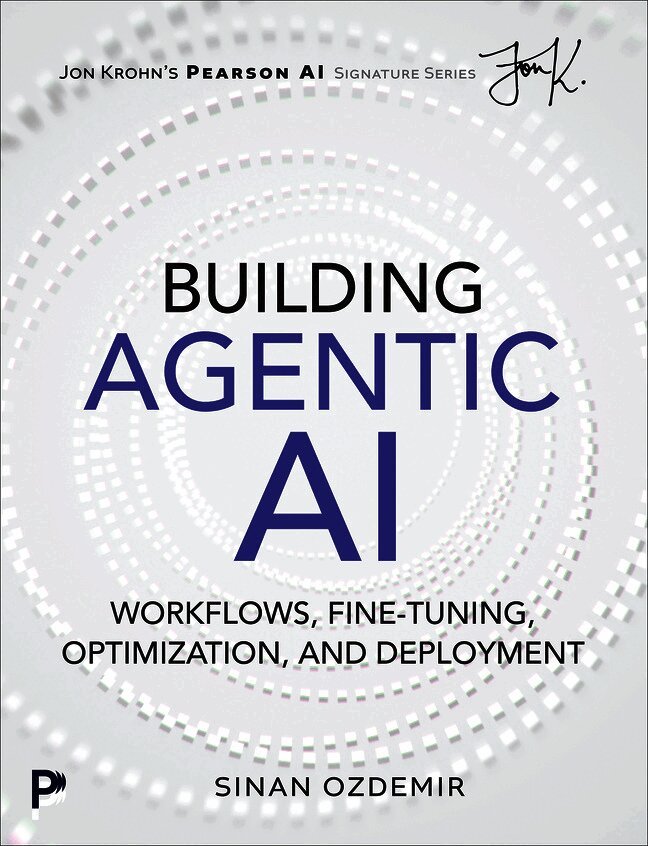
Building reactive AI applications and chatbots is no longer enough. The competitive advantage belongs to those who can build AI that can respond, reason, plan, and execute. Building Agentic AI: Workflows, Fine-Tuning, Optimization, and Deployment takes you beyond basic chatbots to create fully functional, autonomous agents that automate real workflows, enhance human decision-making, and drive measurable business outcomes across high-impact domains like customer support, finance, and research.
Whether you're a developer deploying your first model, a data scientist exploring multi-agent systems and distilled LLMs, or a product manager integrating AI workflows and embedding models, this practical handbook provides tried and tested blueprints for building production-ready systems. Harness the power of reasoning models for applications like computer use, multimodal systems to work with all kinds of data, and fine-tuning techniques to get the most out of AI. Learn to test, monitor, and optimize agentic systems to keep them reliable and cost-effective at enterprise scale.
Master the complete agentic AI pipeline
Design adaptive AI agents with memory, tool use, and collaborative reasoning capabilities Build robust RAG workflows using embeddings, vector databases, and LangGraph state management Implement comprehensive evaluation frameworks beyond accuracy, including precision, recall, and latency metrics Deploy multimodal AI systems that seamlessly integrate text, vision, audio, and code generation Optimize models for production through fine-tuning, quantization, and speculative decoding techniques Navigate the bleeding edge of reasoning LLMs and computer-use capabilities Balance cost, speed, accuracy, and privacy in real-world deployment scenarios Create hybrid architectures that combine multiple agents for complex enterprise applicationsRegister your book for convenient access to downloads, updates, and/or corrections as they become available. See inside book for details.
356 kr
Skickas inom 7-10 vardagar
The Practical, Step-by-Step Guide to Using LLMs at Scale in Projects and Products
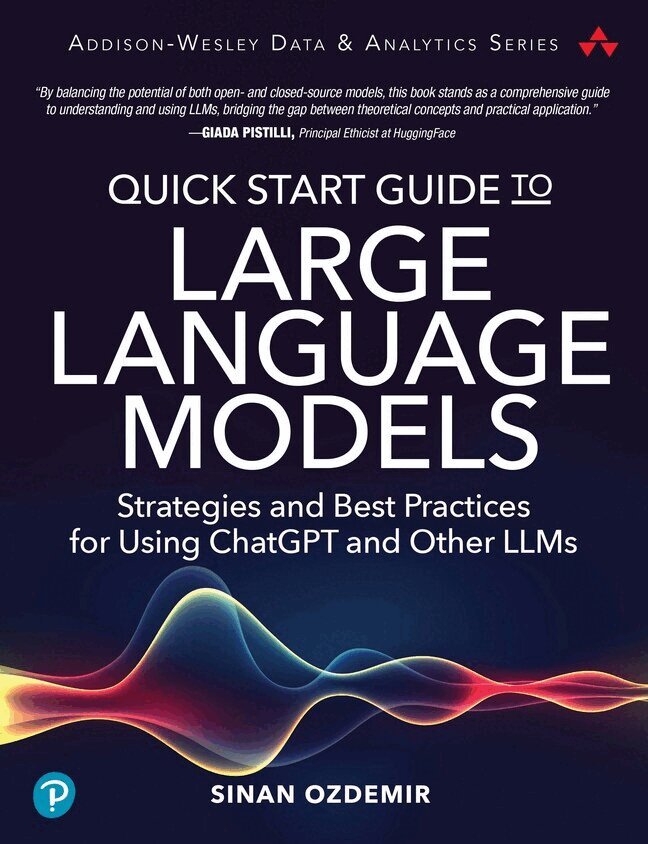
Large Language Models (LLMs) like ChatGPT are demonstrating breathtaking capabilities, but their size and complexity have deterred many practitioners from applying them. In Quick Start Guide to Large Language Models, pioneering data scientist and AI entrepreneur Sinan Ozdemir clears away those obstacles and provides a guide to working with, integrating, and deploying LLMs to solve practical problems.
Ozdemir brings together all you need to get started, even if you have no direct experience with LLMs: step-by-step instructions, best practices, real-world case studies, hands-on exercises, and more. Along the way, he shares insights into LLMs' inner workings to help you optimize model choice, data formats, parameters, and performance. You'll find even more resources on the companion website, including sample datasets and code for working with open- and closed-source LLMs such as those from OpenAI (GPT-4 and ChatGPT), Google (BERT, T5, and Bard), EleutherAI (GPT-J and GPT-Neo), Cohere (the Command family), and Meta (BART and the LLaMA family).
Learn key concepts: pre-training, transfer learning, fine-tuning, attention, embeddings, tokenization, and more Use APIs and Python to fine-tune and customize LLMs for your requirements Build a complete neural/semantic information retrieval system and attach to conversational LLMs for retrieval-augmented generation Master advanced prompt engineering techniques like output structuring, chain-ofthought, and semantic few-shot prompting Customize LLM embeddings to build a complete recommendation engine from scratch with user data Construct and fine-tune multimodal Transformer architectures using opensource LLMs Align LLMs using Reinforcement Learning from Human and AI Feedback (RLHF/RLAIF) Deploy prompts and custom fine-tuned LLMs to the cloud with scalability and evaluation pipelines in mind"By balancing the potential of both open- and closed-source models, Quick Start Guide to Large Language Models stands as a comprehensive guide to understanding and using LLMs, bridging the gap between theoretical concepts and practical application."--Giada Pistilli, Principal Ethicist at HuggingFace
"A refreshing and inspiring resource. Jam-packed with practical guidance and clear explanations that leave you smarter about this incredible new field."--Pete Huang, author of The Neuron
Register your book for convenient access to downloads, updates, and/or corrections as they become available. See inside book for details.
365 kr
Skickas inom 7-10 vardagar
467 kr
Läs direkt efter köp
651 kr
Skickas inom 5-8 vardagar
474 kr
Läs direkt efter köp
Learn the techniques and math you need to start making sense of your data
About This Book
Enhance your knowledge of coding with data science theory for practical insight into data science and analysisMore than just a math class, learn how to perform real-world data science tasks with R and PythonCreate actionable insights and transform raw data into tangible valueWho This Book Is For
You should be fairly well acquainted with basic algebra and should feel comfortable reading snippets of R/Python as well as pseudo code. You should have the urge to learn and apply the techniques put forth in this book on either your own data sets or those provided to you. If you have the basic math skills but want to apply them in data science or you have good programming skills but lack math, then this book is for you.
What You Will Learn
Get to know the five most important steps of data scienceUse your data intelligently and learn how to handle it with careBridge the gap between mathematics and programming Learn about probability, calculus, and how to use statistical models to control and clean your data and drive actionable resultsBuild and evaluate baseline machine learning modelsExplore the most effective metrics to determine the success of your machine learning modelsCreate data visualizations that communicate actionable insightsRead and apply machine learning concepts to your problems and make actual predictionsIn Detail
Need to turn your skills at programming into effective data science skills? Principles of Data Science is created to help you join the dots between mathematics, programming, and business analysis. With this book, you''ll feel confident about asking—and answering—complex and sophisticated questions of your data to move from abstract and raw statistics to actionable ideas.
With a unique approach that bridges the gap between mathematics and computer science, this books takes you through the entire data science pipeline. Beginning with cleaning and preparing data, and effective data mining strategies and techniques, you''ll move on to build a comprehensive picture of how every piece of the data science puzzle fits together. Learn the fundamentals of computational mathematics and statistics, as well as some pseudocode being used today by data scientists and analysts. You''ll get to grips with machine learning, discover the statistical models that help you take control and navigate even the densest datasets, and find out how to create powerful visualizations that communicate what your data means.
Style and approach
This is an easy-to-understand and accessible tutorial. It is a step-by-step guide with use cases, examples, and illustrations to get you well-versed with the concepts of data science. Along with explaining the fundamentals, the book will also introduce you to slightly advanced concepts later on and will help you implement these techniques in the real world.
585 kr
Skickas inom 5-8 vardagar
651 kr
Skickas inom 5-8 vardagar
428 kr
Läs direkt efter köp
397 kr
Läs direkt efter köp
Transform your data into insights with must-know techniques and mathematical concepts to unravel the secrets hidden within your data
Key Features
Learn practical data science combined with data theory to gain maximum insights from dataDiscover methods for deploying actionable machine learning pipelines while mitigating biases in data and modelsExplore actionable case studies to put your new skills to use immediatelyPurchase of the print or Kindle book includes a free PDF eBookBook Description
Principles of Data Science bridges mathematics, programming, and business analysis, empowering you to confidently pose and address complex data questions and construct effective machine learning pipelines. This book will equip you with the tools to transform abstract concepts and raw statistics into actionable insights.Starting with cleaning and preparation, you’ll explore effective data mining strategies and techniques before moving on to building a holistic picture of how every piece of the data science puzzle fits together. Throughout the book, you’ll discover statistical models with which you can control and navigate even the densest or the sparsest of datasets and learn how to create powerful visualizations that communicate the stories hidden in your data.With a focus on application, this edition covers advanced transfer learning and pre-trained models for NLP and vision tasks. You’ll get to grips with advanced techniques for mitigating algorithmic bias in data as well as models and addressing model and data drift. Finally, you’ll explore medium-level data governance, including data provenance, privacy, and deletion request handling.By the end of this data science book, you''ll have learned the fundamentals of computational mathematics and statistics, all while navigating the intricacies of modern ML and large pre-trained models like GPT and BERT.What you will learn
Master the fundamentals steps of data science through practical examplesBridge the gap between math and programming using advanced statistics and MLHarness probability, calculus, and models for effective data controlExplore transformative modern ML with large language modelsEvaluate ML success with impactful metrics and MLOpsCreate compelling visuals that convey actionable insightsQuantify and mitigate biases in data and ML modelsWho this book is for
If you are an aspiring novice data scientist eager to expand your knowledge, this book is for you. Whether you have basic math skills and want to apply them in the field of data science, or you excel in programming but lack the necessary mathematical foundations, you’ll find this book useful. Familiarity with Python programming will further enhance your learning experience.
537 kr
Skickas inom 5-8 vardagar