• Fri frakt över 249 kr
  • •
  • Snabba leveranser
  • •
  • Billiga böcker
Kundservice

Du är på sajten för privatpersoner.

Företag, bibliotek eller offentlig verksamhet?

Du handlar på classic.bokus.com, där alla dina funktioner finns intakta.
Till classic.bokus.com
Bokus logotyp. Gå till startsidan.
  • Erbjudanden
  • Nyheter
  • Student
  • Topplistor
  • Barn & ungdom
  • Bokus Play
  • E-böcker
  • Pocketböcker
  • Spel & pussel

10% rabatt på allt med kod NYSTART10 →

Sidfot

Mina sidor

    Hjälp

    • Kundservice
    • Vanliga frågor och svar
    • Frakt och leverans
    • Retur vid ångerrätt
    • Reklamera vara
    • Betalning
    • Köpvillkor
    • Allmänna villkor
    • Information om webbplatsens tillgänglighet

    Om Bokus

    • Om oss
    • Pressrum
    • För studenter
    • För företag
    • För bibliotek och offentlig verksamhet
    • För leverantörer
    • Hållbarhet

    Populärt

    • Aktuella erbjudanden
    • Presentkort
    • Studentlitteratur
    • Nya böcker
    • Topplistor
    • Signerade böcker
    • Engelska böcker

    Inspiration

    • Boktips
    • BookTok
    • Populära bokserier
    • Barnbokskaraktärer
    • Populära författare
    Logotyp för Bokus
    Följ oss på Facebook (extern länk)Följ oss på Instagram (extern länk)Följ oss på YouTube (extern länk)Följ oss på TikTok (extern länk)
    bokus @ CookiesAnpassa cookiesIntegritetspolicyKöpvillkor
    Till Citymail hemsida (extern länk)Till Budbee hemsida (extern länk)Till Postnord hemsida (extern länk)Till Schenker hemsida (extern länk)Till Early Bird hemsida (extern länk)Till Walleys hemsida (extern länk)
    1. Data och IT
    2. Systemvetenskap och AI

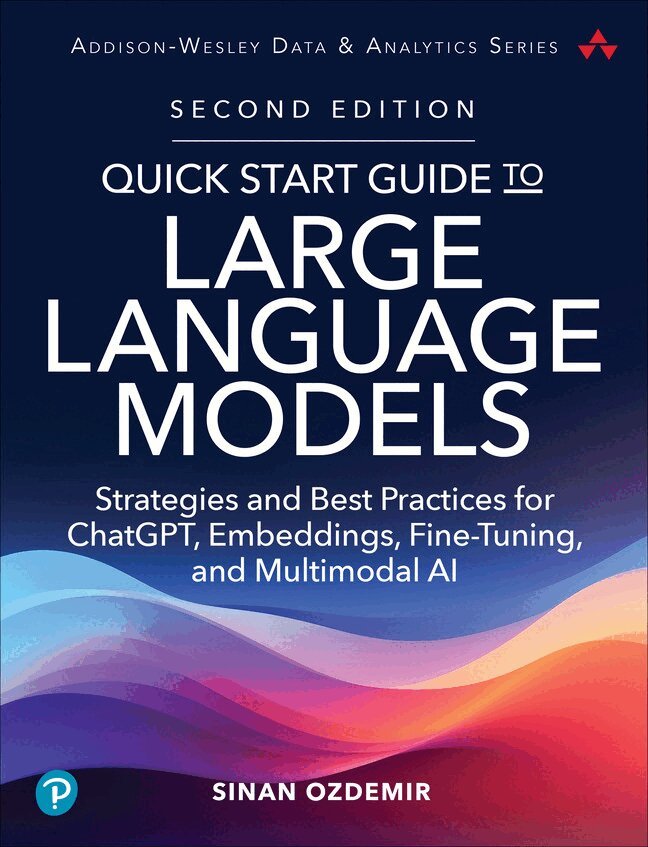
    Quick Start Guide to Large Language Models

    Strategies and Best Practices for ChatGPT, Embeddings, Fine-Tuning, and Multimodal AI

    AvSinan Ozdemir

    Häftad, Engelska, 2024

    Del i serien Addison-Wesley Data & Analytics Series

    373 kr

    Beställningsvara. Skickas inom 7-10 vardagar. Fri frakt över 249 kr.

    Fler format och utgåvor

    Häftad

    355 kr

    Beskrivning

    The Practical, Step-by-Step Guide to Using LLMs at Scale in Projects and Products

    Large Language Models (LLMs) like Llama 3, Claude 3, and the GPT family are demonstrating breathtaking capabilities, but their size and complexity have deterred many practitioners from applying them. In Quick Start Guide to Large Language Models, Second Edition, pioneering data scientist and AI entrepreneur Sinan Ozdemir clears away those obstacles and provides a guide to working with, integrating, and deploying LLMs to solve practical problems.

    Ozdemir brings together all you need to get started, even if you have no direct experience with LLMs: step-by-step instructions, best practices, real-world case studies, and hands-on exercises. Along the way, he shares insights into LLMs' inner workings to help you optimize model choice, data formats, prompting, fine-tuning, performance, and much more. The resources on the companion website include sample datasets and up-to-date code for working with open- and closed-source LLMs such as those from OpenAI (GPT-4 and GPT-3.5), Google (BERT, T5, and Gemini), X (Grok), Anthropic (the Claude family), Cohere (the Command family), and Meta (BART and the LLaMA family).

    • Learn key concepts: pre-training, transfer learning, fine-tuning, attention, embeddings, tokenization, and more
    • Use APIs and Python to fine-tune and customize LLMs for your requirements
    • Build a complete neural/semantic information retrieval system and attach to conversational LLMs for building retrieval-augmented generation (RAG) chatbots and AI Agents
    • Master advanced prompt engineering techniques like output structuring, chain-of-thought prompting, and semantic few-shot prompting
    • Customize LLM embeddings to build a complete recommendation engine from scratch with user data that outperforms out-of-the-box embeddings from OpenAI
    • Construct and fine-tune multimodal Transformer architectures from scratch using open-source LLMs and large visual datasets
    • Align LLMs using Reinforcement Learning from Human and AI Feedback (RLHF/RLAIF) to build conversational agents from open models like Llama 3 and FLAN-T5
    • Deploy prompts and custom fine-tuned LLMs to the cloud with scalability and evaluation pipelines in mind
    • Diagnose and optimize LLMs for speed, memory, and performance with quantization, probing, benchmarking, and evaluation frameworks

    "A refreshing and inspiring resource. Jam-packed with practical guidance and clear explanations that leave you smarter about this incredible new field."
    --Pete Huang, author of The Neuron

    Register your book for convenient access to downloads, updates, and/or corrections as they become available. See inside book for details.

    Produktinformation

    • Utgivningsdatum:2024-11-06
    • Mått:181 x 231 x 18 mm
    • Vikt:623 g
    • Format:Häftad
    • Språk:Engelska
    • Serie:Addison-Wesley Data & Analytics Series
    • Antal sidor:384
    • Upplaga:2
    • Förlag:Pearson Education
    • ISBN:9780135346563

    Utforska kategorier

    • Systemvetenskap och AI inom Data och IT
    • Programspråk inom Data och IT
    • Artificiell intelligens inom Data och IT

    Mer om författaren

    Sinan Ozdemir is currently the founder and CTO of LoopGenius and an advisor to several AI companies. Sinan is a former lecturer of Data Science at Johns Hopkins University and the author of multiple textbooks on data science and machine learning. Additionally, he is the founder of the recently acquired Kylie.ai, an enterprise-grade conversational AI platform with RPA capabilities. He holds a master's degree in Pure Mathematics from Johns Hopkins University and is based in San Francisco, CA.

    Recensioner i media

    "By balancing the potential of both open- and closed-source models, Quick Start Guide to Large Language Models stands as a comprehensive guide to understanding and using LLMs, bridging the gap between theoretical concepts and practical application."--Giada Pistilli, Principal Ethicist at Hugging Face"When it comes to building large language models (LLMs), it can be a daunting task to find comprehensive resources that cover all the essential aspects. However, my search for such a resource recently came to an end when I discovered this book."One of the stand-out features of Sinan is his ability to present complex concepts in a straightforward manner. The author has done an outstanding job of breaking down intricate ideas and algorithms, ensuring that readers can grasp them without feeling overwhelmed. Each topic is carefully explained, building upon examples that serve as stepping stones for better understanding. This approach greatly enhances the learning experience, making even the most intricate aspects of LLM development accessible to readers of varying skill levels."Another strength of this book is the abundance of code resources. The inclusion of practical examples and code snippets is a game-changer for anyone who wants to experiment and apply the concepts they learn. These code resources provide readers with hands-on experience, allowing them to test and refine their understanding. This is an invaluable asset, as it fosters a deeper comprehension of the material and enables readers to truly engage with the content."In conclusion, this book is a rare find for anyone interested in building LLMs. Its exceptional quality of explanation, clear and concise writing style, abundant code resources, and comprehensive coverage of all essential aspects make it an indispensable resource. Whether you are a beginner or an experienced practitioner, this book will undoubtedly elevate your understanding and practical skills in LLM development. I highly recommend Quick Start Guide to Large Language Models to anyone looking to embark on the exciting journey of building LLM applications."--Pedro Marcelino, Machine Learning Engineer, Co-Founder and CEO @overfit.study"Ozdemir's book cuts through the noise to help readers understand where the LLM revolution has come from--and where it is going. Ozdemir breaks down complex topics into practical explanations and easy-to-follow code examples."--Shelia Gulati, Former GM at Microsoft and current Managing Director of Tola Capital

    Innehållsförteckning

    • Foreword xiPreface xiiiAcknowledgments xixAbout the Author xxiPart I: Introduction to Large Language Models 1Chapter 1: Overview of Large Language Models 3What Are Large Language Models? 4Popular Modern LLMs 7Applications of LLMs 25Summary 31Chapter 2: Semantic Search with LLMs 33Introduction 33The Task 34Solution Overview 36The Components 37Putting It All Together 53The Cost of Closed-Source Components 57Summary 58Chapter 3: First Steps with Prompt Engineering 59Introduction 59Prompt Engineering 59Working with Prompts Across Models 70Summary 74Chapter 4: The AI Ecosystem: Putting the Pieces Together 75Introduction 75The Ever-Shifting Performance of Closed-Source AI 76AI Reasoning versus Thinking 77Case Study 1: Retrieval Augmented Generation 79Case Study 2: Automated AI Agents 87Conclusion 93Part II: Getting the Most Out of LLMs 95Chapter 5: Optimizing LLMs with Customized Fine-Tuning 97Introduction 97Transfer Learning and Fine-Tuning: A Primer 99A Look at the OpenAI Fine-Tuning API 102Preparing Custom Examples with the OpenAI CLI 104Setting Up the OpenAI CLI 108Our First Fine-Tuned LLM 109Summary 119Chapter 6: Advanced Prompt Engineering 121Introduction 121Prompt Injection Attacks 121Input/Output Validation 123Batch Prompting 126Prompt Chaining 128Case Study: How Good at Math Is AI? 135Summary 145Chapter 7: Customizing Embeddings and Model Architectures 147Introduction 147Case Study: Building a Recommendation System 148Summary 166Chapter 8: AI Alignment: First Principles 167Introduction 167Aligned to Whom and to What End? 167Alignment as a Bias Mitigator 173The Pillars of Alignment 176Constitutional AI: A Step Toward Self-Alignment 195Conclusion 198Part III: Advanced LLM Usage 199Chapter 9: Moving Beyond Foundation Models 201Introduction 201Case Study: Visual Q/A 201Case Study: Reinforcement Learning from Feedback 218Summary 228Chapter 10: Advanced Open-Source LLM Fine-Tuning 229Introduction 229Example: Anime Genre Multilabel Classification with BERT 230Example: LaTeX Generation with GPT2 244Sinan's Attempt at Wise Yet Engaging Responses: SAWYER 248Summary 271Chapter 11: Moving LLMs into Production 275Introduction 275Deploying Closed-Source LLMs to Production 275Deploying Open-Source LLMs to Production 276Summary 297Chapter 12: Evaluating LLMs 299Introduction 299Evaluating Generative Tasks 300Evaluating Understanding Tasks 317Conclusion 328Keep Going! 329Part IV: Appendices 331Appendix A: LLM FAQs 333Appendix B: LLM Glossary 339Appendix C: LLM Application Archetypes 345Index 349