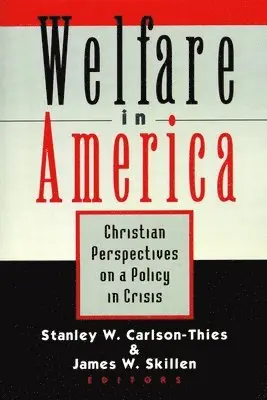
This is a print on demand book and is therefore non- returnable. Between 1992 and 1995, the Center for Public Justice, a Christian civic-education and public-policy think tank undertook an extended project named the Welfare Responsibility Inquiry. In May 1994, the project hosted a conference in Washington, DC, on "Public Justice and Welfare Reform." The project involved, at its center, a group of scholars who met periodically to discuss the issues involved. Those scholars then wrote the papers which are collected in Welfare in America. "Welfare in America," James Skillen writes, "argues that assistance to the needy does not, and should not, come primarily from government. Government, whether at federal or state levels, should help hold people accountable to their various institutional and personal responsibilities rather than fill in for every failure." The range of topics addressed in Welfare in America is extensive. Though no reader will agree with everything here, those whose calling requires them to think through this issue with care will be wise to include Welfare in America in their list of books to be read.Contributors: Stanley Carlson-Thies Jean Bethke Elshtain Max Stackhouse Bob Goudzwaard Mary Ann Glendon Stephanie Collins James Skillen John Mason Stephen Mott Lawrence Mead Mary Stewart Van Leeuwen Paul Marshall Anne Hallum Cynthia Neal Mary Van Hook John Hiemstra Charles Glenn Stephen Monsma Ronald Sider Julia Stronks Clarke Cochran
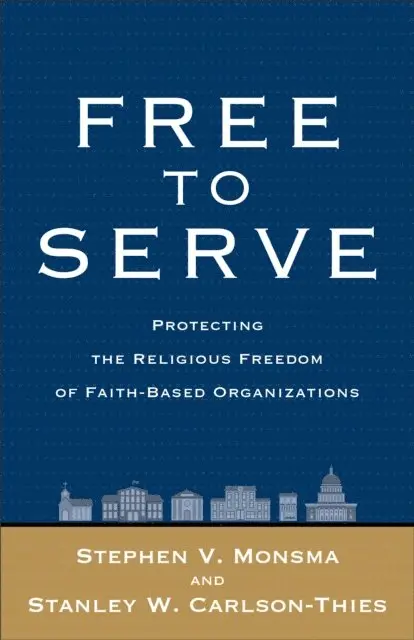
Christianity Today Book Award WinnerWhat do Hobby Lobby, InterVarsity Christian Fellowship, Wheaton College, World Vision, the Little Sisters of the Poor, and the University of Notre Dame have in common? All are faith-based organizations that have faced pressure to act in ways contrary to their religious beliefs. In this book, two policy experts show how faith-based groups--those active in the educational, healthcare, international aid and development, and social service fields--can defend their ability to follow their religiously based beliefs without having to jettison the very faith and faith-based practices that led them to provide services to those in need. They present a pluralist vision for religious freedom for faith-based organizations of all religious traditions. The book includes case studies that document the challenges faith-based organizations face to freely follow the practices of their religious traditions and analyzes these threats as originating in a common, yet erroneous, set of assumptions and attitudes prevalent in American society. The book also includes responses by diverse voices--an Orthodox Jew, a Roman Catholic, two evangelicals, two Islamic leaders, and an unbeliever who is a religious-freedom advocate--underscoring the importance of religious freedom for faith-based organizations.
This is a print on demand book and is therefore non- returnable. Between 1992 and 1995, the Center for Public Justice, a Christian civic-education and public-policy think tank undertook an extended project named the Welfare Responsibility Inquiry. In May 1994, the project hosted a conference in Washington, DC, on "Public Justice and Welfare Reform." The project involved, at its center, a group of scholars who met periodically to discuss the issues involved. Those scholars then wrote the papers which are collected in Welfare in America. "Welfare in America," James Skillen writes, "argues that assistance to the needy does not, and should not, come primarily from government. Government, whether at federal or state levels, should help hold people accountable to their various institutional and personal responsibilities rather than fill in for every failure." The range of topics addressed in Welfare in America is extensive. Though no reader will agree with everything here, those whose calling requires them to think through this issue with care will be wise to include Welfare in America in their list of books to be read.Contributors: Stanley Carlson-Thies Jean Bethke Elshtain Max Stackhouse Bob Goudzwaard Mary Ann Glendon Stephanie Collins James Skillen John Mason Stephen Mott Lawrence Mead Mary Stewart Van Leeuwen Paul Marshall Anne Hallum Cynthia Neal Mary Van Hook John Hiemstra Charles Glenn Stephen Monsma Ronald Sider Julia Stronks Clarke Cochran
Christianity Today Book Award WinnerWhat do Hobby Lobby, InterVarsity Christian Fellowship, Wheaton College, World Vision, the Little Sisters of the Poor, and the University of Notre Dame have in common? All are faith-based organizations that have faced pressure to act in ways contrary to their religious beliefs. In this book, two policy experts show how faith-based groups--those active in the educational, healthcare, international aid and development, and social service fields--can defend their ability to follow their religiously based beliefs without having to jettison the very faith and faith-based practices that led them to provide services to those in need. They present a pluralist vision for religious freedom for faith-based organizations of all religious traditions. The book includes case studies that document the challenges faith-based organizations face to freely follow the practices of their religious traditions and analyzes these threats as originating in a common, yet erroneous, set of assumptions and attitudes prevalent in American society. The book also includes responses by diverse voices--an Orthodox Jew, a Roman Catholic, two evangelicals, two Islamic leaders, and an unbeliever who is a religious-freedom advocate--underscoring the importance of religious freedom for faith-based organizations.