Stefan Poslad - Böcker
Visar alla böcker från författaren Stefan Poslad. Handla med fri frakt och snabb leverans.
2 produkter
2 produkter
1 120 kr
Skickas inom 7-10 vardagar
This book provides an introduction to the complex field of ubiquitous computing Ubiquitous Computing (also commonly referred to as Pervasive Computing) describes the ways in which current technological models, based upon three base designs: smart (mobile, wireless, service) devices, smart environments (of embedded system devices) and smart interaction (between devices), relate to and support a computing vision for a greater range of computer devices, used in a greater range of (human, ICT and physical) environments and activities. The author details the rich potential of ubiquitous computing, the challenges involved in making it a reality, and the prerequisite technological infrastructure. Additionally, the book discusses the application and convergence of several current major and future computing trends. Key Features: Provides an introduction to the complex field of ubiquitous computingDescribes how current technology models based upon six different technology form factors which have varying degrees of mobility wireless connectivity and service volatility: tabs, pads, boards, dust, skins and clay, enable the vision of ubiquitous computingDescribes and explores how the three core designs (smart devices, environments and interaction) based upon current technology models can be applied to, and can evolve to, support a vision of ubiquitous computing and computing for the futureCovers the principles of the following current technology models, including mobile wireless networks, service-oriented computing, human computer interaction, artificial intelligence, context-awareness, autonomous systems, micro-electromechanical systems, sensors, embedded controllers and robotsCovers a range of interactions, between two or more UbiCom devices, between devices and people (HCI), between devices and the physical world.Includes an accompanying website with PowerPoint slides, problems and solutions, exercises, bibliography and further readingGraduate students in computer science, electrical engineering and telecommunications courses will find this a fascinating and useful introduction to the subject. It will also be of interest to ICT professionals, software and network developers and others interested in future trends and models of computing and interaction over the next decades.
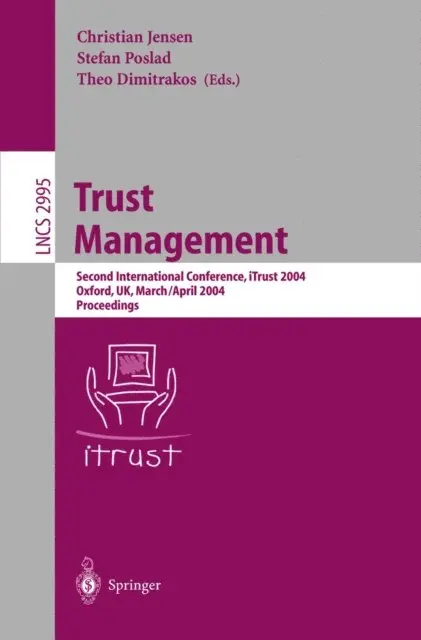
Trust Management
Second International Conference, iTrust 2004, Oxford, UK, March 29 - April 1, 2004, Proceedings
Häftad, Engelska, 2004
556 kr
Skickas inom 10-15 vardagar
This volume constitutes the proceedings of the 2nd International Conference on TrustManagement,heldinOxford,UK,during29March-1April2004.Thec- ference followed a very successful 1st International Conference on Trust Ma- gement held in Crete in 2003. Both conferences were organized by iTrust, which is a working group funded as a thematic network by the Future and Emerging Technologies (FET) unit of the Information Society Technologies (IST) program of the European Union. The purpose of the iTrust working group is to provide a forum for cro- disciplinary investigation of the applications of trust as a means of increasing security, building con?dence and facilitating collaboration in dynamic open - stems. The notion of trust has been studied independently by di?erent academic disciplines, which has helped us to identify and understand di?erent aspects of trust. The aim of this conference was to provide a common forum, bringing together researchers from di?erent academic branches, such as the technolo- oriented disciplines, law, social sciences and philosophy, in order to develop a deeper and more fundamental understanding of the issues and challenges in the area of trust management in dynamic open systems.The response to this conference was excellent; from the 48 papers submitted to the conference, we selected 21 full papers and 6 short papers for presentation. Theprogramalsoincludedthreekeynoteaddresses,givenbyJe?Bradshawfrom theInstituteforHumanandMachineCognitionattheUniversityofWestFlorida (USA), Ian Walden who is Director of the Computer-Related Crime Research Centre at Queen Mary, University of London (UK), and Massimo Marchiori from the World Wide Web Consortium, as well as three panels and a full day of tutorials.