Stephen Hailes – författare
Visar alla böcker från författaren Stephen Hailes. Handla med fri frakt och snabb leverans.
6 produkter
6 produkter
E-bok
PDF, Engelska, 20121 328 kr
Läs direkt efter köp
Ben Shneiderman The turbulence generated by the integration of information technology into higher education provokes more conversations than the weather. The hot winds of hyperpromises and the cold front of angry skeptics are clouding the judgment of administrators, faculty members, and national planners. A clear forecast is not likely to appear until implementations are in place and thoughtful evaluations are conducted. This edited collection points the way towards more clear thinking by presenting detailed reports about promising projects and a hint of the thoughtful evaluations that will be so important in the coming years. Multi-level evaluations will be necessary for developers to refine their user interfaces, for professors to adjust their teaching, and for administrators to understand how university life is being changed. The changes implied by the digital university are nicely categorized by the Dearing Report''s four areas of activity: teaching, research, systems support, and administration. First generation collaborative software tools are already being applied in all four areas, and they are likely to become more sophisticated, integrated, and ubiquitous. Evaluating the impact of these tools in each area will be a prime occupation for several decades.
E-bok
PDF, Engelska, 2012734 kr
Läs direkt efter köp
Computer supported collaboration in academia is becoming increasingly important for two reasons. Firstly, there is a drive to make the most effective use of the resources available to universities, and secondly, there is a growing belief in the pedagogical benefits of using computer support in teaching. In this volume, an international collection of authors from both academia and industry examines ways in which universities can make effective use of asynchronous collaboration. All aspects of academic life are covered, from teaching and research through to support and management. The Digital University contains a range of material, from research-oriented chapters through to the experiences of senior university management in attempting to make their institutions as efficient as they need to be to survive in the 21st century.
Häftad, Engelska, 1998
533 kr
Skickas inom 10-15 vardagar
Computer supported collaboration in academia is becoming increasingly important for two reasons. Firstly, there is a drive to make the most effective use of the resources available to universities, and secondly, there is a growing belief in the pedagogical benefits of using computer support in teaching. In this volume, an international collection of authors from both academia and industry examines ways in which universities can make effective use of asynchronous collaboration. All aspects of academic life are covered, from teaching and research through to support and management. The Digital University contains a range of material, from research-oriented chapters through to the experiences of senior university management in attempting to make their institutions as efficient as they need to be to survive in the 21st century.
Häftad, Engelska, 2001
1 060 kr
Skickas inom 10-15 vardagar
Ben Shneiderman The turbulence generated by the integration of information technology into higher education provokes more conversations than the weather. The hot winds of hyperpromises and the cold front of angry skeptics are clouding the judgment of administrators, faculty members, and national planners. A clear forecast is not likely to appear until implementations are in place and thoughtful evaluations are conducted. This edited collection points the way towards more clear thinking by presenting detailed reports about promising projects and a hint of the thoughtful evaluations that will be so important in the coming years. Multi-level evaluations will be necessary for developers to refine their user interfaces, for professors to adjust their teaching, and for administrators to understand how university life is being changed. The changes implied by the digital university are nicely categorized by the Dearing Report's four areas of activity: teaching, research, systems support, and administration. First generation collaborative software tools are already being applied in all four areas, and they are likely to become more sophisticated, integrated, and ubiquitous. Evaluating the impact of these tools in each area will be a prime occupation for several decades.
Häftad, Engelska, 2010
566 kr
Skickas inom 10-15 vardagar
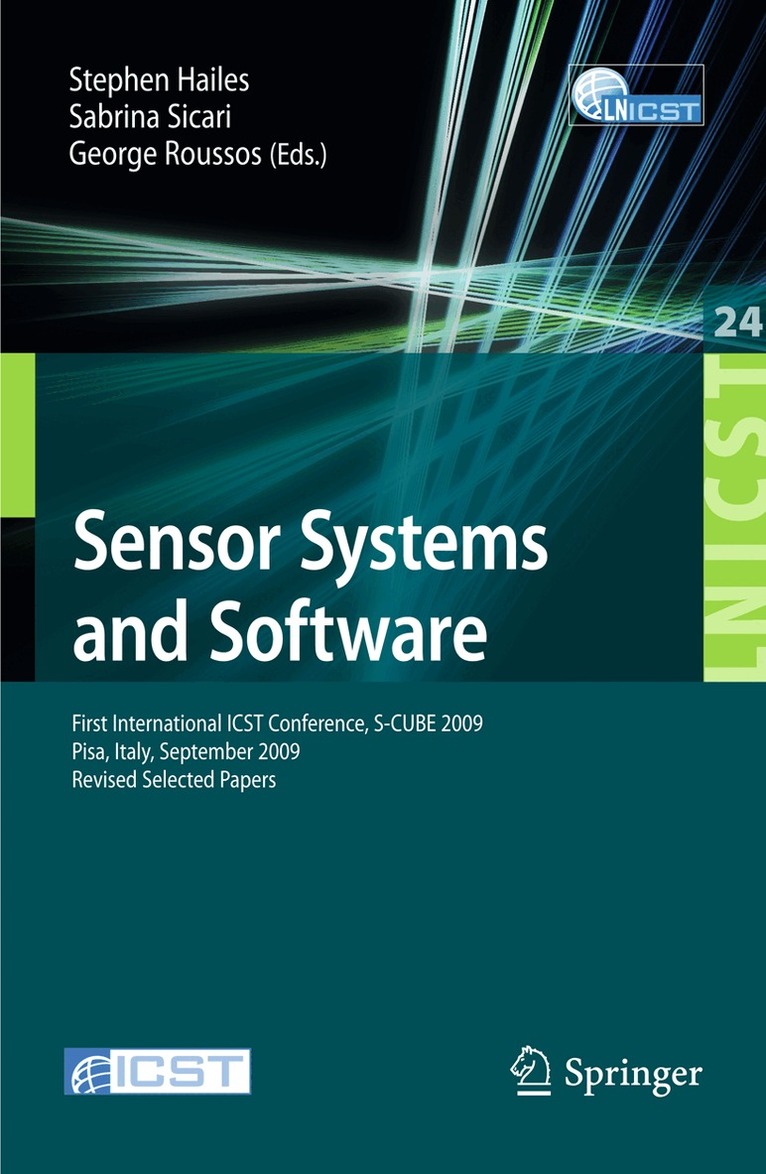
The First International ICST Conference on Sensor Systems and Software (S-cube 2009) was held during 7–8 September in Pisa, Italy. This new international conference was dedicated to addressing the research challenges facing system dev- opment and software support for systems based on wireless sensor networks (WSNs) that have the potential to impact society in many ways. Currently, wireless sensor networks introduce innovative and interesting application scenarios that may support a large amount of different applications including environmental monitoring, disaster prevention, building automation, object tracking, nuclear reactor control, fire det- tion, agriculture, healthcare, and traffic monitoring. The widespread acceptance of these new services can be improved by the definition of frameworks and architectures that have the potential to radically simplify software development for wireless sensor network-based applications. The aim of these new architectures is to support flexible, scalable programming of applications based on adaptive middleware. As a con- quence, WSNs require novel programming paradigms and technologies. Moreover, the design of new complex systems, characterized by the interaction of different and heterogeneous resources, will allow the development of innovative applications that meet high-performance goals. Hence, WSNs require contributions from many fields such as embedded systems, distributed systems, data management, system security and applications. The conference places emphasis on layers well above the traditional MAC and routing and transport layer protocols.
E-bok
PDF, Engelska, 2009734 kr
Läs direkt efter köp
The First International ICST Conference on Sensor Systems and Software (S-cube 2009) was held during 7–8 September in Pisa, Italy. This new international conference was dedicated to addressing the research challenges facing system dev- opment and software support for systems based on wireless sensor networks (WSNs) that have the potential to impact society in many ways. Currently, wireless sensor networks introduce innovative and interesting application scenarios that may support a large amount of different applications including environmental monitoring, disaster prevention, building automation, object tracking, nuclear reactor control, fire det- tion, agriculture, healthcare, and traffic monitoring. The widespread acceptance of these new services can be improved by the definition of frameworks and architectures that have the potential to radically simplify software development for wireless sensor network-based applications. The aim of these new architectures is to support flexible, scalable programming of applications based on adaptive middleware. As a con- quence, WSNs require novel programming paradigms and technologies. Moreover, the design of new complex systems, characterized by the interaction of different and heterogeneous resources, will allow the development of innovative applications that meet high-performance goals. Hence, WSNs require contributions from many fields such as embedded systems, distributed systems, data management, system security and applications. The conference places emphasis on layers well above the traditional MAC and routing and transport layer protocols.