Stephen Read - Böcker
Visar alla böcker från författaren Stephen Read. Handla med fri frakt och snabb leverans.
9 produkter
9 produkter
468 kr
Skickas inom 5-8 vardagar
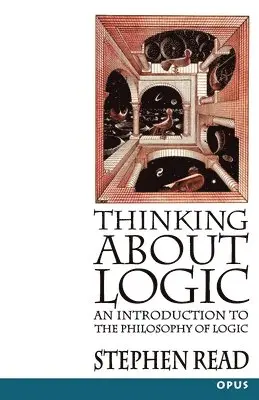
Logic deals with the inevitable - those consequences which follow inescapably from a given set of premisses. This fact has caused it to be seen as different from other more self-questioning branches of philosophy. In this book, Stephen Read sets out to rescue logic from its undeserved reputation as an inflexible, dogmatic discipline by demonstrating that its technicalities and processes are founded on assumptions which are themselves amenable to philosophical investigation.He examines the fundamental principles of consequence, logical truth and correct inference within the context of logic, and shows that the principles by which we delineate consequences are themselves not guaranteed free from error. Central to the notion of truth is the beguiling issue of paradox. Its philosophical value, Read shows, lies in exposing the invalid assumption on which the paradox is built. Thinking About Logic also discusses logical puzzles which introduce questions relating to language, the world, and their relationship.While formal logic often employs its own esoteric language, the achievement of this book is to focus on those issues which raise exciting philosophical questions, and to make them intelligible to readers with no previous knowledge of logic.
1 638 kr
Tillfälligt slut
This text focuses on cities as the dominant form of human settlement for the future, examining the transformation that is happening in urban connobations worldwide today. The last few decades have seen a rate of change and growth in cities that has never been seen before, resulting in giant metropoles with over twenty million inhabitants. This book tackles the causes of these changes, and looks at how the planning and design of cities can shape the urban future.
933 kr
Skickas inom 10-15 vardagar
This text focuses on cities as the dominant form of human settlement for the future, examining the transformation that is happening in urban connobations worldwide today. The last few decades have seen a rate of change and growth in cities that has never been seen before, resulting in giant metropoles with over twenty million inhabitants. This book tackles the causes of these changes, and looks at how the planning and design of cities can shape the urban future.
1 311 kr
Skickas inom 7-10 vardagar
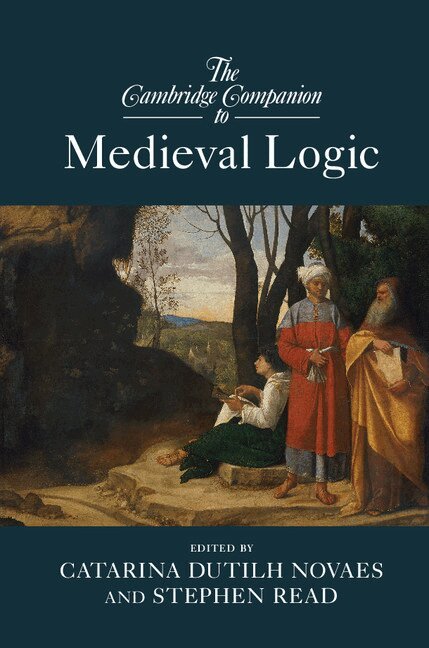
This volume, the first dedicated and comprehensive companion to medieval logic, covers both the Latin and the Arabic traditions, and shows that they were in fact sister traditions, which both arose against the background of a Hellenistic heritage and which influenced one another over the centuries. A series of chapters by both established and younger scholars covers the whole period including early and late developments, and offers new insights into this extremely rich period in the history of logic. The volume is divided into two parts, 'Periods and Traditions' and 'Themes', allowing readers to engage with the subject from both historical and more systematic perspectives. It will be a must-read for students and scholars of medieval philosophy, the history of logic, and the history of ideas.
410 kr
Skickas inom 7-10 vardagar
This volume, the first dedicated and comprehensive companion to medieval logic, covers both the Latin and the Arabic traditions, and shows that they were in fact sister traditions, which both arose against the background of a Hellenistic heritage and which influenced one another over the centuries. A series of chapters by both established and younger scholars covers the whole period including early and late developments, and offers new insights into this extremely rich period in the history of logic. The volume is divided into two parts, 'Periods and Traditions' and 'Themes', allowing readers to engage with the subject from both historical and more systematic perspectives. It will be a must-read for students and scholars of medieval philosophy, the history of logic, and the history of ideas.
1 846 kr
Kommande
Ralph Strode studied and taught at Merton College Oxford in the 1350s and ’60s. Later, he lived in London near Geoffrey Chaucer, who dedicated his poem Troilus and Criseyde to “philosophical Strode”. While in Oxford, Strode wrote six treatises on logic, including one on obligationes, a unique logical genre probably designed to train students in logical inference. Obligationes are logical disputations between an Opponent, who poses a proposition, usually false, against a background scenario, and a Respondent who, having accepted the Opponent’s proposal, must respond by granting, denying or doubting the propositions put forward by the Opponent in accordance with certain rules. Various rival sets of rules were proposed. Strode’s treatise argues against three such theories including Swyneshed’s and Dumbleton’s, and develops Walter Burley’s theory further. Jennifer Ashworth began her edition of Strode’s Obligationes in the 1980s, and began an English translation late in life, but was unable to finish the work before her death in 2024. Stephen Read has completed the translation, and added a history of theories of obligationes and the place of Strode’s theory in it. Apart from a doctoral dissertation presenting Strode’s Consequences, it will be the first of Strode’s treatises to appear in print.
232 kr
Skickas inom 5-8 vardagar
202 kr
Tillfälligt slut
Sophisms in Medieval Logic and Grammar
Acts of the Ninth European Symposium for Medieval Logic and Semantics, held at St Andrews, June 1990
Häftad, Engelska, 2012
2 110 kr
Skickas inom 10-15 vardagar
The first Symposium consisted of three people in a cafe in Warsaw in 1973. Since then, meetings have grown in size and have been held in Leyden, Copenhagen, Nijmegen, Rome, Oxford, Poitiers and Freiburg am-Breisgau. The ninth Symposium was held in St Andrews in June 1990, with 57 participants who listened to addresses by 28 speakers. It was very fitting that Scotland's oldest university, founded in the heyday of medievalleaming in 1411, should have been given the chance to bring together scholars from all over Europe and beyond to present their researches on the glorious past of scholastic rational thought. The topic of the Symposium was "Sophisms in Medieval Logic and Grammar". The present volume consists, for the most part, of the papers presented at the Symposium. In fact, however, it proved impossible to include five of the contributions. Two of the papers included here were intended for the Symposium but in the event not delivered, because of the unavoidable absence of the speakers. The Symposium received very helpful financial support from one of the major philosophical associations in Britain, the Mind Association, from the Philosophical Quarterly, a journal published at St Andrews, from the University of St Andrews, from the British Academy, and from Low and Bonarplc. In organising the programme for the conference and in preparing the papers for publication I received invaluable help from: Professor E.J.