Subhash C. Basu – författare
Visar alla böcker från författaren Subhash C. Basu. Handla med fri frakt och snabb leverans.
5 produkter
5 produkter
Inbunden, Engelska, 2002
1 123 kr
Skickas inom 10-15 vardagar
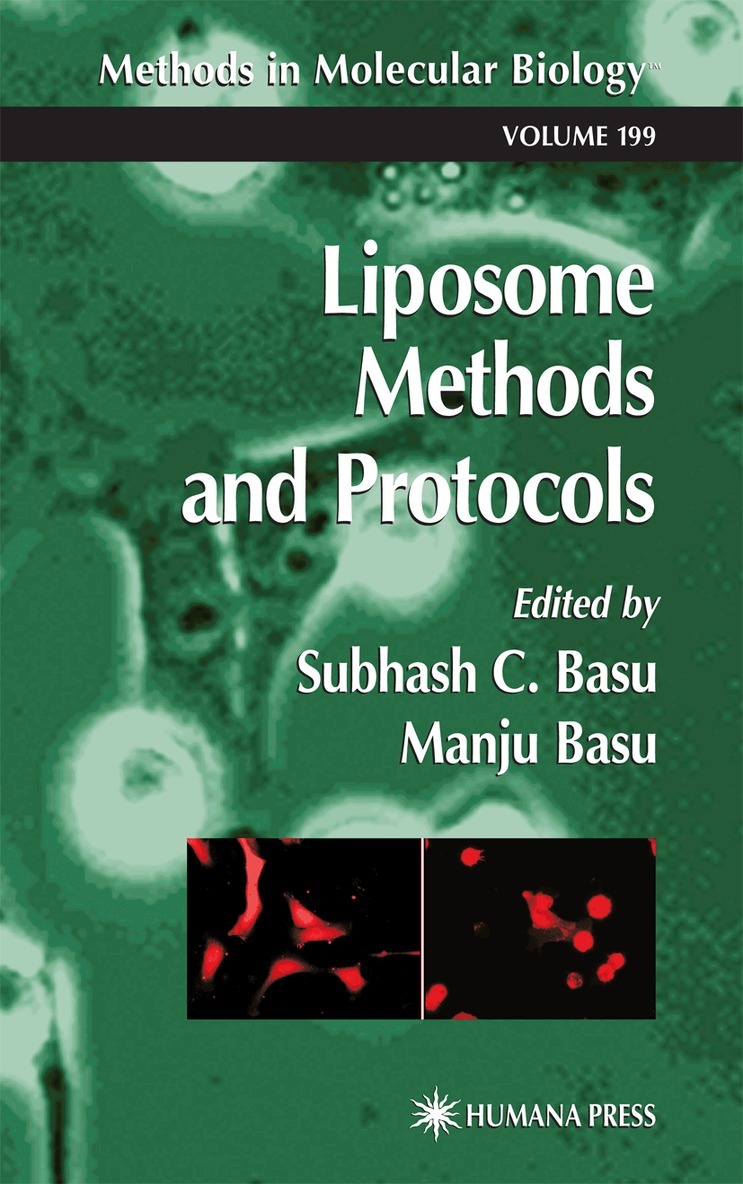
A panel of skilled researchers describes in step-by-step detail their best laboratory techniques for elucidating liposome biology. With these readily reproducible methods, investigators can illuminate such critical questions as the attachment of liposmes to cell surfaces, the permeation of liposomes through the plasma membranes, and the stability of liposomes in cellular and nuclear matrices. Each detailed protocol is presented by an investigator who is intimately familiar with its problems and capabilities, and includes a detailed list of materials to be used, troubleshooting tips straight from the benchtop, and notes on pitfalls to avoid.

E-bok
Engelska, 20081 459 kr
Läs direkt efter köp
In vitro utilization of liposomes is now recognized as a powerful tool in many bioscience investigations and their associated clinical studies, e.g., liposomes in drug targeting; liposomes in gene transport across plasma and nuclear membranes; liposomes in enzyme therapy in patients with genetic disorders. However, before these areas can be effectively explored, many basic areas in liposome research require elucidation, including: (a) attachment of liposomes to cell surfaces; (b) permeation of liposomes through the plasma membranes; and (c) stability of liposomes in cell or nuclear matrices. None of these areas have been exhaustively explored and liposome researchers have ample opportunities to contribute to our knowledge. The aim of Liposome Methods and Protocols is to bring together a wide range of detailed laboratory protocols covering different aspects of liposome biology in order to assist researchers in those rapidly advancing medical fields mentioned earlier. With this goal in mind, in each protocol chapter we have detailed the materials to be used, followed by a step-by-step protocol. The Notes section of each protocol is also certain to prove particularly useful, since the authors include troubleshooting tips straight from their benchtops, valuable information that is seldom given in restricted methods sections of standard research journals. For this reason we feel that the book will prove especially useful for all researchers in the liposome field.
Häftad, Engelska, 2010
1 123 kr
Skickas inom 10-15 vardagar
In vitro utilization of liposomes is now recognized as a powerful tool in many bioscience investigations and their associated clinical studies, e.g., liposomes in drug targeting; liposomes in gene transport across plasma and nuclear membranes; liposomes in enzyme therapy in patients with genetic disorders. However, before these areas can be effectively explored, many basic areas in liposome research require elucidation, including: (a) attachment of liposomes to cell surfaces; (b) permeation of liposomes through the plasma membranes; and (c) stability of liposomes in cell or nuclear matrices. None of these areas have been exhaustively explored and liposome researchers have ample opportunities to contribute to our knowledge. The aim of Liposome Methods and Protocols is to bring together a wide range of detailed laboratory protocols covering different aspects of liposome biology in order to assist researchers in those rapidly advancing medical fields mentioned earlier. With this goal in mind, in each protocol chapter we have detailed the materials to be used, followed by a step-by-step protocol. The Notes section of each protocol is also certain to prove particularly useful, since the authors include troubleshooting tips straight from their benchtops, valuable information that is seldom given in restricted methods sections of standard research journals. For this reason we feel that the book will prove especially useful for all researchers in the liposome field.
Del 1112 - Advances in Experimental Medicine and Biology
Biochemical and Biophysical Roles of Cell Surface Molecules
Inbunden, Engelska, 2019
1 681 kr
Skickas inom 10-15 vardagar
Cell surface small molecules and macromolecules, such as members of cholesterol family (including steroid hormones), the glycolipid family (sphingolipids), the glycoprotein family (both N-linked and O-linked), and a vast array of other receptors have been shown to be involved in normal and abnormal cellular processes. The 11th International Symposium on Cell Surface Macromolecules, held in Mohali, India, in February 2017 provided a comprehensive update on the major advances in this area. Presenting selected contributions from this meeting, this book comprises 24 chapters, which provide in-depth analyses of data on the role of cell surface macromolecules in cellular function and their alterations associated with pathological conditions. It includes comprehensive research papers and critical overviews of the functional role of cell surface molecules, discussing topics such as biochemical, biophysical, and cell biological approaches to study cell membrane molecules, and metabolism of glycoconjugates.
E-bok
Engelska, 20192 054 kr
Läs direkt efter köp
Cell surface small molecules and macromolecules, such as members of cholesterol family (including steroid hormones), the glycolipid family (sphingolipids), the glycoprotein family (both N-linked and O-linked), and a vast array of other receptors have been shown to be involved in normal and abnormal cellular processes. The 11th International Symposium on Cell Surface Macromolecules, held in Mohali, India, in February 2017 provided a comprehensive update on the major advances in this area.
Presenting selected contributions from this meeting, this book comprises 24 chapters, which provide in-depth analyses of data on the role of cell surface macromolecules in cellular function and their alterations associated with pathological conditions. It includes comprehensive research papers and critical overviews of the functional role of cell surface molecules, discussing topics such as biochemical, biophysical, and cell biological approaches to study cell membrane molecules, and metabolism of glycoconjugates.