Susan D. Hyde – författare
Visar alla böcker från författaren . Handla med fri frakt och snabb leverans.
9 produkter
9 produkter
Inbunden, Engelska, 2011
489 kr
Skickas inom 10-15 vardagar
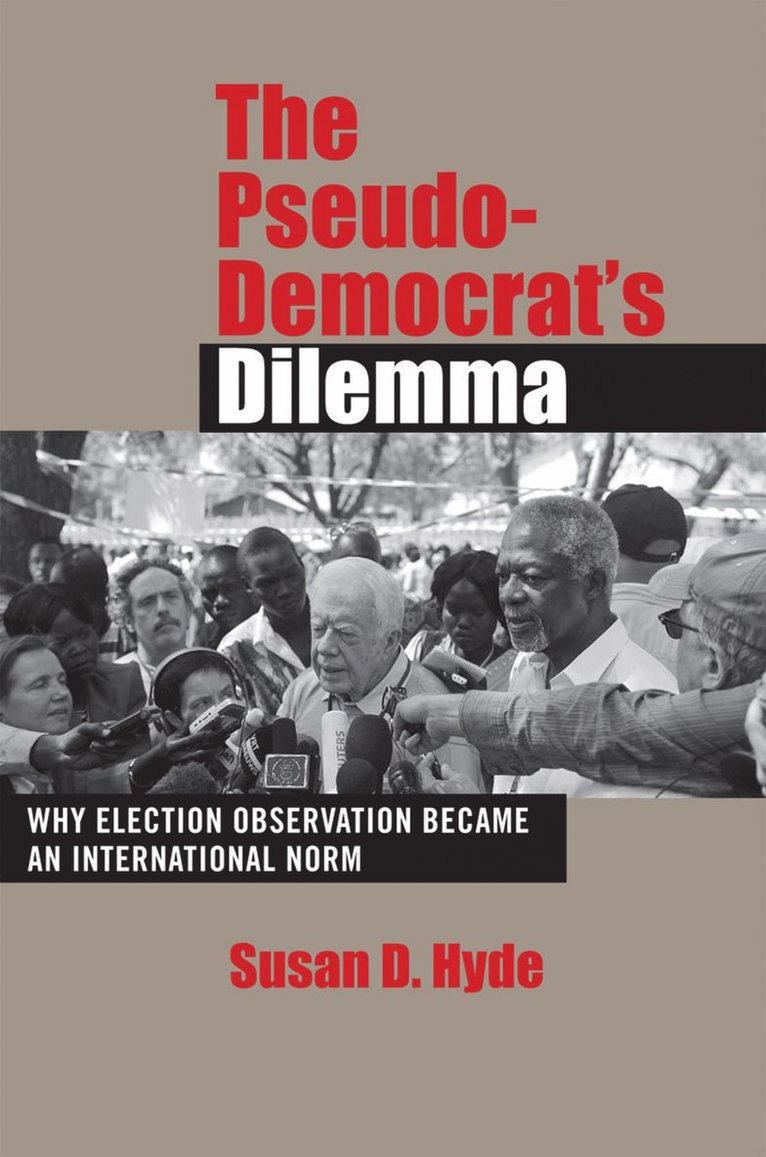
Why did election monitoring become an international norm? Why do pseudo-democrats—undemocratic leaders who present themselves as democratic—invite international observers, even when they are likely to be caught manipulating elections? Is election observation an effective tool of democracy promotion, or is it simply a way to legitimize electoral autocracies? In The Pseudo-Democrat's Dilemma, Susan D. Hyde explains international election monitoring with a new theory of international norm formation. Hyde argues that election observation was initiated by states seeking international support. International benefits tied to democracy give some governments an incentive to signal their commitment to democratization without having to give up power. Invitations to nonpartisan foreigners to monitor elections, and avoiding their criticism, became a widely recognized and imitated signal of a government's purported commitment to democratic elections.Hyde draws on cross-national data on the global spread of election observation between 1960 and 2006, detailed descriptions of the characteristics of countries that do and do not invite observers, and evidence of three ways that election monitoring is costly to pseudo-democrats: micro-level experimental tests from elections in Armenia and Indonesia showing that observers can deter election-day fraud and otherwise improve the quality of elections; illustrative cases demonstrating that international benefits are contingent on democracy in countries like Haiti, Peru, Togo, and Zimbabwe; and qualitative evidence documenting the escalating game of strategic manipulation among pseudo-democrats, international monitors, and pro-democracy forces.
Häftad, Engelska, 2015
393 kr
Skickas inom 10-15 vardagar
Why did election monitoring become an international norm? Why do pseudo-democrats—undemocratic leaders who present themselves as democratic—invite international observers, even when they are likely to be caught manipulating elections? Is election observation an effective tool of democracy promotion, or is it simply a way to legitimize electoral autocracies? In The Pseudo-Democrat's Dilemma, Susan D. Hyde explains international election monitoring with a new theory of international norm formation. Hyde argues that election observation was initiated by states seeking international support. International benefits tied to democracy give some governments an incentive to signal their commitment to democratization without having to give up power. Invitations to nonpartisan foreigners to monitor elections, and avoiding their criticism, became a widely recognized and imitated signal of a government's purported commitment to democratic elections.Hyde draws on cross-national data on the global spread of election observation between 1960 and 2006, detailed descriptions of the characteristics of countries that do and do not invite observers, and evidence of three ways that election monitoring is costly to pseudo-democrats: micro-level experimental tests from elections in Armenia and Indonesia showing that observers can deter election-day fraud and otherwise improve the quality of elections; illustrative cases demonstrating that international benefits are contingent on democracy in countries like Haiti, Peru, Togo, and Zimbabwe; and qualitative evidence documenting the escalating game of strategic manipulation among pseudo-democrats, international monitors, and pro-democracy forces.
Häftad, Engelska, 2008
365 kr
Skickas inom 10-15 vardagar
Allegations of fraud have marred recent elections around the world, from Russia and Italy to Mexico and the United States. Such charges raise fundamental questions about the quality of democracy in each country. Yet election fraud and, more broadly, electoral manipulation remain remarkably understudied concepts. There is no consensus on what constitutes election fraud, let alone how to detect and deter it. E lection Fraud: Detecting and Deterring Electoral Manipulation brings together experts on election law, election administration, and U.S. and comparative politics to address these critical issues. The first part of the book, which opens with an essay by Craig Donsanto of the U.S. Department of Justice, examines the U.S. understanding of election fraud in comparative perspective. In the second part of the book, D. Roderick Kiewiet, Jonathan N. Katz, and other scholars of U.S. elections draw on a wide variety of sources, including survey data, incident reports, and state-collected fraud allegations, to measure the extent and nature of election fraud in the United States. Finally, the third part of the book analyzes techniques for detecting and potentially deterring fraud. These strategies include both statistical analysis, as Walter R. Mebane, Jr. and Peter Ordeshook explain, and the now widespread practice of election monitoring, which Alberto Simpser examines in an intriguing essay.
E-bok
Engelska, 2009394 kr
Läs direkt efter köp
Allegations of fraud have marred recent elections around the world, from Russia and Italy to Mexico and the United States. Such charges raise fundamental questions about the quality of democracy in each country. Yet election fraud and, more broadly, electoral manipulation remain remarkably understudied concepts. There is no consensus on what constitutes election fraud, let alone how to detect and deter it. E lection Fraud: Detecting and Deterring Electoral Manipulation brings together experts on election law, election administration, and U.S. and comparative politics to address these critical issues. The first part of the book, which opens with an essay by Craig Donsanto of the U.S. Department of Justice, examines the U.S. understanding of election fraud in comparative perspective. In the second part of the book, D. Roderick Kiewiet, Jonathan N. Katz, and other scholars of U.S. elections draw on a wide variety of sources, including survey data, incident reports, and state-collected fraud allegations, to measure the extent and nature of election fraud in the United States. Finally, the third part of the book analyzes techniques for detecting and potentially deterring fraud. These strategies include both statistical analysis, as Walter R. Mebane, Jr. and Peter Ordeshook explain, and the now widespread practice of election monitoring, which Alberto Simpser examines in an intriguing essay.
E-bok
Engelska, 2019538 kr
Läs direkt efter köp
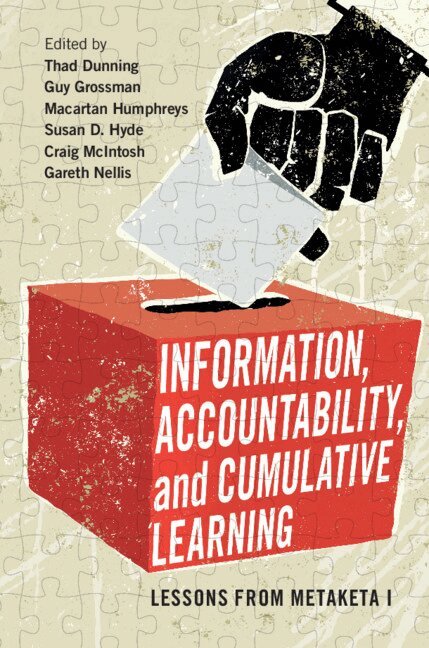
Throughout the world, voters lack access to information about politicians, government performance, and public services. Efforts to remedy these informational deficits are numerous. Yet do informational campaigns influence voter behavior and increase democratic accountability? Through the first project of the Metaketa Initiative, sponsored by the Evidence in Governance and Politics (EGAP) research network, this book aims to address this substantive question and at the same time introduce a new model for cumulative learning that increases coordination among otherwise independent researcher teams. It presents the overall results (using meta-analysis) from six independently conducted but coordinated field experimental studies, the results from each individual study, and the findings from a related evaluation of whether practitioners utilize this information as expected. It also discusses lessons learned from EGAP''s efforts to coordinate field experiments, increase replication of theoretically important studies across contexts, and increase the external validity of field experimental research.
E-bok
PDF, Engelska, 2019538 kr
Läs direkt efter köp
Throughout the world, voters lack access to information about politicians, government performance, and public services. Efforts to remedy these informational deficits are numerous. Yet do informational campaigns influence voter behavior and increase democratic accountability? Through the first project of the Metaketa Initiative, sponsored by the Evidence in Governance and Politics (EGAP) research network, this book aims to address this substantive question and at the same time introduce a new model for cumulative learning that increases coordination among otherwise independent researcher teams. It presents the overall results (using meta-analysis) from six independently conducted but coordinated field experimental studies, the results from each individual study, and the findings from a related evaluation of whether practitioners utilize this information as expected. It also discusses lessons learned from EGAP''s efforts to coordinate field experiments, increase replication of theoretically important studies across contexts, and increase the external validity of field experimental research.
Inbunden, Engelska, 2019
1 406 kr
Skickas inom 7-10 vardagar
Throughout the world, voters lack access to information about politicians, government performance, and public services. Efforts to remedy these informational deficits are numerous. Yet do informational campaigns influence voter behavior and increase democratic accountability? Through the first project of the Metaketa Initiative, sponsored by the Evidence in Governance and Politics (EGAP) research network, this book aims to address this substantive question and at the same time introduce a new model for cumulative learning that increases coordination among otherwise independent researcher teams. It presents the overall results (using meta-analysis) from six independently conducted but coordinated field experimental studies, the results from each individual study, and the findings from a related evaluation of whether practitioners utilize this information as expected. It also discusses lessons learned from EGAP's efforts to coordinate field experiments, increase replication of theoretically important studies across contexts, and increase the external validity of field experimental research.
Häftad, Engelska, 2019
444 kr
Skickas inom 7-10 vardagar
Throughout the world, voters lack access to information about politicians, government performance, and public services. Efforts to remedy these informational deficits are numerous. Yet do informational campaigns influence voter behavior and increase democratic accountability? Through the first project of the Metaketa Initiative, sponsored by the Evidence in Governance and Politics (EGAP) research network, this book aims to address this substantive question and at the same time introduce a new model for cumulative learning that increases coordination among otherwise independent researcher teams. It presents the overall results (using meta-analysis) from six independently conducted but coordinated field experimental studies, the results from each individual study, and the findings from a related evaluation of whether practitioners utilize this information as expected. It also discusses lessons learned from EGAP's efforts to coordinate field experiments, increase replication of theoretically important studies across contexts, and increase the external validity of field experimental research.
836 kr
Skickas inom 5-8 vardagar
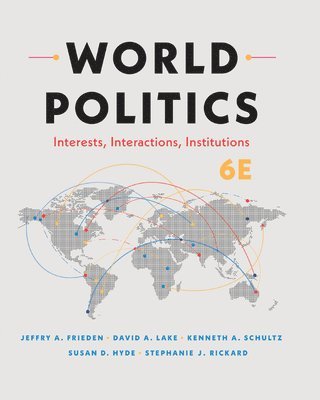
With its innovative 3Is framework based around interests, interactions, and institutions, the Sixth Edition of World Politics takes a contemporary approach to the international relations course, presenting students with puzzles about the world around them. Two new co-authors, Susan Hyde (University of California, Berkeley) and Stephanie Rickard (London School of Economics), bring fresh insights to the international political economy chapters, as well as to emerging topics of interest in the course, including human migration, human rights, and the environment. A new Norton Illumine Ebook provides an interactive environment for students to read, learn, and apply the 3Is framework to examples in the book and beyond.Highlights of the Sixth Edition’s new content:New co-authors Stephanie Rickard and Susan Hyde bring a next-generation approach to the 3I’s framework, offering fresh perspectives on international political economy and on emerging areas of scholarship, such as human rights, deglobalization, and the environment.Significant revisions to the following chapters: Ch. 7, now titled Cross-Border Flows of Goods and Services; Ch. 8, now titled Cross-Border Flows of Money and People; Ch. 11: International Law and Norms; Ch. 12: Human Rights; and Ch.13: The Global Environment.The authors explore contemporary themes in international relations across all chapters, including democratic backsliding, the rise of authoritarianism, and the spread of populism.New and revised “What Shaped Our World?” and “How Do We Know?” pedagogy provide windows into historical and contemporary events and data using the three I’s framework.A new Norton Illumine Ebook provides a robust interactive environment for students to read, learn, and apply the concepts of the course. End-of-section Check Your Understanding Questions confirm students’ understanding of key concepts and provide opportunities to apply the 3Is framework.