Susan M. Ford - Böcker
Visar alla böcker från författaren Susan M. Ford. Handla med fri frakt och snabb leverans.
4 produkter
4 produkter
2 101 kr
Skickas inom 10-15 vardagar
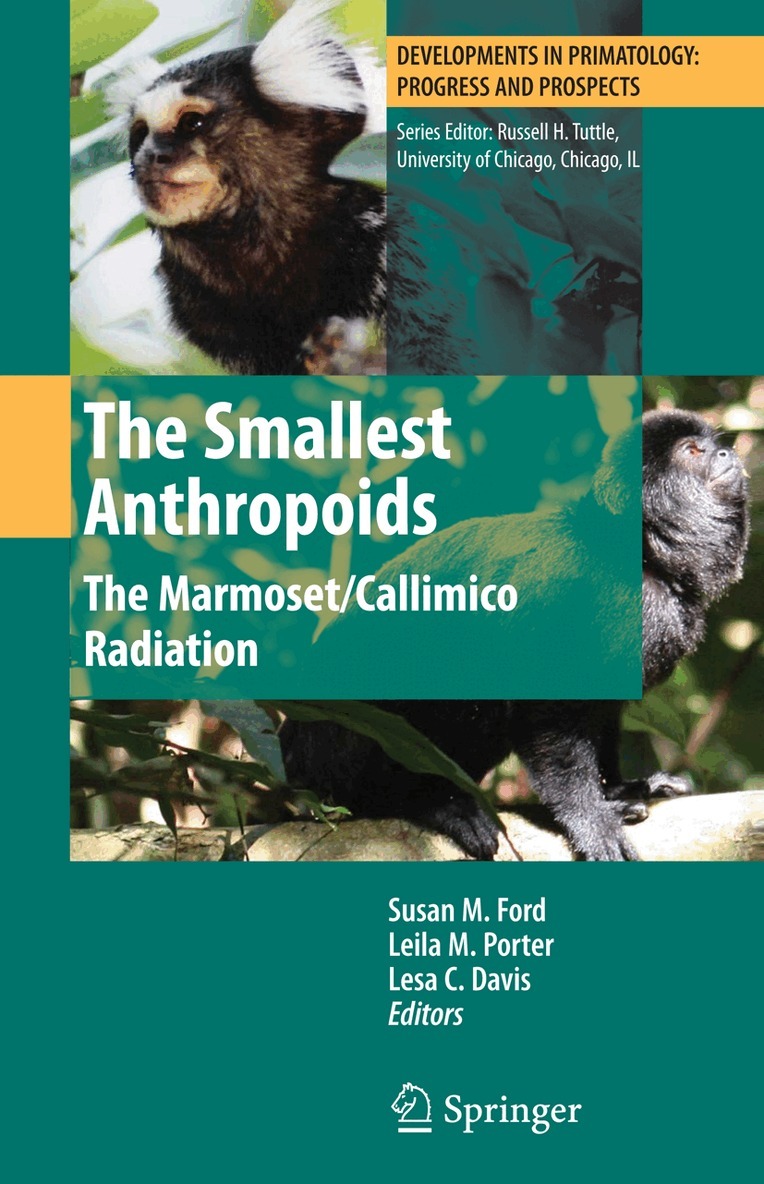
The marmosets and callimicos are diminutive monkeys from the Amazon basin and Atlantic Coastal Forest of South America. The marmosets are the smallest anthropoid primates in the world, ranging in size from approximately 100 to 350 g (Hershkovitz 1977; Soini 1988; Ford and Davis 1992; Araujo et al. 2000); calli- cos are not much bigger, at around 350-540 g (Ford and Davis 1992; Encarnacion and Heymann 1998; Garber and Leigh 2001). Overwhelming genetic evidence, from both nuclear and mitochondrial DNA, now indicates that these taxa represent a unified clade within the callitrichid radiation of New World monkeys, a finding that was unthinkable to all but a few geneticists a decade ago (see review in Cortes- Ortiz, this volume Chap. 2). With increasing evidence that the earliest anthropoids were themselves small bodied (under the 0. 8-1 kg threshold that marks all other living anthropoids; see Ross and Kay 2004), the ecology, behavior, reproductive stresses, and anatomical adaptations of the marmosets and callimicos provide the best living models with which to assess the types of adaptations that may have characterized early anthropoids.When Anthony Rylands' Marmosets and Tamarins: Systematics, Behaviour and Ecology was published in 1993, contributions focused almost entirely on tamarins due to the scarcity of data on marmoset behavior and the almost total lack of kno- edge about the enigmatic callimicos. Fortunately, this has changed (see Fig. 1).
2 101 kr
Skickas inom 10-15 vardagar
The marmosets and callimicos are diminutive monkeys from the Amazon basin and Atlantic Coastal Forest of South America. The marmosets are the smallest anthropoid primates in the world, ranging in size from approximately 100 to 350 g (Hershkovitz 1977; Soini 1988; Ford and Davis 1992; Araujo et al. 2000); calli- cos are not much bigger, at around 350-540 g (Ford and Davis 1992; Encarnacion and Heymann 1998; Garber and Leigh 2001). Overwhelming genetic evidence, from both nuclear and mitochondrial DNA, now indicates that these taxa represent a unified clade within the callitrichid radiation of New World monkeys, a finding that was unthinkable to all but a few geneticists a decade ago (see review in Cortes- Ortiz, this volume Chap. 2). With increasing evidence that the earliest anthropoids were themselves small bodied (under the 0. 8-1 kg threshold that marks all other living anthropoids; see Ross and Kay 2004), the ecology, behavior, reproductive stresses, and anatomical adaptations of the marmosets and callimicos provide the best living models with which to assess the types of adaptations that may have characterized early anthropoids.When Anthony Rylands' Marmosets and Tamarins: Systematics, Behaviour and Ecology was published in 1993, contributions focused almost entirely on tamarins due to the scarcity of data on marmoset behavior and the almost total lack of kno- edge about the enigmatic callimicos. Fortunately, this has changed (see Fig. 1).
565 kr
Skickas inom 7-10 vardagar
Help students make the most of the unparalleled clinical pharmacology foundation established in Introductory Clinical Pharmacology, 12th Edition, with this engaging Study Guide. Featuring a wide range of learning tools, this practical companion resource delivers the review and practice opportunities students need to reinforce their knowledge and confidently prepare for the NCLEX®. This revised edition is updated throughout to reflect the latest clinical practices and perspectives presented in the textbook and integrates a wealth of approachable review questions, application exercises, and realistic clinical scenarios to clarify essential textbook concepts and cultivate students’ critical thinking and clinical judgment capabilities.
966 kr
Skickas inom 7-10 vardagar
Known for its impeccably accurate drug content and proven nursing process approach, Roach’s Introductory Clinical Pharmacology, 12th Edition, is developed by nurses for nurses, delivering the pharmacologic foundation and clinical judgment skills essential for success on the NCLEX-PN® and in today’s nursing practice. Written with client outcomes in mind, this bestselling text not only helps students learn about drugs and their effects on real people, but also teaches students how to effectively relay this information to clients. Straightforward, simplified language makes complex concepts accessible, and a focus on practical application ultimately strengthens adherence to treatment strategies for optimal client outcomes. The extensively updated 12th Edition reflects the latest approaches to basic principles and the nurse’s role in medication management, including in-depth coverage of the drug approval process, drug administration, the use of drugs in pain management, and more. Accompanied by powerful online resources — such as videos, NCLEX-PN-style review questions, and drug monographs — it’s the perfect resource to hone students’ critical thinking and problem-solving skills and prepare them for clinical success.