Susanne Moser – författare
2 389 kr
Skickas inom 10-15 vardagar
749 kr
Skickas inom 10-15 vardagar
860 kr
Läs direkt efter köp
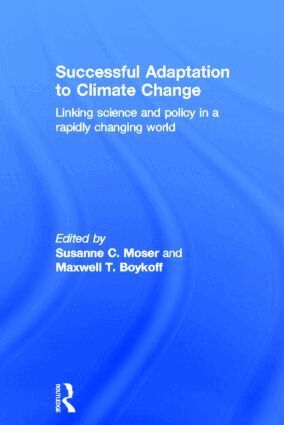
What does successful adaptation look like? This is a question we are frequently asked by planners, policy makers and other professionals charged with the task of developing and implementing adaptation strategies. While adaptation is increasingly recognized as an important climate risk management strategy, and on-the-ground adaptation planning activity is becoming more common-place, there is no clear guidance as to what success would look like, what to aim for and how to judge progress.
This edited volume makes significant progress toward unpacking the question of successful adaptation, offering both scientifically informed and practice-relevant answers from various sectors and regions of the world. It brings together 18 chapters from leading experts within the field to present careful analyses of different cases and situations, questioning throughout commonly avowed truisms and unspoken assumptions that have pervaded climate adaptation science and practice to date. This book offers not one answer but demonstrates how the question of success in important ways is normative and context specific. It identifies the various dimensions of success, such as economic, political, institutional, ecological, and social, explores the tensions between them, and compiles encouraging evidence that resolutions can be found. The book appraises how climatic and non-climatic stressors play a role, what role science does and can play in adaptation decision making, and how trade-offs and other concerns and priorities shape adaptation planning and implementation on the ground.
This is timely interdisciplinary text sheds light on key issues that arise in on-the-ground adaptation to climate change. It bridges the gap between science and practical application of successful adaptation strategies and will be of interest to both students, academics and practitioners.
860 kr
Läs direkt efter köp
What does successful adaptation look like? This is a question we are frequently asked by planners, policy makers and other professionals charged with the task of developing and implementing adaptation strategies. While adaptation is increasingly recognized as an important climate risk management strategy, and on-the-ground adaptation planning activity is becoming more common-place, there is no clear guidance as to what success would look like, what to aim for and how to judge progress.
This edited volume makes significant progress toward unpacking the question of successful adaptation, offering both scientifically informed and practice-relevant answers from various sectors and regions of the world. It brings together 18 chapters from leading experts within the field to present careful analyses of different cases and situations, questioning throughout commonly avowed truisms and unspoken assumptions that have pervaded climate adaptation science and practice to date. This book offers not one answer but demonstrates how the question of success in important ways is normative and context specific. It identifies the various dimensions of success, such as economic, political, institutional, ecological, and social, explores the tensions between them, and compiles encouraging evidence that resolutions can be found. The book appraises how climatic and non-climatic stressors play a role, what role science does and can play in adaptation decision making, and how trade-offs and other concerns and priorities shape adaptation planning and implementation on the ground.
This is timely interdisciplinary text sheds light on key issues that arise in on-the-ground adaptation to climate change. It bridges the gap between science and practical application of successful adaptation strategies and will be of interest to both students, academics and practitioners.
1 090 kr
Skickas inom 10-15 vardagar
1 367 kr
Läs direkt efter köp
This book offers valuable climate policy and climate assessment lessons, depicting what it takes to build a sustained climate assessment process. It explores the third U.S. National Climate Assessment (NCA3) report as compared with previous US national climate assessments, from both a process and content perspective. The U.S. Global Change Research Program is required by law to produce a National Climate Assessment report every four years, and these reports provide a comprehensive evaluation of climate science as well as observed and projected climate impacts on a variety of sectors.
As the book describes, a key contribution of the NCA3 approach is a far more deliberate interdisciplinary process, as well as an engagement strategy that brought hundreds of public and private sector stakeholders into the assessment community. Among its most important conceptual contributions was an explicit focus on building the infrastructure to conduct better assessments over time and an experimental approach to analysis of the impacts of climate on cross-sectoral systems and inter-locking and cascading effects across sectors.
Readers may explore innovations such as the development of regional climatologies and projections for every region of the US, as well as the development of the Global Change Information System. The book also highlights the need for decision-makers to be part of the assessment process, in order for assessment findings to be truly useful from a decision-maker''s perspective. Many lessons have been learned by the NCA3 authors that can be useful in future assessments and adaptation processes, both within the US and internationally. This book passes on such lessons and includes an evaluation of the role of state climate assessments in ongoing national assessment processes.
1 090 kr
Skickas inom 10-15 vardagar
614 kr
Skickas inom 10-15 vardagar
611 kr
Läs direkt efter köp
1 999 kr
Skickas inom 10-15 vardagar
1 999 kr
Skickas inom 10-15 vardagar
Simone de Beauvoir: 50 Jahre Nach Dem «Anderen Geschlecht»
2. Auflage
706 kr
Tillfälligt slut
Integrale Und Das Gebrochene Ganze
Zum 100. Geburtstag Von Leo Gabriel
771 kr
Tillfälligt slut