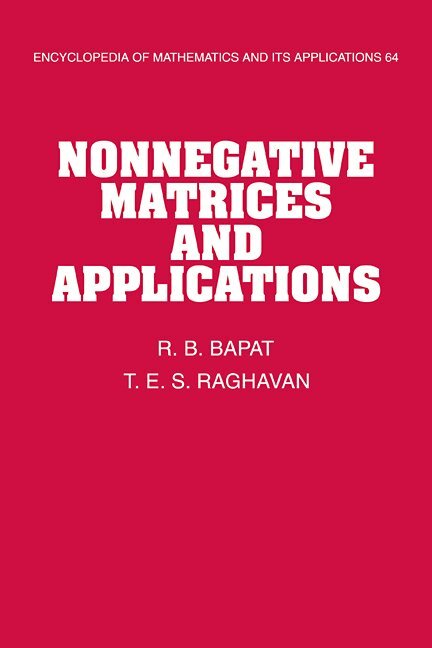
This book provides an integrated treatment of the theory of nonnegative matrices (matrices with only positive numbers or zero as entries) and some related classes of positive matrices, concentrating on connections with game theory, combinatorics, inequalities, optimisation and mathematical economics. The wide variety of applications, which include price fixing, scheduling and the fair division problem, have been carefully chosen both for their elegant mathematical content and for their accessibility to students with minimal preparation. Many results in matrix theory are also presented. The treatment is rigorous and almost all results are proved completely. These results and applications will be of great interest to researchers in linear programming, statistics and operations research. The minimal prerequisites also make the book accessible to first-year graduate students.
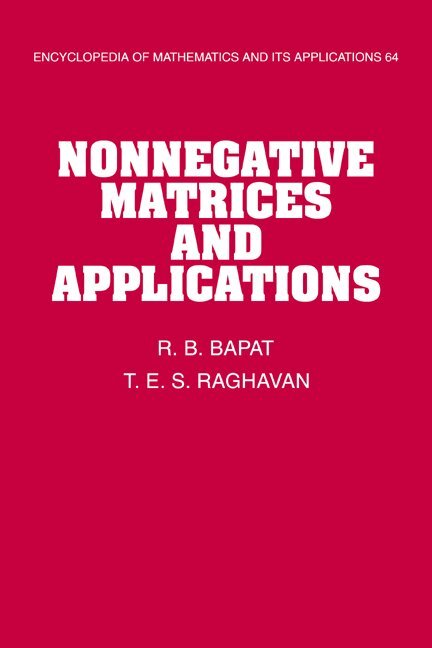
Del 64 - Encyclopedia of Mathematics and its Applications
This book provides an integrated treatment of the theory of nonnegative matrices (matrices with only positive numbers or zero as entries) and some related classes of positive matrices, concentrating on connections with game theory, combinatorics, inequalities, optimisation and mathematical economics. The wide variety of applications, which include price fixing, scheduling and the fair division problem, have been carefully chosen both for their elegant mathematical content and for their accessibility to students with minimal preparation. Many results in matrix theory are also presented. The treatment is rigorous and almost all results are proved completely. These results and applications will be of great interest to researchers in linear programming, statistics and operations research. The minimal prerequisites also make the book accessible to first-year graduate students.
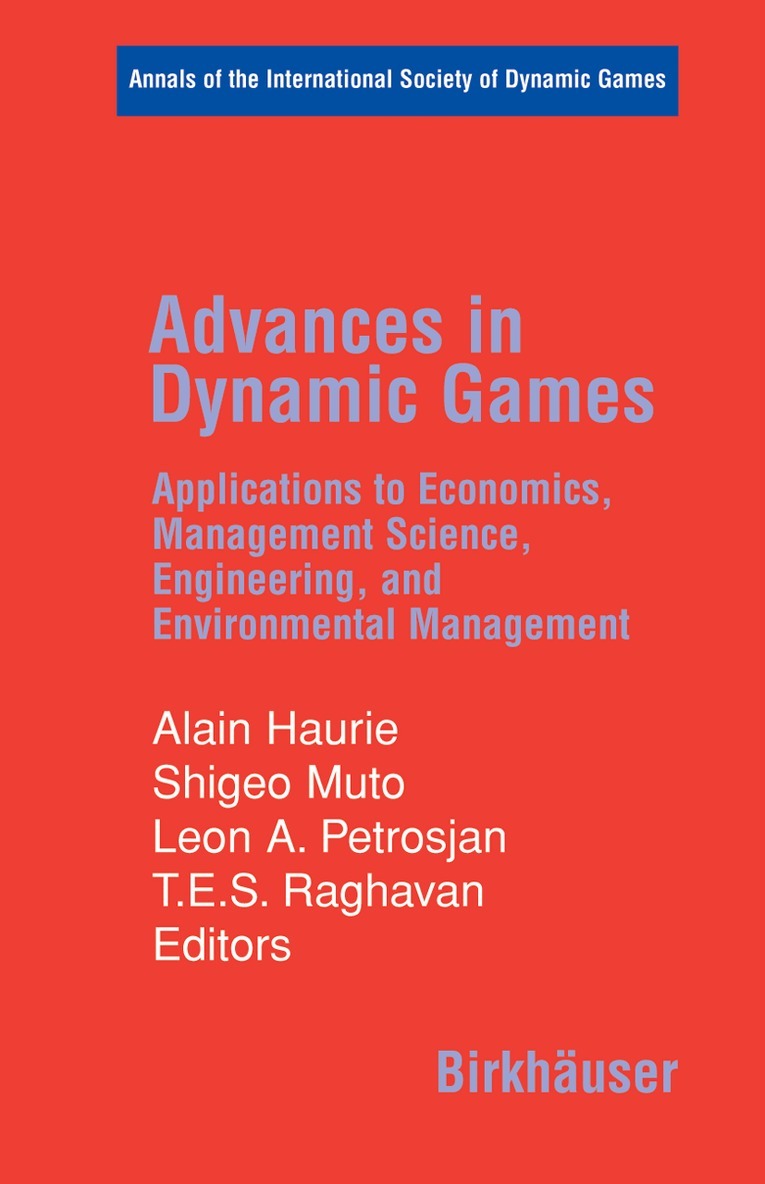
The paradigms of dynamic games play an important role in the development of multi-agent models in engineering, economics, and management science. The applicability of their concepts stems from the ability to encompass situations with uncertainty, incomplete information, fluctuating coalition structure, and coupled constraints imposed on the strategies of all the players. This book—an outgrowth of the 10th International Symposium on Dynamic Games—presents current developments of the theory of dynamic games and its applications to various domains, in particular energy-environment economics and management sciences. This work will serve as a state-of-the art account of recent advances in dynamic game theory and its applications for researchers, practitioners, and graduate students in applied mathematics, engineering, economics, as well as environmental and management sciences.
The paradigms of dynamic games play an important role in the development of multi-agent models in engineering, economics, and management science. The applicability of their concepts stems from the ability to encompass situations with uncertainty, incomplete information, fluctuating coalition structure, and coupled constraints imposed on the strategies of all the players. This book-an outgrowth of the 10th International Symposium on Dynamic Games-presents current developments of the theory of dynamic games and its applications to various domains, in particular energy-environment economics and management sciences. This work will serve as a state-of-the art account of recent advances in dynamic game theory and its applications for researchers, practitioners, and graduate students in applied mathematics, engineering, economics, as well as environmental and management sciences.