T. Q. Khan – författare
Visar alla böcker från författaren T. Q. Khan. Handla med fri frakt och snabb leverans.
5 produkter
5 produkter
Inbunden, Engelska, 2014
1 658 kr
Skickas inom 11-20 vardagar
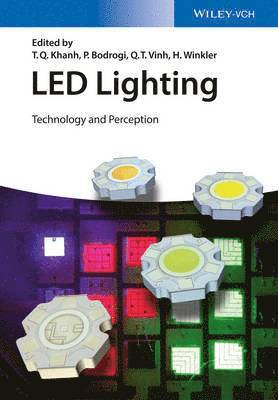
Promoting the design, application and evaluation of visually and electrically effective LED light sources and luminaires for general indoor lighting as well as outdoor and vehicle lighting, this book combines the knowledge of LED lighting technology with human perceptual aspects for lighting scientists and engineers. After an introduction to the human visual system and current radiometry, photometry and color science, the basics of LED chip and phosphor technology are described followed by specific issues of LED radiometry and the optical, thermal and electric modeling of LEDs. This is supplemented by the relevant practical issues of pulsed LEDs, remote phosphor LEDs and the aging of LED light sources. Relevant human visual aspects closely related to LED technology are described in detail for the photopic and the mesopic range of vision, including color rendering, binning, whiteness, Circadian issues, as well as flicker perception, brightness, visual performance, conspicuity and disability glare. The topic of LED luminaires is discussed in a separate chapter, including retrofit LED lamps, LED-based road and street luminaires and LED luminaires for museum and school lighting. Specific sections are devoted to the modularity of LED luminaires, their aging and the planning and evaluation methods of new LED installations. The whole is rounded off by a summary and a look towards future developments.
1 756 kr
Läs direkt efter köp
This much needed, comprehensive and modern reference on display technology, illumination sources and color imaging focuses on visual effects and how reproduced images are best matched to human visual features. As such, it teaches readers how to exploit the knowledge of human color information processing to design usable, ergonomic, and pleasing displays or visual environments. The contents describe design principles and methods to optimize self-luminous visual technologies for the human user, including modern still and motion image displays, and indoor light sources. Design principles and methods are derived from the knowledge of the human visual system, with a special emphasis on color vision, color cognition, color harmony, color preference and visually evoked emotions. The expert authors include the most important and latest applications of the design principles and methods, forming a comprehensive view of human color information processing from the receptors through the retina via high-level visual perception right up to the level of cognition, preference, harmony, as well as visually evoked emotions. This book is included in the Wiley SID Series.
E-bok
PDF, Engelska, 20121 772 kr
Läs direkt efter köp
This much needed, comprehensive and modern reference on display technology, illumination sources and color imaging focuses on visual effects and how reproduced images are best matched to human visual features. As such, it teaches readers how to exploit the knowledge of human color information processing to design usable, ergonomic, and pleasing displays or visual environments. The contents describe design principles and methods to optimize self-luminous visual technologies for the human user, including modern still and motion image displays, and indoor light sources. Design principles and methods are derived from the knowledge of the human visual system, with a special emphasis on color vision, color cognition, color harmony, color preference and visually evoked emotions. The expert authors include the most important and latest applications of the design principles and methods, forming a comprehensive view of human color information processing from the receptors through the retina via high-level visual perception right up to the level of cognition, preference, harmony, as well as visually evoked emotions. This book is included in the Wiley SID Series.
E-bok
Engelska, 20142 153 kr
Läs direkt efter köp
Promoting the design, application and evaluation of visually and electrically effective LED light sources and luminaires for general indoor lighting as well as outdoor and vehicle lighting, this book combines the knowledge of LED lighting technology with human perceptual aspects for lighting scientists and engineers. After an introduction to the human visual system and current radiometry, photometry and color science, the basics of LED chip and phosphor technology are described followed by specific issues of LED radiometry and the optical, thermal and electric modeling of LEDs. This is supplemented by the relevant practical issues of pulsed LEDs, remote phosphor LEDs and the aging of LED light sources. Relevant human visual aspects closely related to LED technology are described in detail for the photopic and the mesopic range of vision, including color rendering, binning, whiteness, Circadian issues, as well as flicker perception, brightness, visual performance, conspicuity and disability glare. The topic of LED luminaires is discussed in a separate chapter, including retrofit LED lamps, LED-based road and street luminaires and LED luminaires for museum and school lighting. Specific sections are devoted to the modularity of LED luminaires, their aging and the planning and evaluation methods of new LED installations. The whole is rounded off by a summary and a look towards future developments.
E-bok
PDF, Engelska, 20142 153 kr
Läs direkt efter köp
Promoting the design, application and evaluation of visually and electrically effective LED light sources and luminaires for general indoor lighting as well as outdoor and vehicle lighting, this book combines the knowledge of LED lighting technology with human perceptual aspects for lighting scientists and engineers. After an introduction to the human visual system and current radiometry, photometry and color science, the basics of LED chip and phosphor technology are described followed by specific issues of LED radiometry and the optical, thermal and electric modeling of LEDs. This is supplemented by the relevant practical issues of pulsed LEDs, remote phosphor LEDs and the aging of LED light sources. Relevant human visual aspects closely related to LED technology are described in detail for the photopic and the mesopic range of vision, including color rendering, binning, whiteness, Circadian issues, as well as flicker perception, brightness, visual performance, conspicuity and disability glare. The topic of LED luminaires is discussed in a separate chapter, including retrofit LED lamps, LED-based road and street luminaires and LED luminaires for museum and school lighting. Specific sections are devoted to the modularity of LED luminaires, their aging and the planning and evaluation methods of new LED installations. The whole is rounded off by a summary and a look towards future developments.