Tarak Nath Sahu – författare
727 kr
Läs direkt efter köp
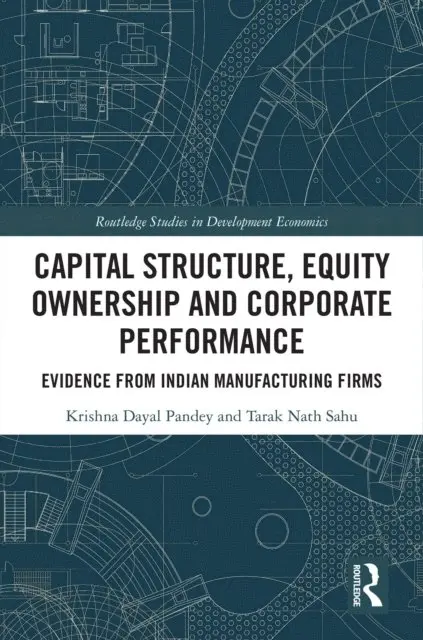
This book provides empirical insights into the relationship between capital and equity-ownership structure of Indian manufacturing companies and their financial performance. It discusses and analyses the basic theories and concepts associated with capital structure, debt financing, levered and unlevered firms, the various forms of ownership, agency problem and its kind and the exploitation of minority owners by the large and largest owners.
The study employs a set of the most reliable and suitable econometric estimation techniques to draw meaningful inferences on the Indian manufacturing sector. The novelty of this book lies in three particular aspects: the depth and dimension with which the topic is addressed; the robust empirical evidence that it has produced and the simple and intelligible approach with which it is authored. It communicates the crucial relevance of corporate capital structure and equity-ownership to the moderation of agency relationship and shaping the internal governance mechanism, which ultimately results in increased or decreased operational efficiency and financial performance. It will enable readers to understand whether an increased amount of debt capital would bring about positive results for firms or create an extra burden on the management of their finances, preventing them from taking productive investment decisions due to the threat of liquidation.
The book will find an audience among advanced students, scholars and researchers who are interested in understanding the corporate finance practices and governance mechanism of Indian organizations.
727 kr
Läs direkt efter köp
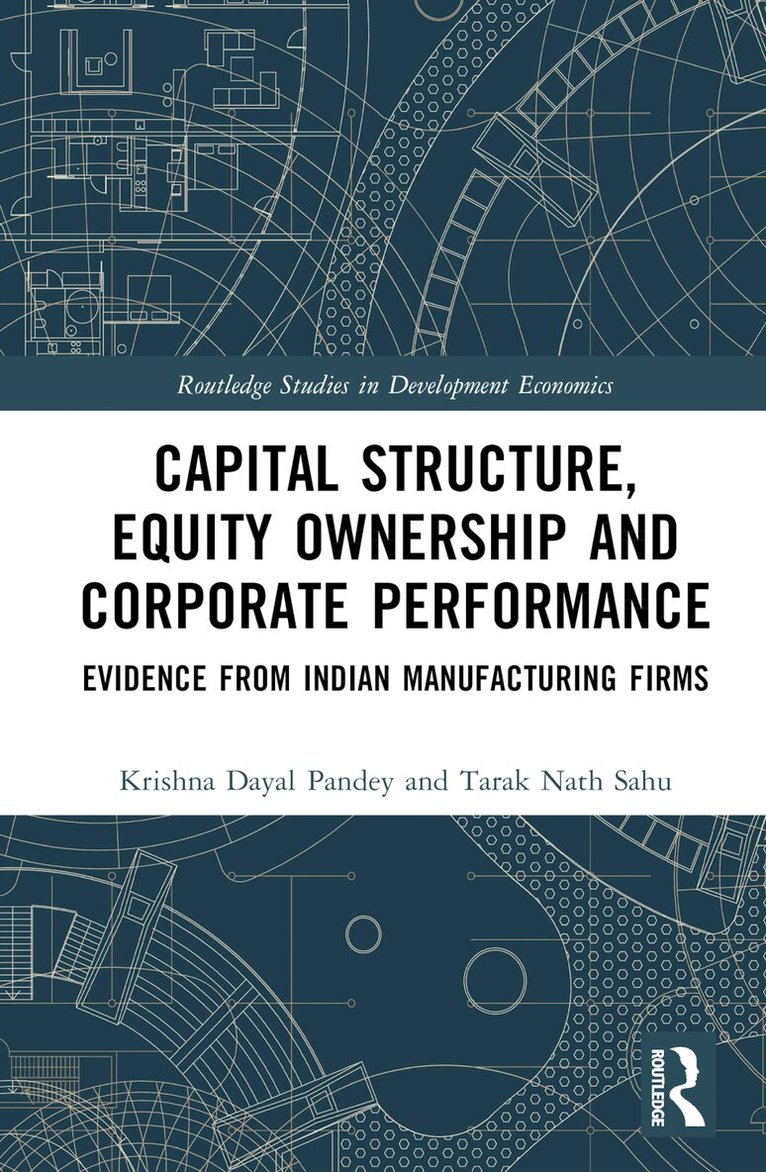
This book provides empirical insights into the relationship between capital and equity-ownership structure of Indian manufacturing companies and their financial performance. It discusses and analyses the basic theories and concepts associated with capital structure, debt financing, levered and unlevered firms, the various forms of ownership, agency problem and its kind and the exploitation of minority owners by the large and largest owners.
The study employs a set of the most reliable and suitable econometric estimation techniques to draw meaningful inferences on the Indian manufacturing sector. The novelty of this book lies in three particular aspects: the depth and dimension with which the topic is addressed; the robust empirical evidence that it has produced and the simple and intelligible approach with which it is authored. It communicates the crucial relevance of corporate capital structure and equity-ownership to the moderation of agency relationship and shaping the internal governance mechanism, which ultimately results in increased or decreased operational efficiency and financial performance. It will enable readers to understand whether an increased amount of debt capital would bring about positive results for firms or create an extra burden on the management of their finances, preventing them from taking productive investment decisions due to the threat of liquidation.
The book will find an audience among advanced students, scholars and researchers who are interested in understanding the corporate finance practices and governance mechanism of Indian organizations.
2 508 kr
Skickas inom 10-15 vardagar
618 kr
Skickas inom 10-15 vardagar
776 kr
Läs direkt efter köp
797 kr
Läs direkt efter köp
2 435 kr
Skickas inom 10-15 vardagar
1 116 kr
Skickas inom 10-15 vardagar
1 100 kr
Läs direkt efter köp
1 023 kr
Skickas inom 5-8 vardagar
1 062 kr
Läs direkt efter köp
1 039 kr
Läs direkt efter köp
966 kr
Skickas inom 5-8 vardagar
1 039 kr
Läs direkt efter köp
183 kr
Skickas inom 5-8 vardagar
262 kr
Skickas inom 5-8 vardagar
1 338 kr
Skickas inom 10-15 vardagar
1 785 kr
Läs direkt efter köp
1 005 kr
Skickas inom 10-15 vardagar
1 296 kr
Läs direkt efter köp
1 116 kr
Skickas inom 10-15 vardagar
1 415 kr
Läs direkt efter köp
This book explores the role and effect of Microfinance Institutions (MFIs) with different dimensions. It is being supported with strong empirical evidence into various parameters of MFIs directed towards inclusive finance and the transformation journey of livelihoods of its beneficiaries.
It also incorporates empirical evidence with the perception of both beneficiaries and non-beneficiaries. Starting its journey toward the path of comprehending how MFIs make their footprint among the excluded population in the selected areas, it incorporates the different outcomes of MFI lending like credit utilisation patterns, income generation, and employability. As financial stability helps to break out the vicious cycle of poverty, this book emphasises the self-dependent element for the beneficiaries and their households.
It addresses the important issue of the female counterparts in society. It shows how the MFIs work actively to generate female empowerment from multiple dimensions among the selected communities. It addresses key issues to consider for inclusive policy formulation, especially for backward communities in the backward areas and gives a realistic scenario of the MFI activities, their interactions with the respondents, the various outcomes, and areas for further developments, etc. This book is beneficial for academicians, researchers, and policymakers.
667 kr
Skickas inom 5-8 vardagar
1 116 kr
Skickas inom 10-15 vardagar