Tatiana Iakovleva - Böcker
Visar alla böcker från författaren Tatiana Iakovleva. Handla med fri frakt och snabb leverans.
4 produkter
4 produkter
2 088 kr
Skickas inom 10-15 vardagar
The study of universities’ role in regional engagement has traditionally been focusing on exceptional cases. This book presents a reconceptualization which embraces its underlying complexity and proposes a roadmap for a renewed research agenda. Starting from the grassroots level of universities’ "everyday" engagements, the book delves into the manifold ways in which university knowledge agents build connections with regional partners.Through 11 empirical chapters, the authors not only chart the diversity among case institutions, engagement mechanisms, and regional contexts but also use that diversity to advance a novel conceptual framework, centered on the process of mundaneness, for unpacking university-regions’ everyday activities, taking into account the dynamic, complex, and co-evolving interplay between (a) key social agents and institutions, (b) the contexts in which they are embedded, as well as (c) the historical trajectories and strategic ambitions underpinning context-specific social arrangements and interactions that are mediated by temporal and spatial dimensions.Drawing on evolutionary economic geography, innovation studies, management and organization studies, and historical perspectives, the volume advances a new mode of understanding university-regional engagement as a form of extendable temporary coupling, which also helps to address perennial policy and managerial questions alike of what to do with universities that do not serve local labour market needs and/or are located in regions suffering from brain drain. The book illustrates such dynamics from diverse national contexts and three continents: Brazil, Caribbean, China, Italy, Norway, and Poland.This book will be valuable reading for advanced students, researchers, and policymakers working in economic geography, regional development, innovation, and higher education management.The Open Access version of this book, available at www.taylorfrancis.com, has been made available under a Creative Commons Attribution-Non Commercial-No Derivatives 4.0 license.
617 kr
Skickas inom 10-15 vardagar
The study of universities’ role in regional engagement has traditionally been focusing on exceptional cases. This book presents a reconceptualization which embraces its underlying complexity and proposes a roadmap for a renewed research agenda. Starting from the grassroots level of universities’ "everyday" engagements, the book delves into the manifold ways in which university knowledge agents build connections with regional partners.Through 11 empirical chapters, the authors not only chart the diversity among case institutions, engagement mechanisms, and regional contexts but also use that diversity to advance a novel conceptual framework, centered on the process of mundaneness, for unpacking university-regions’ everyday activities, taking into account the dynamic, complex, and co-evolving interplay between (a) key social agents and institutions, (b) the contexts in which they are embedded, as well as (c) the historical trajectories and strategic ambitions underpinning context-specific social arrangements and interactions that are mediated by temporal and spatial dimensions.Drawing on evolutionary economic geography, innovation studies, management and organization studies, and historical perspectives, the volume advances a new mode of understanding university-regional engagement as a form of extendable temporary coupling, which also helps to address perennial policy and managerial questions alike of what to do with universities that do not serve local labour market needs and/or are located in regions suffering from brain drain. The book illustrates such dynamics from diverse national contexts and three continents: Brazil, Caribbean, China, Italy, Norway, and Poland.This book will be valuable reading for advanced students, researchers, and policymakers working in economic geography, regional development, innovation, and higher education management.The Open Access version of this book, available at www.taylorfrancis.com, has been made available under a Creative Commons Attribution-Non Commercial-No Derivatives 4.0 license.
1 922 kr
Skickas inom 7-10 vardagar
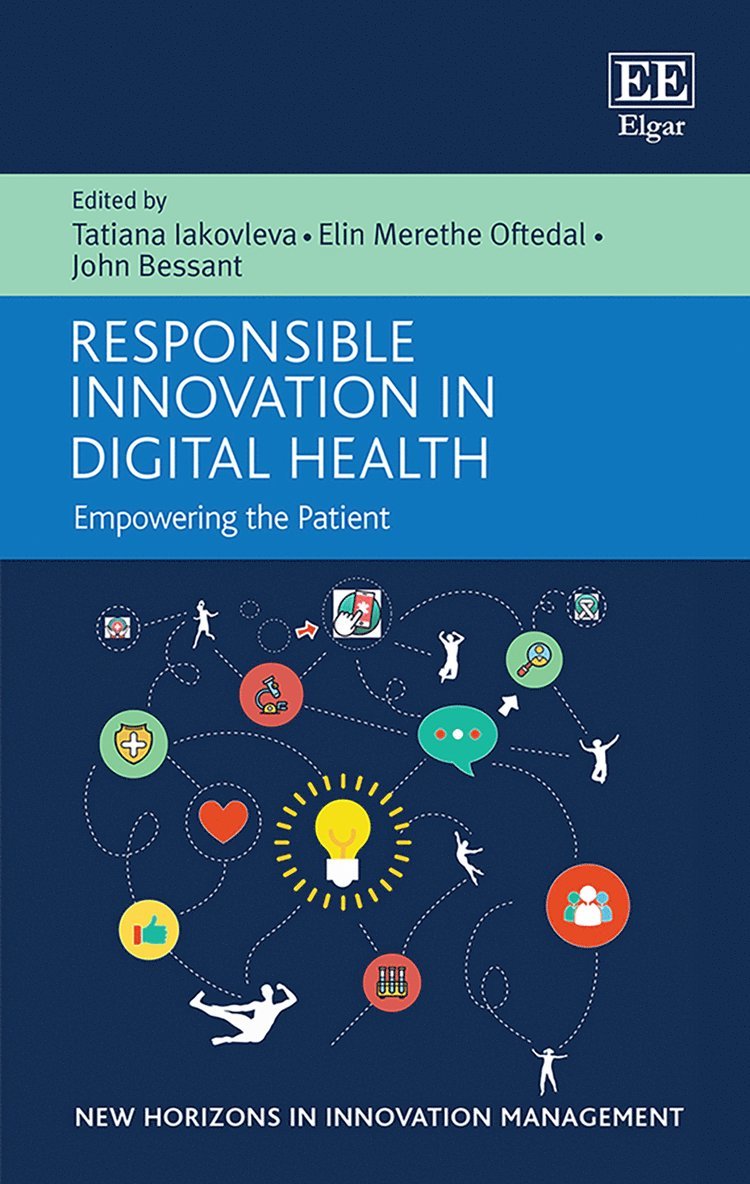
Powerful new approaches and advances in medical systems drive increasingly high expectations for healthcare providers internationally. The form of digital healthcare - a suite of new technologies offering significant benefits in cost and quality - allow institutions to keep pace with society's needs. This book covers the need for responsible innovation in this area, exploring the issues of implementation as well as potential negative consequences to ensure digital healthcare delivers for the benefit of all stakeholders.This book offers a considered view on what a responsible innovation process might involve and how this will enable multiple stakeholders - users, medics, businesses and policymakers - to create a system of delivering better care at lower costs. Illustrated by international case studies, the contributing authors explore the dimensions of responsible innovation with patient engagement and the ways in which this can lead to better design, enhanced diffusion of knowledge and improvement in healthcare.A much-needed exploration of the role of innovation in healthcare with patients in mind, this book will be essential for academics in innovation, ethics, social entrepreneurship and healthcare studies.
1 656 kr
Skickas inom 3-6 vardagar
User inclusion in innovation is increasingly the target of policy rhetoric at both organizational and societal levels. And extensive research has demonstrated the potential contribution that users can make, both at the ‘front end’ of innovation with their ideas and insights and downstream, facilitating adoption and diffusion. However, translating this potential into practice remains problematic, not least because we need to understand more about how to hear user voices, amplify their insights, and provide practical channels for inclusion to ensure full co-creation of innovation. Our earlier book from 2019 (‘Responsible Innovation in Digital Health’, Edward Elgar) added to the growing body of knowledge around whether users can be involved, and this book opens up the ‘how?’ theme. Our work suggested a spectrum of user involvement ranging from those who can participate fully to those who are passive players in the innovation process, and we explore in this book different tools, techniques, and mechanisms for enabling such users to become more involved in the innovation process. We look at the concept of ‘boundary innovation spaces’ as environments in which co-creation can be enabled, drawing on experience across a wide international research network. We also explore the broader innovation environment – the specific networks of actors and their interactions which define the innovation ecosystem where user inclusion may be embedded. This book moves the discussion beyond the question of whether users can be more effectively included throughout the innovation process to explore the ways in which this might be enabled.