T.F Glick – författare
Visar alla böcker från författaren T.F Glick. Handla med fri frakt och snabb leverans.
6 produkter
6 produkter
Inbunden, Engelska, 2001
1 084 kr
Skickas inom 10-15 vardagar
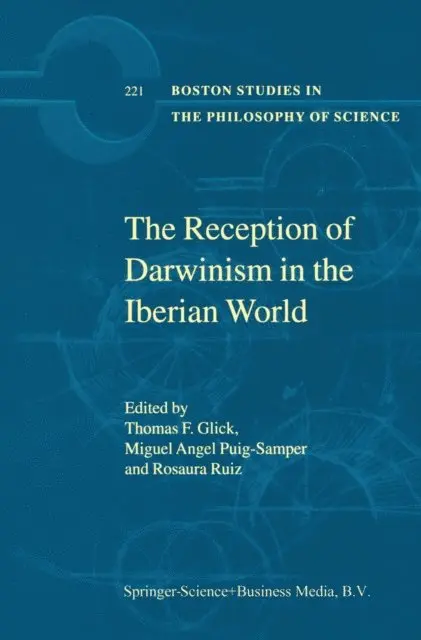
I Twenty-five years ago, at the Conference on the Comparative Reception of Darwinism held at the University of Texas in 1972, only two countries of the Iberian world-Spain and Mexico-were represented.' At the time, it was apparent that the topic had attracted interest only as regarded the "mainstream" science countries of Western Europe, plus the United States. The Eurocentric bias of professional history of science was a fact. The sea change that subsequently occurred in the historiography of science makes 1972 appear something like the antediluvian era. Still, we would like to think that that meeting was prescient in looking beyond the mainstream science countries-as then perceived-in order to test the variation that ideas undergo as they pass from center to periphery. One thing that the comparative study of the reception of ideas makes abundantly clear, however, is the weakness of the center/periphery dichotomy from the perspective of the diffusion of scientific ideas. Catholics in mainstream countries, for example, did not handle evolution much better than did their corre1igionaries on the fringes. Conversely, Darwinians in Latin America were frequently better placed to advance Darwin's ideas in a social and political sense than were their fellow evolutionists on the Continent. The Texas meeting was also a marker in the comparative reception of scientific ideas, Darwinism aside. Although, by 1972, scientific institutions had been studied comparatively, there was no antecedent for the comparative history of scientific ideas.
Inbunden, Engelska, 1987
2 161 kr
Skickas inom 10-15 vardagar
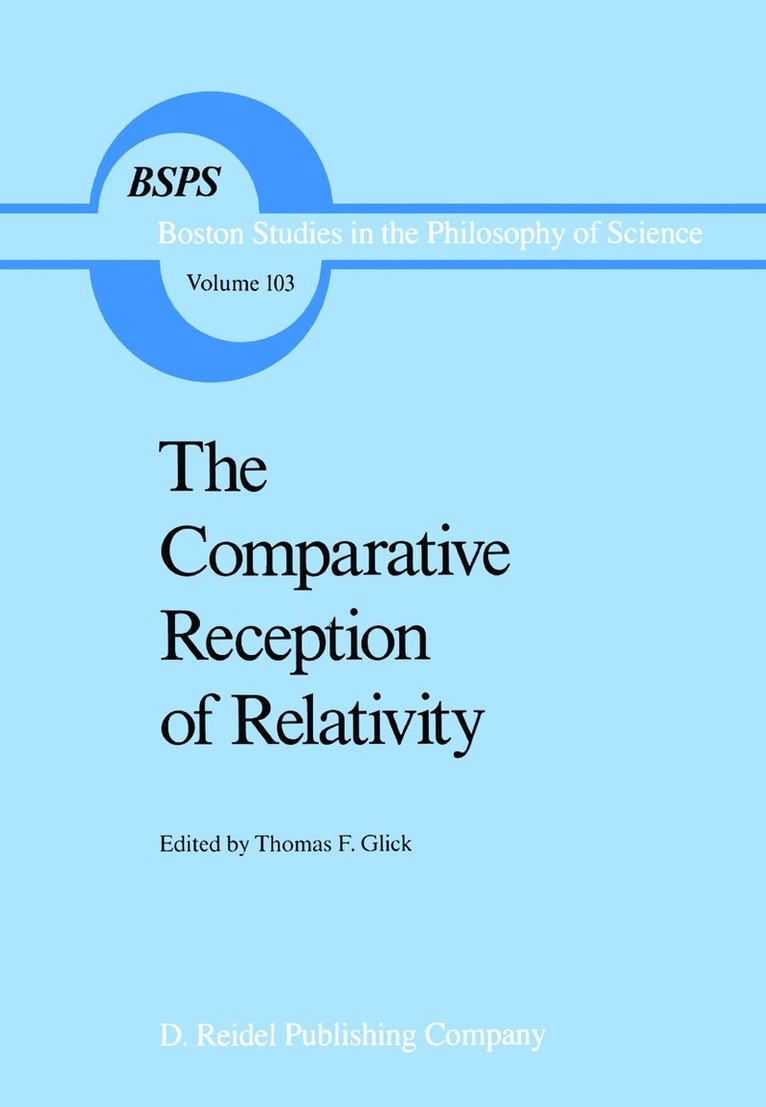
The present volume grew out of a double session of the Boston Collo quium for the Philosophy of Science held in Boston on March 25, 1983. The papers presented there (by Biezunski, Glick, Goldberg, and Judith Goodstein!) offered both sufficient comparability to establish regulari ties in the reception of relativity and Einstein's impact in France, Spain, the United States and Italy, and sufficient contrast to suggest the salience of national inflections in the process. The interaction among the participants and the added perspectives offered by members of the audience suggested the interest of commissioning articles for a more inclusive volume which would cover as many national cases as we could muster. Only general guidelines were given to the authors: to treat the special or general theories, or both, hopefully in a multidisciplinary setting, to examine the popular reception of relativity, or Einstein's personal impact, or to survey all these topics. In a previous volume, on the 2 comparative reception of Darwinism, one of us devised a detailed set of guidelines which in general were not followed. In our opinion, the studies in this collection offer greater comparability, no doubt because relativity by its nature and its complexity offers a sharper, more easily bounded target. As in the Darwinism volume, this book concludes with an essay intended to draw together in comparative perspective some of many themes addressed by the participants.
E-bok
PDF, Engelska, 20122 925 kr
Läs direkt efter köp
The present volume grew out of a double session of the Boston Collo quium for the Philosophy of Science held in Boston on March 25, 1983. The papers presented there (by Biezunski, Glick, Goldberg, and Judith Goodstein!) offered both sufficient comparability to establish regulari ties in the reception of relativity and Einstein''s impact in France, Spain, the United States and Italy, and sufficient contrast to suggest the salience of national inflections in the process. The interaction among the participants and the added perspectives offered by members of the audience suggested the interest of commissioning articles for a more inclusive volume which would cover as many national cases as we could muster. Only general guidelines were given to the authors: to treat the special or general theories, or both, hopefully in a multidisciplinary setting, to examine the popular reception of relativity, or Einstein''s personal impact, or to survey all these topics. In a previous volume, on the 2 comparative reception of Darwinism, one of us devised a detailed set of guidelines which in general were not followed. In our opinion, the studies in this collection offer greater comparability, no doubt because relativity by its nature and its complexity offers a sharper, more easily bounded target. As in the Darwinism volume, this book concludes with an essay intended to draw together in comparative perspective some of many themes addressed by the participants.
E-bok
PDF, Engelska, 20121 459 kr
Läs direkt efter köp
I Twenty-five years ago, at the Conference on the Comparative Reception of Darwinism held at the University of Texas in 1972, only two countries of the Iberian world-Spain and Mexico-were represented.'' At the time, it was apparent that the topic had attracted interest only as regarded the "mainstream" science countries of Western Europe, plus the United States. The Eurocentric bias of professional history of science was a fact. The sea change that subsequently occurred in the historiography of science makes 1972 appear something like the antediluvian era. Still, we would like to think that that meeting was prescient in looking beyond the mainstream science countries-as then perceived-in order to test the variation that ideas undergo as they pass from center to periphery. One thing that the comparative study of the reception of ideas makes abundantly clear, however, is the weakness of the center/periphery dichotomy from the perspective of the diffusion of scientific ideas. Catholics in mainstream countries, for example, did not handle evolution much better than did their corre1igionaries on the fringes. Conversely, Darwinians in Latin America were frequently better placed to advance Darwin''s ideas in a social and political sense than were their fellow evolutionists on the Continent. The Texas meeting was also a marker in the comparative reception of scientific ideas, Darwinism aside. Although, by 1972, scientific institutions had been studied comparatively, there was no antecedent for the comparative history of scientific ideas.
Del 221 - Boston Studies in the Philosophy and History of Science
Reception of Darwinism in the Iberian World
Spain, Spanish America and Brazil
Häftad, Engelska, 2012
1 084 kr
Skickas inom 10-15 vardagar
I Twenty-five years ago, at the Conference on the Comparative Reception of Darwinism held at the University of Texas in 1972, only two countries of the Iberian world-Spain and Mexico-were represented.' At the time, it was apparent that the topic had attracted interest only as regarded the "mainstream" science countries of Western Europe, plus the United States. The Eurocentric bias of professional history of science was a fact. The sea change that subsequently occurred in the historiography of science makes 1972 appear something like the antediluvian era. Still, we would like to think that that meeting was prescient in looking beyond the mainstream science countries-as then perceived-in order to test the variation that ideas undergo as they pass from center to periphery. One thing that the comparative study of the reception of ideas makes abundantly clear, however, is the weakness of the center/periphery dichotomy from the perspective of the diffusion of scientific ideas. Catholics in mainstream countries, for example, did not handle evolution much better than did their corre1igionaries on the fringes. Conversely, Darwinians in Latin America were frequently better placed to advance Darwin's ideas in a social and political sense than were their fellow evolutionists on the Continent. The Texas meeting was also a marker in the comparative reception of scientific ideas, Darwinism aside. Although, by 1972, scientific institutions had been studied comparatively, there was no antecedent for the comparative history of scientific ideas.
Del 103 - Boston Studies in the Philosophy and History of Science
Comparative Reception of Relativity
Häftad, Engelska, 2011
2 226 kr
Skickas inom 10-15 vardagar
The present volume grew out of a double session of the Boston Collo quium for the Philosophy of Science held in Boston on March 25, 1983. The papers presented there (by Biezunski, Glick, Goldberg, and Judith Goodstein!) offered both sufficient comparability to establish regulari ties in the reception of relativity and Einstein's impact in France, Spain, the United States and Italy, and sufficient contrast to suggest the salience of national inflections in the process. The interaction among the participants and the added perspectives offered by members of the audience suggested the interest of commissioning articles for a more inclusive volume which would cover as many national cases as we could muster. Only general guidelines were given to the authors: to treat the special or general theories, or both, hopefully in a multidisciplinary setting, to examine the popular reception of relativity, or Einstein's personal impact, or to survey all these topics. In a previous volume, on the 2 comparative reception of Darwinism, one of us devised a detailed set of guidelines which in general were not followed. In our opinion, the studies in this collection offer greater comparability, no doubt because relativity by its nature and its complexity offers a sharper, more easily bounded target. As in the Darwinism volume, this book concludes with an essay intended to draw together in comparative perspective some of many themes addressed by the participants.