T.H. Fleming - Böcker
Visar alla böcker från författaren T.H. Fleming. Handla med fri frakt och snabb leverans.
4 produkter
4 produkter
3 149 kr
Skickas inom 10-15 vardagar
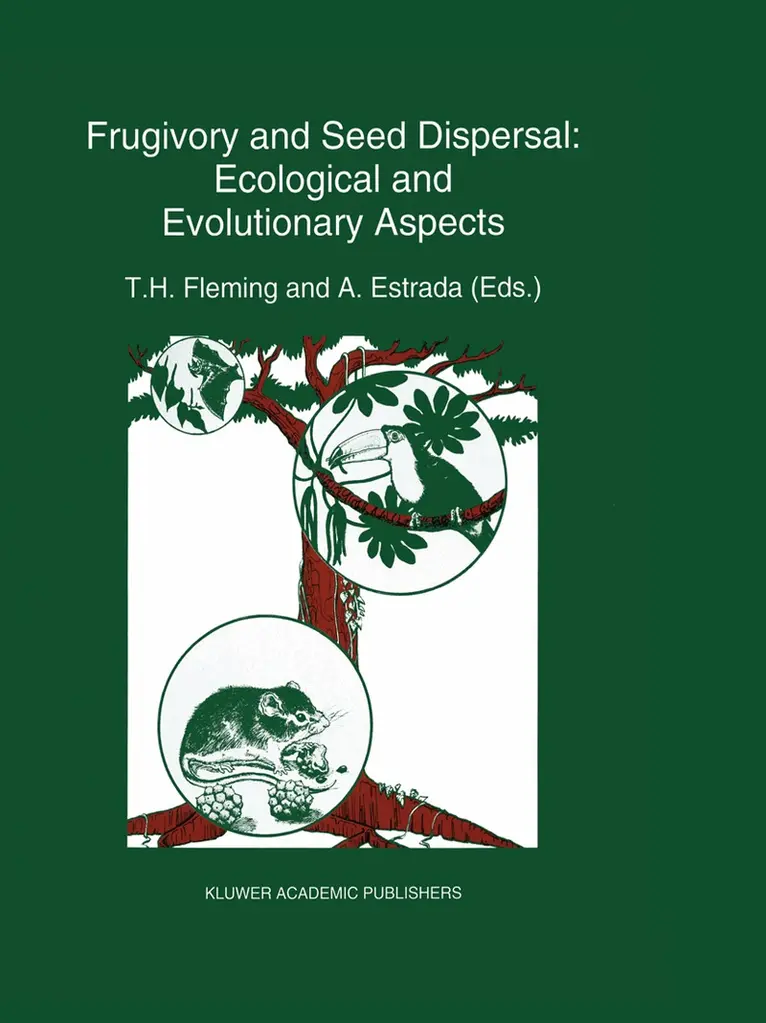
This book is the second major volume dealing with the fruit/seed/frugivore mutualism, which is an ecological interaction of profound importance in many habitats around the world. This mutualism is particularly well-developed in the tropics, where a majority of trees and shrubs depend on animals for their seed dispersal. Detailed studies of this interaction have only recently begun, and the field is in its infancy. Yet these studies are extremely important for an understanding of how complex ecosystems evolve, how they function, and how they must be managed to preserve their structure and function. Chapters in this book are written by many of the major researchers in the field and deal with the frugivory mutualism from both theoretical and applied perspectives. The book is rich in details about fruits and frugivores stemming from a variety of observational and experimental approaches. It also contains examples of new empirical and theoretical approaches to studying the fruit-frugivore mutualism. Finally, it contains important new perspectives on the conservation implications of this mutualism.Because of its breadth and depth, this book is a valuable source of information for advanced as well as beginning students in ecology, evolution and conservation.
3 149 kr
Skickas inom 10-15 vardagar
A wide variety of plants, ranging in size from forest floor herbs to giant canopy trees, rely on animals to disperse their seeds. Typical values of the proportion of tropical vascular plants that produce fleshy fruits and have animal-dispersed seeds range from 50-90%, depending on habitat. In this section, the authors discuss this mutualism from the plant's perspective. Herrera begins by challenging the notion that plant traits traditionally interpreted as being the product of fruit-frugivore coevolution really are the outcome of a response-counter-response kind of evolutionary process. He uses examples of congeneric plants living in very different biotic and abiotic environments and whose fossilizable characteristics have not changed over long periods of time to argue that there exists little or no basis for assuming that gradualistic change and environmental tracking characterizes the interactions between plants and their vertebrate seed dispersers. A common theme that runs through the papers by Herrera, Denslow et at. , and Stiles and White is the importance of the 'fruiting environment' (i. e. the spatial relationships of conspecific and non-conspecific fruiting plants) on rates of fruit removal and patterns of seed rain. Herrera and Denslow et at. point out that this environment is largely outside the control of individual plant species and, as a result, closely coevolved interactions between vertebrates and plants are unlikely to evolve.
3 149 kr
Skickas inom 10-15 vardagar
Any scientific discipline needs a theoretical framework to guide its development and to sharpen the questions its researchers pursue. In biology, evolution is the grand theoretical framework, and an his torical perspective is necessary to understand present-day biological conditions. In its formative years, the modern study of the fruit-frugivore mutualism was guided by the 'specialist-generalist' paradigm developed by D. Snow, D. McKey, and H. Howe. Howe reviews the current status of this evolution ary paradigm and points out that it has been dismissed by many workers before being adequately tested. This is because ecologists working with the tropical plants and frugivorous birds for which the paradigm was originally developed rarely measure the seed dispersal effectiveness of different disperser species. He indicates that this paradigm still has heuristic value and suggests that several additional ecological paradigms, including the concept ofkeystone species ofplants and frugivores and the role that frugivores play in density-dependent mortality in tropical trees, are worth studying. The concept of seed dispersal quality has been central to discussions of fruit-frugivore coevolution. Schupp thoroughly reviews data bearing on this concept, constructs a hierarchical framework for viewing disperser effectiveness, and points out that disperser effectiveness depends on both the quantity and quality of seed dispersal. Effectiveness, in turn, affects both evolutionary and ecological relationships between dispersers and their food plants.
3 149 kr
Skickas inom 10-15 vardagar
A wide variety of plants, ranging in size from forest floor herbs to giant canopy trees, rely on animals to disperse their seeds. Typical values of the proportion of tropical vascular plants that produce fleshy fruits and have animal-dispersed seeds range from 50-90%, depending on habitat. In this section, the authors discuss this mutualism from the plant's perspective. Herrera begins by challenging the notion that plant traits traditionally interpreted as being the product of fruit-frugivore coevolution really are the outcome of a response-counter-response kind of evolutionary process. He uses examples of congeneric plants living in very different biotic and abiotic environments and whose fossilizable characteristics have not changed over long periods of time to argue that there exists little or no basis for assuming that gradualistic change and environmental tracking characterizes the interactions between plants and their vertebrate seed dispersers. A common theme that runs through the papers by Herrera, Denslow et at. , and Stiles and White is the importance of the 'fruiting environment' (i. e. the spatial relationships of conspecific and non-conspecific fruiting plants) on rates of fruit removal and patterns of seed rain. Herrera and Denslow et at. point out that this environment is largely outside the control of individual plant species and, as a result, closely coevolved interactions between vertebrates and plants are unlikely to evolve.