• Fri frakt över 249 kr
  • •
  • Snabba leveranser
  • •
  • Billiga böcker
Kundservice

Du är på sajten för privatpersoner.

Företag, bibliotek eller offentlig verksamhet?

Du handlar på classic.bokus.com, där alla dina funktioner finns intakta.
Till classic.bokus.com
Bokus logotyp. Gå till startsidan.
  • Erbjudanden
  • Nyheter
  • Student
  • Topplistor
  • Barn & ungdom
  • Bokus Play
  • E-böcker
  • Pocketböcker
  • Spel & pussel

10% rabatt på allt med kod: NYSTART10 →

Sidfot

Mina sidor

    Hjälp

    • Kundservice
    • Vanliga frågor och svar
    • Frakt och leverans
    • Retur vid ångerrätt
    • Reklamera vara
    • Betalning
    • Köpvillkor
    • Allmänna villkor
    • Information om webbplatsens tillgänglighet

    Om Bokus

    • Om oss
    • Pressrum
    • För studenter
    • För företag
    • För bibliotek och offentlig verksamhet
    • För leverantörer
    • Hållbarhet

    Populärt

    • Aktuella erbjudanden
    • Presentkort
    • Studentlitteratur
    • Nya böcker
    • Topplistor
    • Signerade böcker
    • Engelska böcker

    Inspiration

    • Boktips
    • BookTok
    • Populära bokserier
    • Barnbokskaraktärer
    • Populära författare
    Logotyp för Bokus
    Följ oss på Facebook (extern länk)Följ oss på Instagram (extern länk)Följ oss på YouTube (extern länk)Följ oss på TikTok (extern länk)
    bokus @ CookiesAnpassa cookiesIntegritetspolicyKöpvillkor
    Till Citymail hemsida (extern länk)Till Budbee hemsida (extern länk)Till Postnord hemsida (extern länk)Till Schenker hemsida (extern länk)Till Early Bird hemsida (extern länk)Till Walleys hemsida (extern länk)
    1. Djur och Natur
    2. Naturböcker
    3. Växtböcker

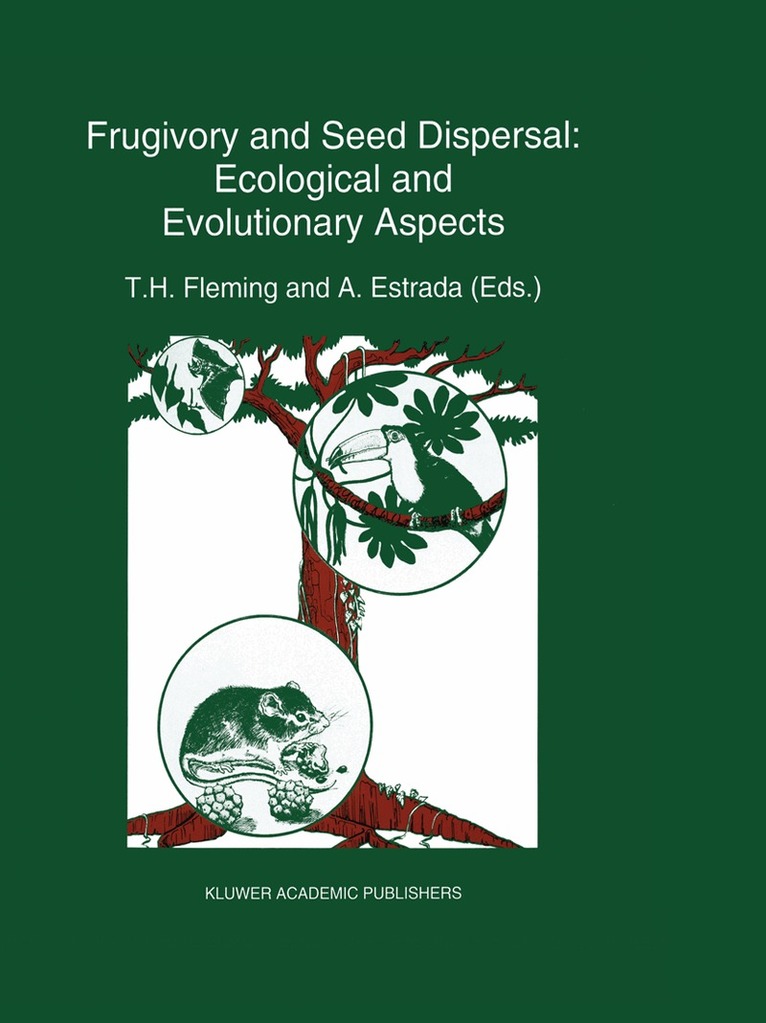
    Frugivory and seed dispersal: ecological and evolutionary aspects

    AvT.H. Fleming,Alejandro Estrada

    Häftad, Engelska, 2012

    Del i serien Advances in Vegetation Science

    3 244 kr

    Beställningsvara. Skickas inom 10-15 vardagar. Fri frakt över 249 kr.

    Beskrivning

    Any scientific discipline needs a theoretical framework to guide its development and to sharpen the questions its researchers pursue. In biology, evolution is the grand theoretical framework, and an his­ torical perspective is necessary to understand present-day biological conditions. In its formative years, the modern study of the fruit-frugivore mutualism was guided by the 'specialist-generalist' paradigm developed by D. Snow, D. McKey, and H. Howe. Howe reviews the current status of this evolution­ ary paradigm and points out that it has been dismissed by many workers before being adequately tested. This is because ecologists working with the tropical plants and frugivorous birds for which the paradigm was originally developed rarely measure the seed dispersal effectiveness of different disperser species. He indicates that this paradigm still has heuristic value and suggests that several additional ecological paradigms, including the concept ofkeystone species ofplants and frugivores and the role that frugivores play in density-dependent mortality in tropical trees, are worth studying. The concept of seed dispersal quality has been central to discussions of fruit-frugivore coevolution. Schupp thoroughly reviews data bearing on this concept, constructs a hierarchical framework for viewing disperser effectiveness, and points out that disperser effectiveness depends on both the quantity and quality of seed dispersal. Effectiveness, in turn, affects both evolutionary and ecological relationships between dispersers and their food plants.

    Produktinformation

    • Utgivningsdatum:2012-10-16
    • Mått:195 x 260 x 23 mm
    • Vikt:857 g
    • Format:Häftad
    • Språk:Engelska
    • Serie:Advances in Vegetation Science
    • Antal sidor:392
    • Förlag:Springer
    • ISBN:9789401047678

    Utforska kategorier

    • Växtböcker inom Djur och Natur
    • Botanik inom Naturvetenskap och teknik
    • Miljövetenskap och miljöpolitik inom Naturvetenskap och teknik

    Innehållsförteckning

    • Specialized and generalized dispersal systems: where does ‘the paradigm’ stand?.- Quantity, quality and the effectiveness of seed dispersal by animals.- The population-dynamic functions of seed dispersal.- Consumption of fruits of the Melastomataceae by birds: how diffuse is coevolution?.- Speciation and coevolution: an interpretation of frugivory phenomena.- Geographical ecology and variation of plantseed disperser interactions: southern Spanish junipers and frugivorous thrushes.- Opportunism vs. specialization: the evolution of dispersal strategies in fleshy-fruited plants.- Consequences for seed distributions of intra-crob variation in wingloading of wind-dispersed species.- Evolutionary ecology of mast-seeding in temperate and tropical oaks (Quercus spp.).- Aspects of variation in a neotropical seed dispersal system.- Fruit size in a tropical tree species: variation, preference by birds, and heritability.- Spatial distribution of understory fruit-eating birds and fruiting plants in a neotropical lowland wet forest.- Weak interactions between avian and insect frugivores: the case of Pistacia terebinthus L. (Anacardiaceae).- Ecological and behavioral consequences of digestion in frugivorous animals.- The influence of seed packaging and fruit color on feeding preferences of American robins.- The influence of pulp lipids on fruit preference by birds.- Seed dispersal versus seed predation: an inter-site comparison of two related African monkeys.- Patterns of frugivore species richness and abundance in forest islands and in agricultural habitats at Los Tuxtlas, Mexico.- Dispersal mode seed shadows, and colonization patterns.- The influence of seed dispersal mechanisms on the genetic structure of tropical tree populations.- Soto-Castro, Seed rain and advancedregeneration in a tropical rain forest.- Monitoring seed dispersal at isolated standing trees in tropical pastures: consequences for local species availability.- The role of seed dispersal in the natural regeneration of rain forest after strip-cutting in the Peruvian Amazon.- Spatial scale and dispersion pattern of ant- and bird-dispersed herbs in two tropical lowland rain forests.- Removal of seeds from frugivore defecations by ants in a Costa Rican rain forest.- Predation by vertebrates and invertebrates on the seeds of five canopy tree species of an Amazonian forest.