Theo Verbeek – författare
Visar alla böcker från författaren Theo Verbeek. Handla med fri frakt och snabb leverans.
10 produkter
Spinoza's Theologico-Political Treatise
Exploring 'The Will of God'
Av Theo Verbeek
Inbunden, 2003
2513 kr
Lägg i varukorg
This book presents the first accessible analysis of Spinoza's Tractatus Theologico-politicus, situating the work in the context of Spinoza’s general philosophy and its 17th-century historical background. According to Spinoza it is impossible for a being to be infinitely perfect and to have a …
A to Z of Descartes and Cartesian Philosophy
Av Roger Ariew, Dennis Des Chene m. fl.
Häftad, 2010
715 kr
Lägg i varukorg
The A to Z of Descartes and Cartesian Philosophy includes many entries on Descartes's writings, concepts, and findings. Since it is historical, there are other entries on those who supported him, those who criticized him, those who corrected him, and those who together formed one of the major …
Spinoza's Theologico-Political Treatise
Exploring 'The Will of God'
Av Theo Verbeek
Häftad, 2018
927 kr
Lägg i varukorg
This book presents the first accessible analysis of Spinoza's Tractatus Theologico-politicus, situating the work in the context of Spinoza’s general philosophy and its 17th-century historical background. According to Spinoza it is impossible for a being to be infinitely perfect and to have a …
Spinoza's Theologico-Political Treatise
Exploring ''The Will of God''
Av Theo Verbeek
E-bok, 2017
1059 kr
Lägg i varukorg
This book presents the first accessible analysis of Spinoza''s Tractatus Theologico-politicus, situating the work in the context of Spinoza’s general philosophy and its 17th-century historical background. According to Spinoza it is impossible for a being to be infinitely perfect and to have a …
Spinoza's Theologico-Political Treatise
Exploring ''The Will of God''
Av Theo Verbeek
E-bok, 2017
1091 kr
Lägg i varukorg
This book presents the first accessible analysis of Spinoza''s Tractatus Theologico-politicus, situating the work in the context of Spinoza’s general philosophy and its 17th-century historical background. According to Spinoza it is impossible for a being to be infinitely perfect and to have a …
Historical Dictionary of Descartes and Cartesian Philosophy
Av Roger Ariew, Dennis Des Chene m. fl.
Inbunden, 2015
1990 kr
Lägg i varukorg
Descartes is perhaps most closely associated with the title, “the Father of Modern Philosophy.” Generations of students have been introduced to the study of philosophy through a consideration of his Meditations on First Philosophy. His contributions to natural science is shown by the fact that his …
A to Z of Descartes and Cartesian Philosophy
Av Roger Ariew, Dennis Des Chene m. fl.
E-bok, 2010
763 kr
Lägg i varukorg
The A to Z of Descartes and Cartesian Philosophy includes many entries on Descartes''s writings, concepts, and findings. Since it is historical, there are other entries on those who supported him, those who criticized him, those who corrected him, and those who together formed one of the major …
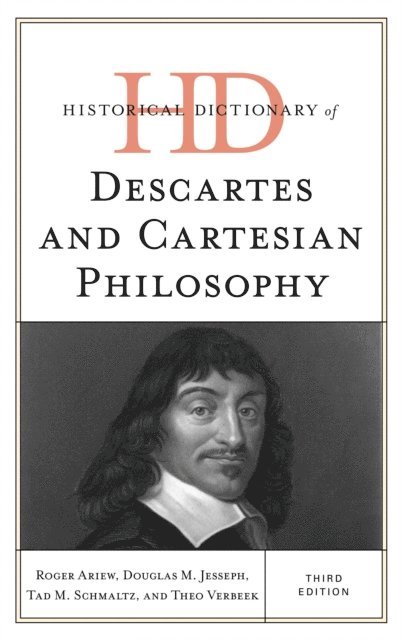
Historical Dictionary of Descartes and Cartesian Philosophy
Av Roger Ariew, Douglas M. Jesseph m. fl.
Inbunden, 2024
2415 kr
Lägg i varukorg
The Historical Dictionary of Descartes and Cartesian Philosophy, Third Edition, centers on Descartes’ philosophy (considered broadly to include his science and mathematics) in the context of 17th-century thought, with attention being paid to its reception. This is done through a chronology, an …
Historical Dictionary of Descartes and Cartesian Philosophy
Av Roger Ariew, Douglas M. Jesseph m. fl.
E-bok, 2024
2592 kr
Lägg i varukorg
The Historical Dictionary of Descartes and Cartesian Philosophy, Third Edition, centers on Descartes’ philosophy (considered broadly to include his science and mathematics) in the context of 17th-century thought, with attention being paid to its reception. This is done through a chronology, an …
Descartes and the Dutch – Early Reactions to Cartesian Philosophy, 1637–1650
Av Theo Verbeek
Inbunden, 1992
282 kr
Tillfälligt slut
Theo Verbeek provides the first book-length examination of the initial reception of Descartes's written works.Drawing on his research of primary materials written in Dutch and Latin and found in libraries all over Europe, even including the Soviet Union, Theo Verbeek opens a period of Descartes's …