Theodore L. Becker – författare
Visar alla böcker från författaren Theodore L. Becker. Handla med fri frakt och snabb leverans.
3 produkter
3 produkter
1 021 kr
Skickas inom 10-15 vardagar
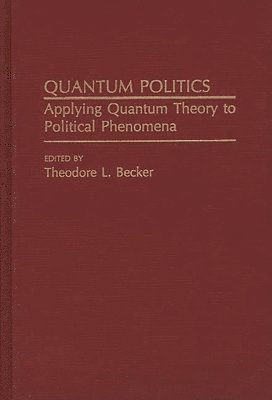
Quantum physics, according to Theodore Becker, provides the means for replacing outdated eighteenth-century political and economic philosophies with a new paradigm more appropriate to our current understanding of physical reality. Becker had selected contributions by a number of political scientists who subscribe to the view that a Newtonian worldview is inadequate to explain today's political phenomena. These theorists believe that the laws and findings of quantum physics provide a more appropriate scientific paradigm. Becker terms intellectual forays exploring this hypothesis thought experiments. Together they comprise a major challenge to prevailing views held by the wealthy, government officials, and corporate executives. Newtonian theory, according to one contributor to this volume, is related to classic, liberal democratic thought and thereby to indirect, representative democracy. Quantum theory is linked with participatory democratic thinking--a more direct and purer form of democracy.The book moves from a discussion of the relationship of physical and political theory to an explanation of the meaning of quantum politics. One thought experiment argues that all political perception is subjective. Another shows why the quantum focus on energy instead of momentum yields a better gauge of political stability and entropy. Among the author's compendium of ideas from the perspective of the political quantum are: quantum theory provides the scientific basis for selecting representatives by random sampling; the hydrogen citizen only captures one electron in his or her lifetime; Marxism is the most ambitious child of Newtonian Europe; and the dogma of individual freedom is hardly more than a myth. The book will elicit serious reflection on fundamental assumptions by anyone interested in government, politics, or political science.
795 kr
Skickas inom 10-15 vardagar
The best way to teach democracy has been the subject of an ongoing debate for 2,500 years. Unlike most books about teaching democracy, this one spends more time on how to teach democracy than the what and why of teaching democracy. It punctures the irony of teaching democracy by lectures and superior teachers. In its place, this book provides a variety of illustrations for the teaching of democracy in an experiential and egalitarian fashion. The introduction presents a theoretical and analytical framework of democracy and democratic pedagogy. The six chapters cover topics such as structuring a democratic classroom; democratic practices that empower students; problem solving and community service that make the classroom a laboratory for democracy; and university-based programs of democratic alternatives that serve the community. The volume's treatment of community organization, students as collaborators, personal empowerment, the community of need and response, and the democratic organization expresses its preference for direct democratic participation.
480 kr
Skickas inom 10-15 vardagar
The best way to teach democracy has been the subject of an ongoing debate for 2,500 years. Unlike most books about teaching democracy, this one spends more time on how to teach democracy than the what and why of teaching democracy. It punctures the irony of teaching democracy by lectures and superior teachers. In its place, this book provides a variety of illustrations for the teaching of democracy in an experiential and egalitarian fashion. The introduction presents a theoretical and analytical framework of democracy and democratic pedagogy. The six chapters cover topics such as structuring a democratic classroom; democratic practices that empower students; problem solving and community service that make the classroom a laboratory for democracy; and university-based programs of democratic alternatives that serve the community. The volume's treatment of community organization, students as collaborators, personal empowerment, the community of need and response, and the democratic organization expresses its preference for direct democratic participation.