Thomas Julian Thomas – författare
Visar alla böcker från författaren . Handla med fri frakt och snabb leverans.
3 produkter
3 produkter
E-bok
PDF, Engelska, 2015183 kr
Läs direkt efter köp
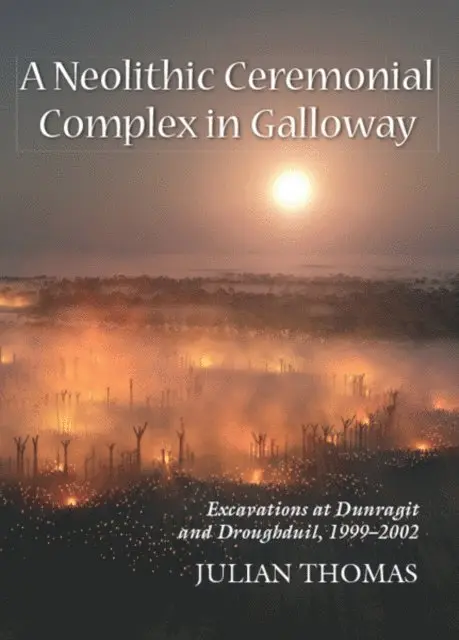
A complex enclosure identified by aerial photography at Dunragit Galloway, was demonstrated by excavation to have been of Late Neolithic date, and comprised three concentric timber ramped post-rings, 120–300 m in diameter. The two outer post-rings each comprised large uprights interspersed with smaller members, probably forming a continuous palisade. Each was a single-phase structure and the posts had rotted out. The inner ring had largely been made up of large, freestanding posts, most of which had rotted away, but some of which had been deliberately removed, the post-holes being considerably larger than those of the two outer rings. Where posts had been pulled out, a number of elaborate deposits had been placed in the crater left by the post-removal. The entrances to the post-rings are not aligned and the preferred interpretation is that the monument as a whole had two phases of construction, in each of which a timber circle was surrounded by a palisade, and in which the middle post-ring succeeded the outer, or vice-versa.The enclosure had been preceded by a post-defined cursus monument in which all the post had been burned in situ and numerous other post-holes were located on the same axis as the cursus, extending beyond the monument itself.The most elaborate entrance, connected with the middle post-ring, is composed of two parallel lines of features, presumably post-holes, opening toward the south, and aligned on a large earthen mound at Droughduil, 400 m away. Droughduil Mote, though recorded as a medieval motte, recalls the association of various very large mounds with with henges or palisaded enclosures, as at Silbury Hill, Wiltshire. Excavation demonstrated that it had been constructed with stepped sides, and that a stone cairn had been constructed on its summit. A series of optically stimulated luminescence dates on the accumulated sand over the surface of the mound demonstrated that it was certainly not medieval, and was probably Neolithic in date.
E-bok
PDF, Engelska, 2002328 kr
Läs direkt efter köp
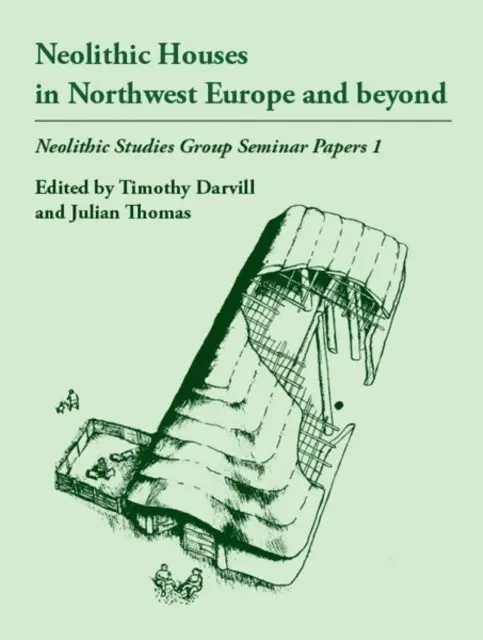
A digital reprint which makes available again the first publication of the Neolithic Studies Group, containing papers given to a special colloquium on the `structures'' of Neolithic Europe. Contributions include: Neolithic houses in mainland Britain and Ireland - a skeptical view (Julian Thomas); Houses in context: Building as process (Alasdair Whitlle); A Central European Perspective (Jonathon Last); Neolithic houses in Ireland (Eoin Grogan); Neolithic buildings in Scotland (Gordon Barclay); Neolithic buildings in England, Wales and the Isle of Man (Tim Darvill); Mesolithic or later houses at Bowmans Farm, Romsey Extra, Hampshire (Francis Green); Ballygalley houses, co.Antrim (Derek Simpson); Later Neolthic Structires at Trelystan, Powys (Alex Gibson); Life, times and works of House 59, Tell Ovcharovo, Bulgaria (Douglass Bailey); Structure ans ritual in Neolithic houses (Peter Topping); Architecture and Cosmology in the Balinese house: life is not that simple (Colin Richards); Houses in the Neolithic imagination: an Amazonian Example (Christine Hugh-Jones).
E-bok
PDF, Engelska, 2011329 kr
Läs direkt efter köp
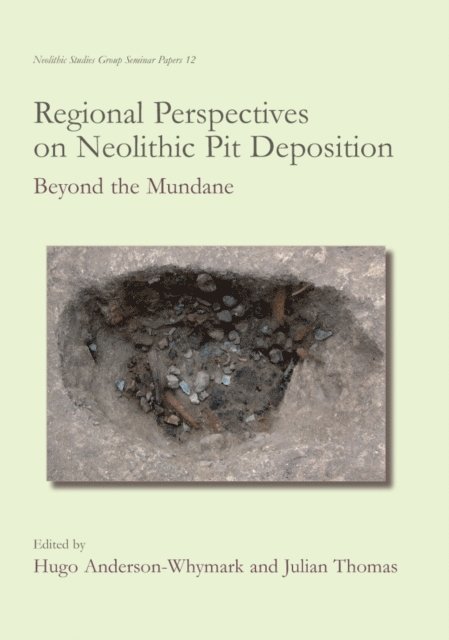
The rise to prominence of pits within narratives of the British and Irish Neolithic is well-documented in recent literature. Pits have been cropping up in excavations for centuries, resulting in a very broad spectrum of interpretations but three main factors have led to the recent change in our perception and representation of these features: a broad shift in people''s expectations as to what a Neolithic settlement should be; the development of the concept of ''structured deposition'', within which pits have played a key role; and a dramatic rise in the number of pits actually known about. Development-led archaeology, and the often very large areas its excavations expose, has simply revealed many more pits. The 15 papers in this volume explore these inter-related factors and present new thoughts and interpretations arising from new analysis of Neolithic pits and their contents.