Tianshu Liu – författare
1 360 kr
Läs direkt efter köp
Introduction to Flight Testing
Provides an introduction to the basic flight testing methods employed on general aviation aircraft and unmanned aerial vehicles
Introduction to Flight Testing provides a concise introduction to the basic flight testing methods employed on general aviation aircraft and unmanned aerial vehicles for courses in aeronautical engineering. There is particular emphasis on the use of modern on-board instruments and inexpensive, off-the-shelf portable devices that make flight testing accessible to nearly any student.
This text presents a clear articulation of standard methods for measuring aircraft performance characteristics. Topics covered include aircraft and instruments, digital data acquisition techniques, flight test planning, the standard atmosphere, uncertainty analysis, level flight performance, airspeed calibration, stall, climb and glide, take-off and landing, level turn, static and dynamic longitudinal stability, lateral-directional stability, and flight testing of unmanned aircraft systems.
Unique to this book is a detailed discussion of digital data acquisition (DAQ) techniques, which are an integral part of modern flight test programs. This treatment includes discussion of the analog-to-digital conversion, sample rate, aliasing, and filtering. These critical details provide the flight test engineer with the insight needed to understand the capabilities and limitations of digital DAQ.
Key features:
Provides an introduction to the basic flight testing methods and instrumentation employed on general aviation aircraft and unmanned aerial vehicles. Includes examples of flight testing on general aviation aircraft such as Cirrus, Diamond, and Cessna aircraft, along with unmanned aircraft vehicles. Suitable for courses on Aircraft Flight Test Engineering.Introduction to Flight Testing provides resources and guidance for practitioners in the rapidly-developing field of drone performance flight test and the general aviation flight test community.
1 275 kr
Läs direkt efter köp
Introduction to Flight Testing
Provides an introduction to the basic flight testing methods employed on general aviation aircraft and unmanned aerial vehicles
Introduction to Flight Testing provides a concise introduction to the basic flight testing methods employed on general aviation aircraft and unmanned aerial vehicles for courses in aeronautical engineering. There is particular emphasis on the use of modern on-board instruments and inexpensive, off-the-shelf portable devices that make flight testing accessible to nearly any student.
This text presents a clear articulation of standard methods for measuring aircraft performance characteristics. Topics covered include aircraft and instruments, digital data acquisition techniques, flight test planning, the standard atmosphere, uncertainty analysis, level flight performance, airspeed calibration, stall, climb and glide, take-off and landing, level turn, static and dynamic longitudinal stability, lateral-directional stability, and flight testing of unmanned aircraft systems.
Unique to this book is a detailed discussion of digital data acquisition (DAQ) techniques, which are an integral part of modern flight test programs. This treatment includes discussion of the analog-to-digital conversion, sample rate, aliasing, and filtering. These critical details provide the flight test engineer with the insight needed to understand the capabilities and limitations of digital DAQ.
Key features:
Provides an introduction to the basic flight testing methods and instrumentation employed on general aviation aircraft and unmanned aerial vehicles. Includes examples of flight testing on general aviation aircraft such as Cirrus, Diamond, and Cessna aircraft, along with unmanned aircraft vehicles. Suitable for courses on Aircraft Flight Test Engineering.Introduction to Flight Testing provides resources and guidance for practitioners in the rapidly-developing field of drone performance flight test and the general aviation flight test community.
1 186 kr
Skickas inom 5-8 vardagar
3 179 kr
Skickas inom 5-8 vardagar
3 948 kr
Läs direkt efter köp
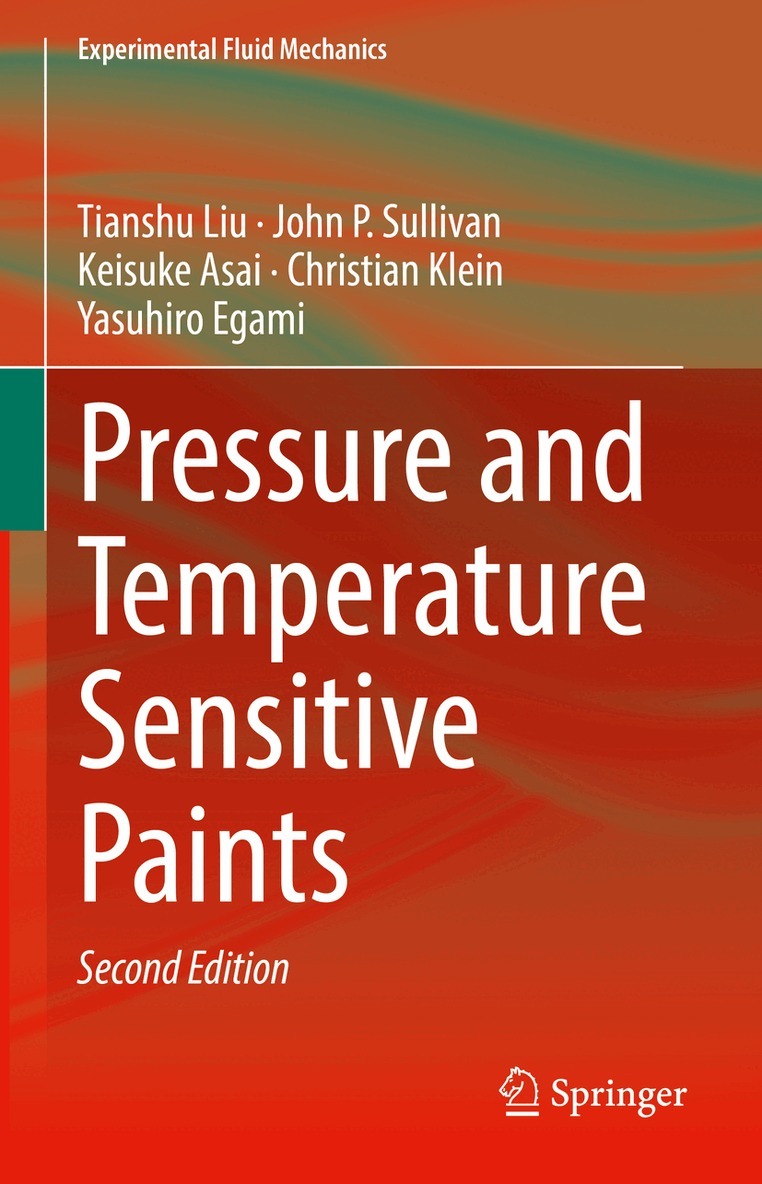
This new edition describes pressure and temperature sensitive paints (PSP and TSP) in global surface pressure and temperature measurements in aerodynamics and fluid mechanics. The book includes the latest progress in paint formulations, instrumentation, and steady and unsteady aerodynamic measurements in various facilities including low-speed, transonic, supersonic and hypersonic wind tunnels. The updated technical aspects of PSP and TSP in the book will be useful for students and researchers in experimental aerodynamics and fluid mechanics.
3 179 kr
Skickas inom 5-8 vardagar
1 838 kr
Skickas inom 10-15 vardagar
2 366 kr
Läs direkt efter köp
This book describes unified image-based measurement methods (theories, numerical methods, and algorithms) to determine the important physical quantities of complex flows in engineering and natural systems, including velocity, pressure, temperature, heat transfer, and skin friction. It presents a systematical study of the inverse problems in global flow diagnostics in a unified framework of the variational formulations. The authors further illustrate the main physical quantities in fluid mechanics, including velocity, pressure, skin friction and surface heat flux, extracted from flow visualization images obtained in experiments and observations. The developed methods are applicable in various image-based flow measurements in diverse disciplines ranging from fluid mechanics/aerodynamics to plenary sciences.
1 838 kr
Skickas inom 10-15 vardagar
3 179 kr
Skickas inom 5-8 vardagar
3 157 kr
Läs direkt efter köp
Luminescent molecule sensors, called pressure-sensitive paint (PSP) and temperature-sensitive paint (TSP), measure factors essential for understanding the aerodynamic performance and heat transfer characteristics of flight vehicles. They provide a powerful tool for experimental aerodynamicists to obtain a deeper understanding of the rich physical phenomena in complex flows around a flight vehicle. This book helps the reader to understand the physics and chemistry and the capabilities of PSP and TSP. It provides an overview of the wide scope of applications and explains the system requirements for using these sensors. The book also includes an extensive table of properties of PTP and TSP. As such, it is a thorough and up-to-date coverage of the underlying physics and applications of luminescent molecules designed for global pressure and temperature mapping