Tim L. Tinker – författare
Visar alla böcker från författaren Tim L. Tinker. Handla med fri frakt och snabb leverans.
6 produkter
6 produkter
Inbunden, Engelska, 1996
1 082 kr
Skickas inom 10-15 vardagar
Experts from academia and government who are actively engaged in research in the area of risk communication present a compendium of cases that give information and allow the development of strategies to improve the communication of scientific information to the public. The cases span Western, Central and Eastern Europe, covering such areas as nuclear waste, heavy metal contamination, landfill siting, risk perception, global warming, international health for all, and more. The conclusions and recommendations presented here are being used to develop future activities to further explore this area of risk communication as an international study.
Del 49 - NATO Science Partnership Subseries: 2
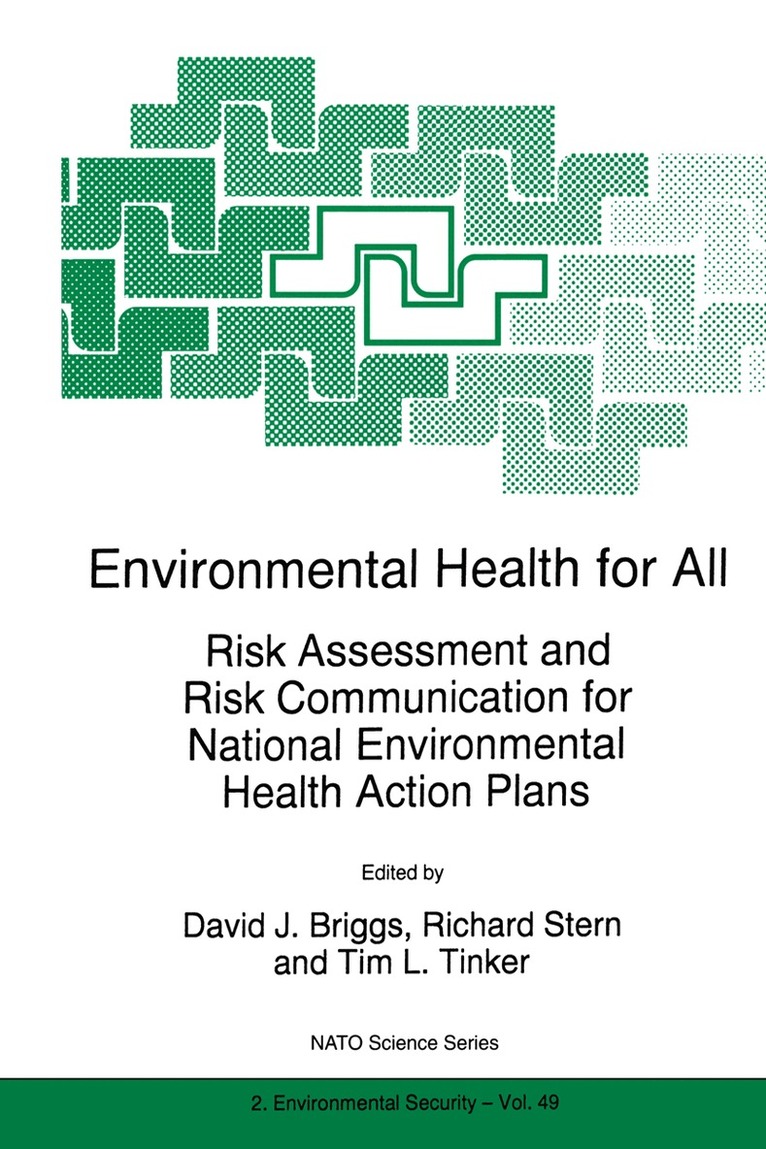
Environmental Health for All
Risk Assessment and Risk Communication for National Environmental Health Action Plans
Inbunden, Engelska, 1998
2 221 kr
Skickas inom 10-15 vardagar
The development of "National environmental health action plans" (NEHAPs) has become a major initiative in Europe, with 51 countries now committed to introducing plans by the new millennium. This book is an attempt to review recent experience in formulating these plans, and to examine and assess the technical and psycho-sociological tools available to support such plans. It brings together results from four of the leading countries involved in NEHAP developments (Sweden, Czech Republic, Romania and Poland) and describes the techniques that were used to identify and prioritise key environmental issues, and to identify policy responses. The book also provides a review of the methods and tools available for risk assessment, risk communication and priority setting, which are relevant not only to NEHAPs but to environmental planning more generally, and to many other areas of public policy. The discussion of these techniques is supported by case studies, and is concluded by a series of chapters reflecting on the conceptual and research issues that still need to be addressed.
Häftad, Engelska, 1998
2 221 kr
Skickas inom 10-15 vardagar
The development of "National environmental health action plans" (NEHAPs) has become a major initiative in Europe, with 51 countries now committed to introducing plans by the new millennium. This book is an attempt to review recent experience in formulating these plans, and to examine and assess the technical and psycho-sociological tools available to support such plans. It brings together results from four of the leading countries involved in NEHAP developments (Sweden, Czech Republic, Romania and Poland) and describes the techniques that were used to identify and prioritise key environmental issues, and to identify policy responses. The book also provides a review of the methods and tools available for risk assessment, risk communication and priority setting, which are relevant not only to NEHAPs but to environmental planning more generally, and to many other areas of public policy. The discussion of these techniques is supported by case studies, and is concluded by a series of chapters reflecting on the conceptual and research issues that still need to be addressed.
Häftad, Engelska, 2010
1 082 kr
Skickas inom 10-15 vardagar
Experts from academia and government who are actively engaged in research in the area of risk communication present a compendium of cases that give information and allow the development of strategies to improve the communication of scientific information to the public. The cases span Western, Central and Eastern Europe, covering such areas as nuclear waste, heavy metal contamination, landfill siting, risk perception, global warming, international health for all, and more. The conclusions and recommendations presented here are being used to develop future activities to further explore this area of risk communication as an international study. Audience: Scientists, risk communicators, psychologists, toxicologists, health professionals, and anyone who has an interest in public communication on scientific uncertainty.
E-bok
PDF, Engelska, 20122 822 kr
Läs direkt efter köp
Accurate assessment of environmental hazards and related risks is a primary prerequisite for effective environmental health protection, at both the individual and collective level. National and regional policies on environmental health need to be guided by knowledge about the risks to the populations involved; as the Environmental Action Plan for Europe notes, ''priority setting requires the comparative assessment of risks to health of different environmental factors against the cost of controlling them.'' In recent years this has assumed particular importance, for with the encouragement of the World Health Organisation (WHO), all countries in Europe are committed to producing National Environmental Health Action Plans (NEHAPs), which will define priorities and targets for environmental health and the actions needed to achieve them. Reliable information on risks is clearly fundamantal to this process. Individual risk assessment is no less important in this context. Much of the responsibility and capacity to improve public health lies ultimately in the choices (e.g. about diet, smoking, alcohol consumption, sexual activities, sporting activities, travel mode, place of residence and occupation) which we make as individuals. If we are to improve and protect our own health, therefore, and in so doing play our personal role in achieving the targets set by these Plans, we need to be guided by a clear understanding of the risks involved.
E-bok
PDF, Engelska, 20131 367 kr
Läs direkt efter köp
Experts from academia and government who are actively engaged in research in the area of risk communication present a compendium of cases that give information and allow the development of strategies to improve the communication of scientific information to the public. The cases span Western, Central and Eastern Europe, covering such areas as nuclear waste, heavy metal contamination, landfill siting, risk perception, global warming, international health for all, and more. The conclusions and recommendations presented here are being used to develop future activities to further explore this area of risk communication as an international study. Audience: Scientists, risk communicators, psychologists, toxicologists, health professionals, and anyone who has an interest in public communication on scientific uncertainty.