Timo Pukkala – författare
Visar alla böcker från författaren Timo Pukkala. Handla med fri frakt och snabb leverans.
13 produkter
Sustainable Forest Management
Av Klaus von Gadow, Timo Pukkala m. fl.
Häftad, 2001
2194 kr
Lägg i varukorg
During its 200-year history the concept of sustainable forest ecosystem management has been the object of scientific and political discussion, with varying degrees of intensity - promoted with vehement fervour during periods of social or economic crisis, and less intensely during periods of …
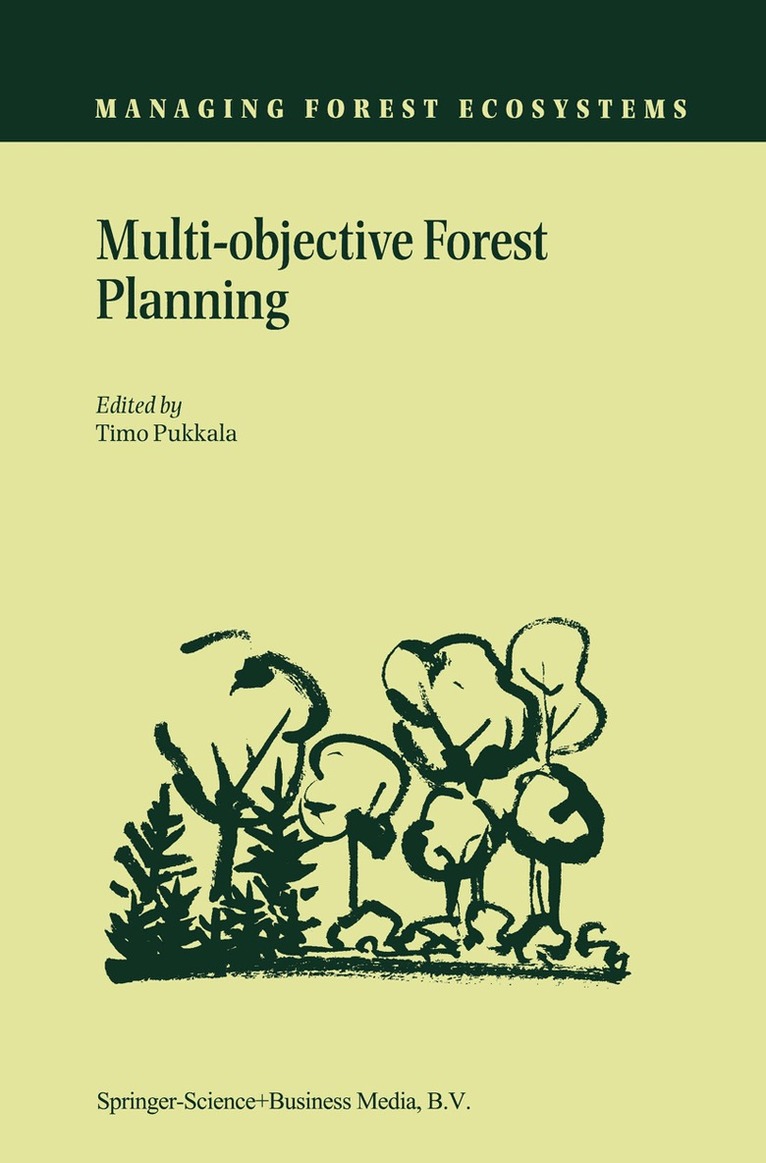
Multi-objective Forest Planning
Av Timo Pukkala
Inbunden, 2002
1647 kr
Lägg i varukorg
Most of the scientific methods devised for forest planning support timber production ignoring the existence of forest functions other than wood production. Fortunately, the realisation that the forest planning methods available today do not correspond to the needs of today's forestry has activated …
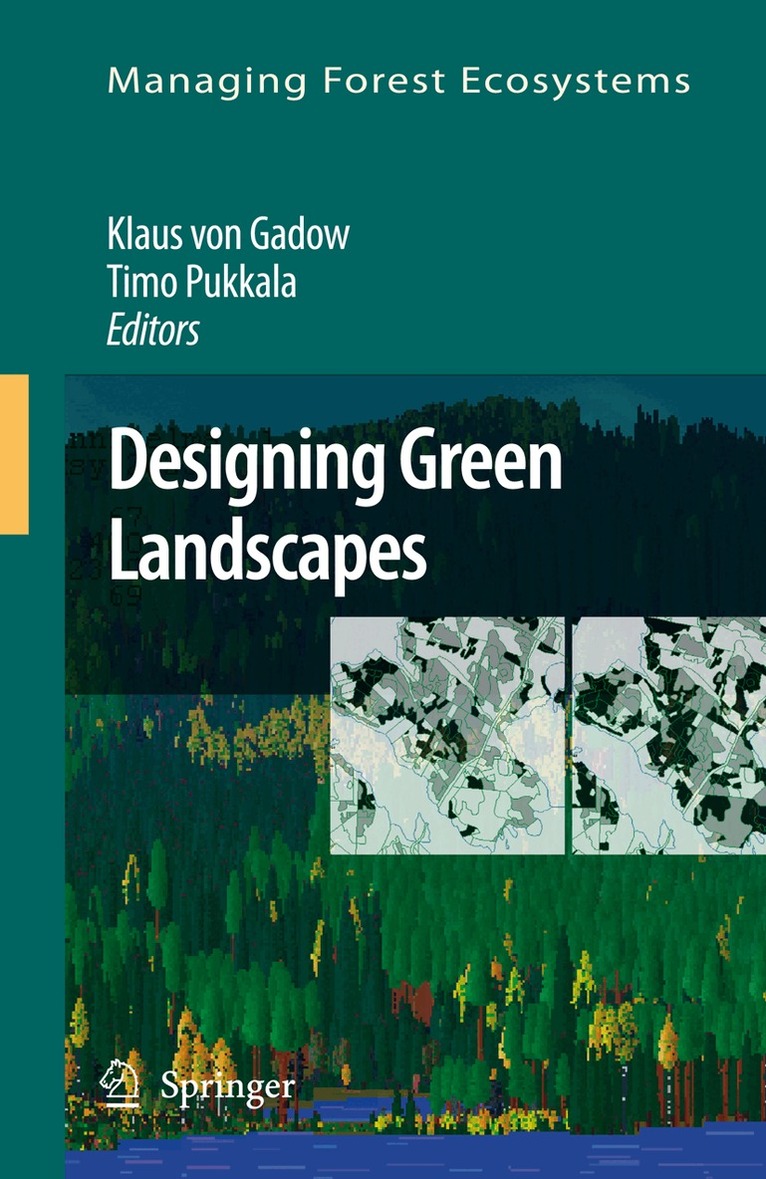
Designing Green Landscapes
Inbunden, 2008
1101 kr
Lägg i varukorg
While the natural resources of the earth continue to diminish, “Green Landscapes” arebeingcalleduponto produceanincreasingrangeofgoodsandservices.A Green Landscape is a rural expanse of scenery that may comprise a variety of visible f- tures. This book focuses on forested landscapes, although much …
Designing Green Landscapes
E-bok, 2008
1459 kr
Lägg i varukorg
While the natural resources of the earth continue to diminish, “Green Landscapes” arebeingcalleduponto produceanincreasingrangeofgoodsandservices.A Green Landscape is a rural expanse of scenery that may comprise a variety of visible f- tures. This book focuses on forested landscapes, although much …
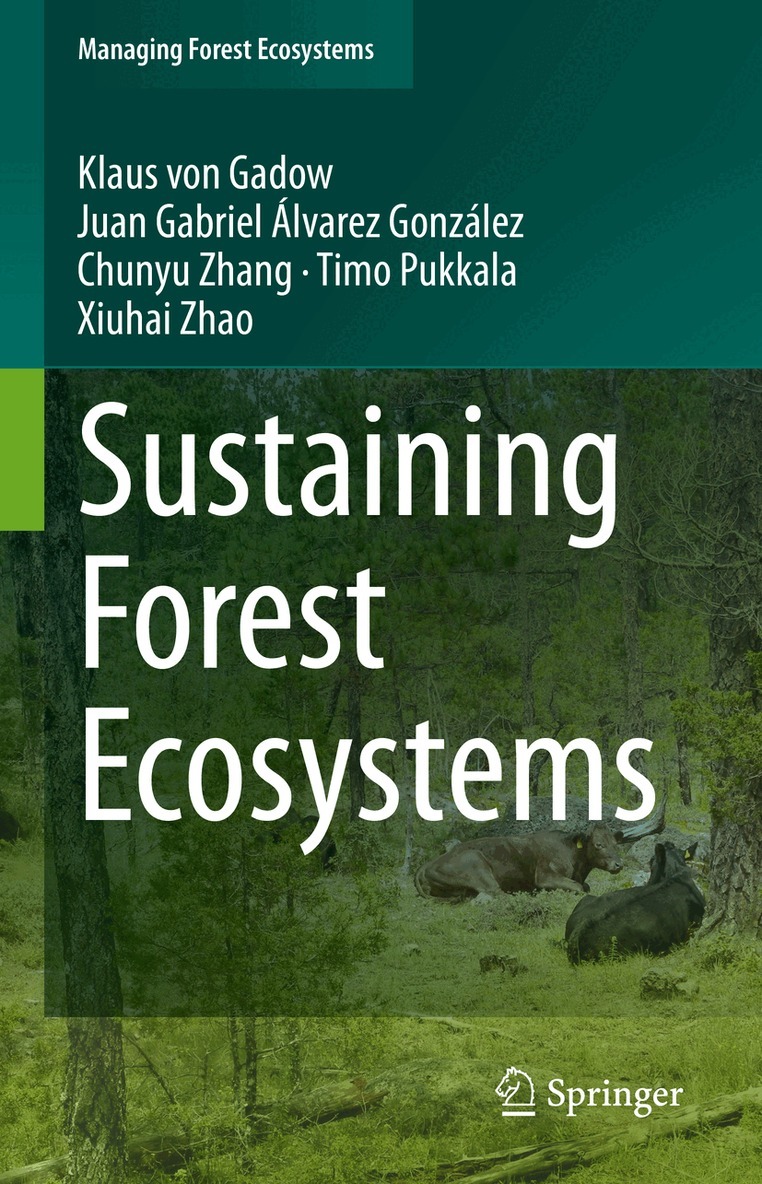
Sustaining Forest Ecosystems
Av Klaus von Gadow, Juan Gabriel Álvarez González m. fl.
Inbunden, 2021
1212 kr
Lägg i varukorg
Forest ecosystems include a great variety of communities of organisms interacting with their physical environment: multi-aged natural forests, even-aged monocultures, and secondary forests invaded by foreign species. The challenge is to sustain their ability to function, by adapting to changing …
Sustaining Forest Ecosystems
Av Xiuhai Zhao, Timo Pukkala m. fl.
E-bok, 2021
1587 kr
Lägg i varukorg
Forest ecosystems include a great variety of communities of organisms interacting with their physical environment: multi-aged natural forests, even-aged monocultures, and secondary forests invaded by foreign species. The challenge is to sustain their ability to function, by adapting to changing …
Multi-objective Forest Planning
Av Timo Pukkala
Häftad, 2010
1643 kr
Lägg i varukorg
Most of the scientific methods devised for forest planning support timber production ignoring the existence of forest functions other than wood production. Fortunately, the realisation that the forest planning methods available today do not correspond to the needs of today's forestry has activated …
Designing Green Landscapes
Häftad, 2010
1098 kr
Lägg i varukorg
While the natural resources of the earth continue to diminish, “Green Landscapes” arebeingcalleduponto produceanincreasingrangeofgoodsandservices.A Green Landscape is a rural expanse of scenery that may comprise a variety of visible f- tures. This book focuses on forested landscapes, although much …
Continuous Cover Forestry
Inbunden, 2011
2734 kr
Lägg i varukorg
Although the majority of the world’s forest ecosystems are dominated by uneven-sized multi-species stands, forest management practice and theory has focused on the development of plantation monocultures to maximize the supply of timber at low cost. Societal expectations are changing, however, and …
Continuous Cover Forestry
E-bok, 2011
3500 kr
Lägg i varukorg
Although the majority of the world’s forest ecosystems are dominated by uneven-sized multi-species stands, forest management practice and theory has focused on the development of plantation monocultures to maximize the supply of timber at low cost. Societal expectations are changing, however, and …
Continuous Cover Forestry
Häftad, 2013
2741 kr
Lägg i varukorg
Although the majority of the world’s forest ecosystems are dominated by uneven-sized multi-species stands, forest management practice and theory has focused on the development of plantation monocultures to maximize the supply of timber at low cost. Societal expectations are changing, however, and …
Sustainable Forest Management
Av Margarida Tome, Timo Pukkala m. fl.
E-bok, 2012
2833 kr
Lägg i varukorg
During its 200-year history the concept of sustainable forest ecosystem management has been the object of scientific and political discussion, with varying degrees of intensity - promoted with vehement fervour during periods of social or economic crisis, and less intensely during periods of …
Multi-objective Forest Planning
Av Timo Pukkala
E-bok, 2013
2111 kr
Lägg i varukorg
Most of the scientific methods devised for forest planning support timber production ignoring the existence of forest functions other than wood production. Fortunately, the realisation that the forest planning methods available today do not correspond to the needs of today''s forestry has activated …