Timothy P. Clement – författare
Visar alla böcker från författaren Timothy P. Clement. Handla med fri frakt och snabb leverans.
4 produkter
4 produkter
E-bok
PDF, Engelska, 2013734 kr
Läs direkt efter köp
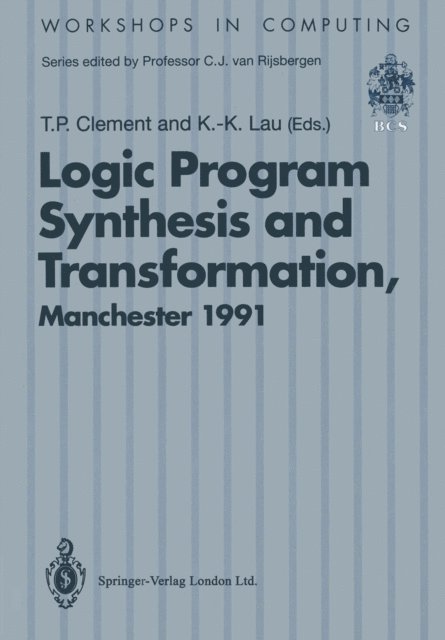
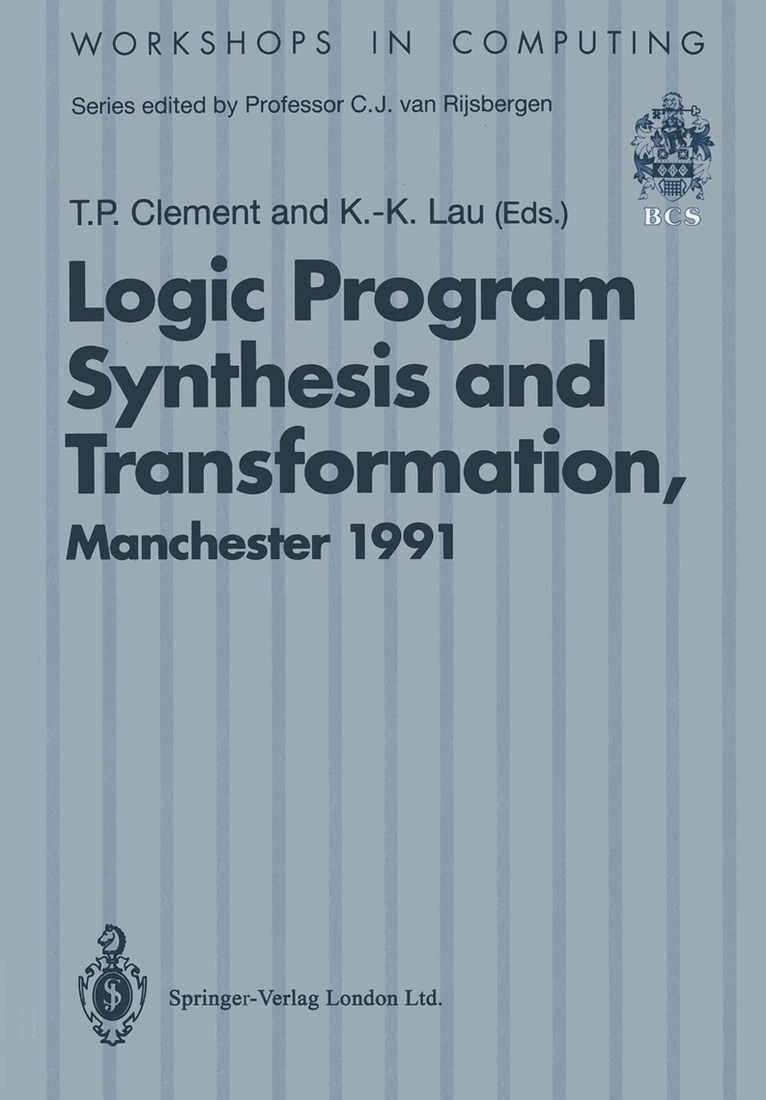
Logic programming synthesis and transformation are methods of deriving logic programs from their specifications and, where necessary, producing alternative but equivalent forms of a given program. The techniques involved in synthesis and transformation are extremely important as they allow the systematic construction of correct and efficient programs and have the potential to enhance current methods of software production. Transformation strategies are also being widely used in the field of logic program development. LOPSTR 91 was the first workshop to deal exclusively with both logic program synthesis and transformation and, as such, filled an obvious gap in the existing range of logic programming workshops. In attempting to cover the subject as comprehensively as possible, the workshop brought together researchers with an interest in all aspects of logic (including Horn Clause and first order logic) and all approaches to program synthesis and transformation. Logic Program Synthesis and Transformation provides a complete record of the workshop, with all the papers reproduced either in full or as extended abstracts. They cover a wide range of aspects, both practical and theoretical, including the use of mode input-output in program transformation, program specification and synthesis in constructive formal systems and a case study in formal program development in modular Prolog. This volume provides a comprehensive overview of current research and will be invaluable to researchers and postgraduate students who wish to enhance their understanding of logic programming techniques.
E-bok
PDF, Engelska, 2013734 kr
Läs direkt efter köp
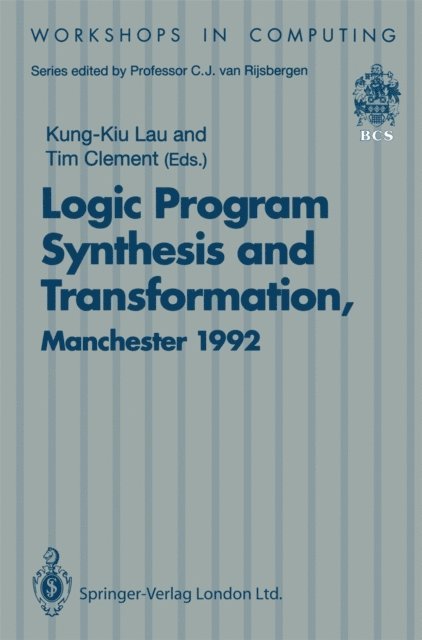
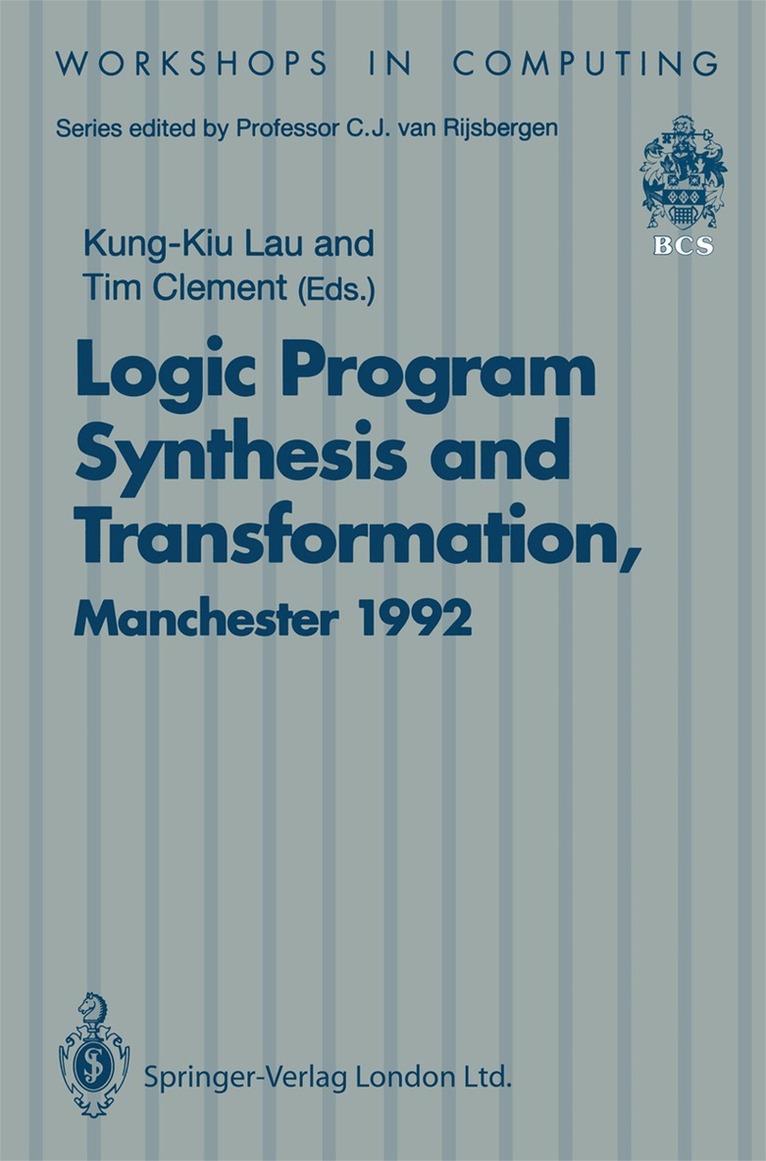
Logic program synthesis and transformation are topics of central importance to the software industry. The demand for software can not be met by the current supply, in terms of volume, complexity, or reliability. The most promising solution seems to be the increased automation of software production: programmer productivity would improve, and correctness could be ensured by the application of mathematical methods. Because of their mathematical foundations, logic programs lend themselves particularly well to machine-assisted development techniques, and therefore to automation. This volume contains the proceedings of the second International Workshop on Logic Program Synthesis and Transformation (LOPSTR 92), held at the University of Manchester, 2-3 July 1992. The LOPSTR workshops are the only international meetings devoted to these two important areas. A variety of new techniques were described at the workshop, all of which promise to revolutionize the software industry once they become standard practise. These include techniques for the transformation of an inefficient program into an equivalent, efficient one, and the synthesis of a program from a formal specification of its required behaviour. Among the topics covered in this volume are: optimal transformation of logic programs; logic program synthesis via proof planning; deductive synthesis of programs for query answering; efficient compilation of lazy narrowing into Prolog; synthesis of narrowing programs; Logimix: a self-applicable partial evaluator for Prolog; proof nets; automatic termination analysis. Logic Program Synthesis and Transformation describes the latest advances in machine-assisted development of logic programs. It will provide essential reading for researchers and postgraduate students concerned with these two important areas.
Häftad, Engelska, 1992
566 kr
Skickas inom 10-15 vardagar
Logic programming synthesis and transformation are methods are deriving logic programs from their specifications and, where necessary, producing alternative but equivalent forms of a given program. The techniques involved in synthesis and transformation are extremely important as they allow the systematic construction of correct and efficient programs and have the potential to enhance current methods of software production. Transformation strategies are also being widely used in the field of logic program development. LOPSTR 91 was the first workshop to deal exclusively with both logic program synthesis and transformation and, as such, filled an obvious gap in the existing range of logic programming workshops. In attempting to cover the subject as comprehensively as possible, the workshop brought together researchers with an interest in all aspects of logic (including Horn Clause and first order logic) and all approaches to program synthesis and transformation. "Logic Program Synthesis and Transformation" provides a complete record of the workshop, with all the papers re-produced either in full or as extended abstracts.They cover a wide range of aspects, both practical and theoretical, including the use of mode input-output in program transformation, program specification and synthesis in constructive formal systems and a case study in formal program development in modular Prolog. This volume provides a comprehensive overview of current research and will be invaluable to researchers and postgraduate students who wish to enhance their understanding of logic programming techniques.
Häftad, Engelska, 1993
566 kr
Skickas inom 10-15 vardagar
Logic program synthesis and transformation are topics of central importance to the software industry. The demand for software can not be met by the current supply, in terms of volume, complexity, or reliability. The most promising solution seems to be the increased automation of software production: programmer productivity would improve, and correctness could be ensured by the application of mathematical methods. Because of their mathematical foundations, logic programs lend themselves particularly well to machine-assisted development techniques, and therefore to automation. This volume contains the proceedings of the second International Workshop on Logic Program Synthesis and Transformation (LOPSTR 92), held at the University of Manchester, 2-3 July 1992. The LOPSTR workshops are the only international meetings devoted to these two important areas. A variety of new techniques were described at the workshop, all of which promise to revolutionize the software industry once they become standard practise. These include techniques for the transformation of an inefficient program into an equivalent, efficient one, and the synthesis of a program from a formal specification of its required behaviour. Among the topics covered in this volume are: optimal transformation of logic programs; logic program synthesis via proof planning; deductive synthesis of programs for query answering; efficient compilation of lazy narrowing into Prolog; synthesis of narrowing programs; Logimix: a self-applicable partial evaluator for Prolog; proof nets; automatic termination analysis. Logic Program Synthesis and Transformation describes the latest advances in machine-assisted development of logic programs. It will provide essential reading for researchers and postgraduate students concerned with these two important areas.