Timothy Smeeding - Böcker
Visar alla böcker från författaren Timothy Smeeding. Handla med fri frakt och snabb leverans.
6 produkter
6 produkter
1 801 kr
Skickas inom 5-8 vardagar
This book explores the role of the welfare state in the overall wealth and wellbeing of nations and in particular looks at the American welfare state in comparison with other developed nations in Europe and elsewhere.It is widely believed that the welfare state undermines productivity and economic growth, that the United States has an unusually small welfare state, and that it is, and always has been, a welfare state laggard. This book shows that all rich nations, including the United States, have large welfare states because the socialized programs that comprise the welfare state-public education and health and social insurance--enhance the productivity of capitalism. In public education, the most productive part of the welfare state, for most of the 19th and 20th centuries, the United States was a leader. Though few would argue that public education is not part of the welfare state, most previous cross national analyses of welfare states have omitted education. Including education has profound consequences, undergirding the case for the productivity of welfare state programs and the explanation for why all rich nations have large welfare states, and identifying US welfare state leadership. From 1968 through 2006, the United States swung right politically and lost its lead in education and opportunity, failed to adopt universal health insurance and experienced the most rapid explosion of health care costs and economic inequality in the rich world. The American welfare state faces large challenges. Restoring its historical lead in education is the most important but requires investing large sums in education, beginning with universal pre-school and in complementary programs that aid children's development. The American health insurance system is by far the most costly in the rich world, yet fails to insure one sixth of its population, produces below average results, crowds out useful investments in children, and is the least equitably financed. Achieving universal coverage will increase costs. Only complete government financing is likely to restrain long term costs. In memory of Robert J. Lampman Colleague, Co-author, Friend and Mentor
625 kr
Skickas inom 5-8 vardagar
This book explores the role of the welfare state in the overall wealth and wellbeing of nations and in particular looks at the American welfare state in comparison with other developed nations in Europe and elsewhere.It is widely believed that the welfare state undermines productivity and economic growth, that the United States has an unusually small welfare state, and that it is, and always has been, a welfare state laggard. This book shows that all rich nations, including the United States, have large welfare states because the socialized programs that comprise the welfare state-public education and health and social insurance--enhance the productivity of capitalism. In public education, the most productive part of the welfare state, for most of the 19th and 20th centuries, the United States was a leader. Though few would argue that public education is not part of the welfare state, most previous cross national analyses of welfare states have omitted education. Including education has profound consequences, undergirding the case for the productivity of welfare state programs and the explanation for why all rich nations have large welfare states, and identifying US welfare state leadership. From 1968 through 2006, the United States swung right politically and lost its lead in education and opportunity, failed to adopt universal health insurance and experienced the most rapid explosion of health care costs and economic inequality in the rich world. The American welfare state faces large challenges. Restoring its historical lead in education is the most important but requires investing large sums in education, beginning with universal pre-school and in complementary programs that aid children's development. The American health insurance system is by far the most costly in the rich world, yet fails to insure one sixth of its population, produces below average results, crowds out useful investments in children, and is the least equitably financed. Achieving universal coverage will increase costs. Only complete government financing is likely to restrain long term costs. In memory of Robert J. Lampman Colleague, Co-author, Friend and Mentor
1 229 kr
Tillfälligt slut
The result of a National Bureau of Economic Research Income and Wealth conference held in December 1983, this volume looks at the concept of "economic well-being" and the ways that analysts have tried to measure it. In addition to income, economists have begun to consider such factors as pensions, wealth, health, and environment when measuring the well-being of a particular group. They have also begun to measure how consumers respond, successfully or unsuccessfully, to such economic uncertainties as inflation, divorce, and retirement. Using new data and techniques, the contributors to this book concentrate on issues of uncertainty and horizontal equity (the equal treatment of individuals within a defined group). Their work points to better ways of determining how various groups in a society are faring relative to other groups. Economists and policy analysts, therefore, will be in a better position to determine how government programs should be applied when well-being is used as a test.
1 275 kr
Skickas inom 7-10 vardagar
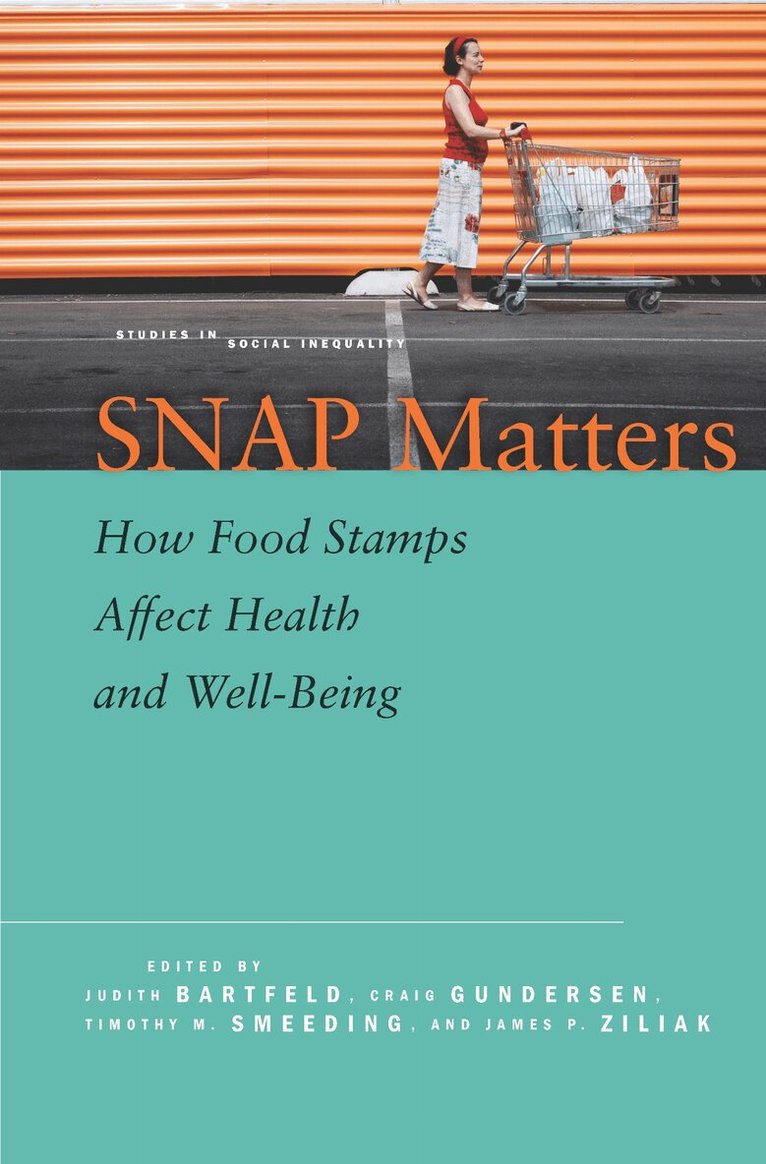
In 1963, President Kennedy proposed making permanent a small pilot project called the Food Stamp Program (FSP). By 2013, the program's fiftieth year, more than one in seven Americans received benefits at a cost of nearly $80 billion. Renamed the Supplemental Nutrition Assistance Program (SNAP) in 2008, it currently faces sharp political pressure, but the social science research necessary to guide policy is still nascent.In SNAP Matters, Judith Bartfeld, Craig Gundersen, Timothy M. Smeeding, and James P. Ziliak bring together top scholars to begin asking and answering the questions that matter. For example, what are the antipoverty effects of SNAP? Does SNAP cause obesity? Or does it improve nutrition and health more broadly? To what extent does SNAP work in tandem with other programs, such as school breakfast and lunch? Overall, the volume concludes that SNAP is highly responsive to macroeconomic pressures and is one of the most effective antipoverty programs in the safety net, but the volume also encourages policymakers, students, and researchers to continue examining this major pillar of social assistance in America.
311 kr
Skickas inom 7-10 vardagar
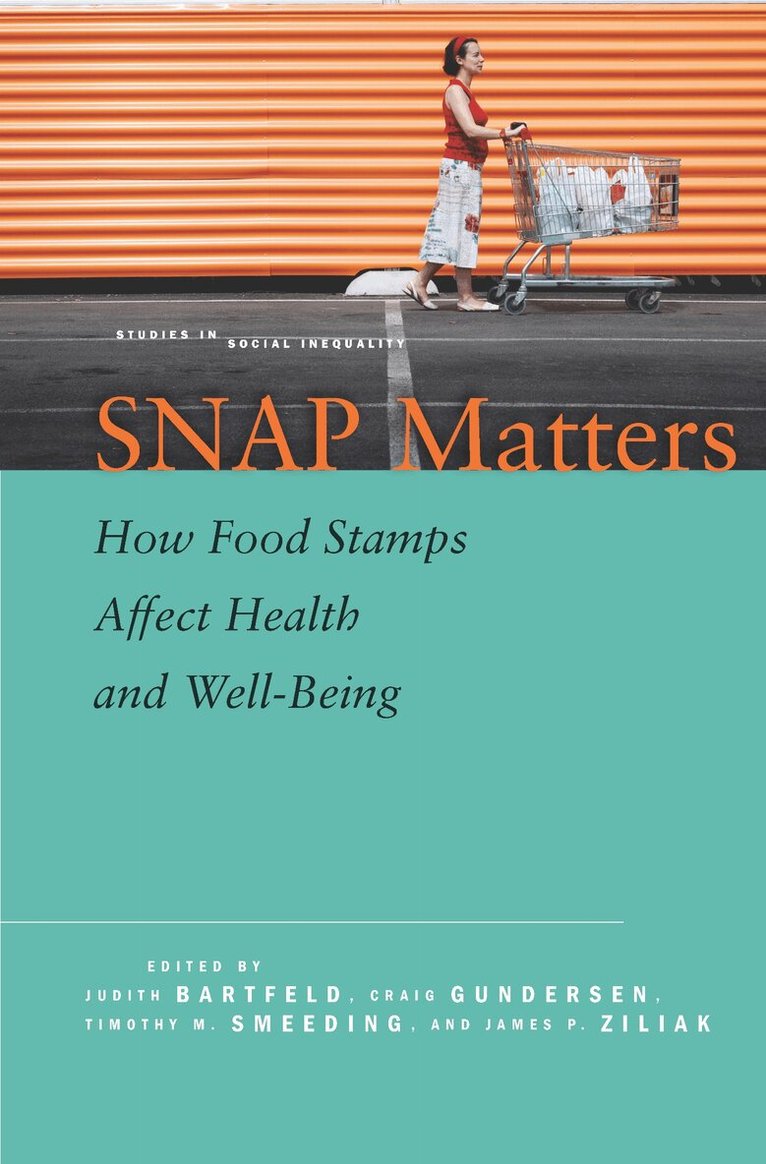
In 1963, President Kennedy proposed making permanent a small pilot project called the Food Stamp Program (FSP). By 2013, the program's fiftieth year, more than one in seven Americans received benefits at a cost of nearly $80 billion. Renamed the Supplemental Nutrition Assistance Program (SNAP) in 2008, it currently faces sharp political pressure, but the social science research necessary to guide policy is still nascent.In SNAP Matters, Judith Bartfeld, Craig Gundersen, Timothy M. Smeeding, and James P. Ziliak bring together top scholars to begin asking and answering the questions that matter. For example, what are the antipoverty effects of SNAP? Does SNAP cause obesity? Or does it improve nutrition and health more broadly? To what extent does SNAP work in tandem with other programs, such as school breakfast and lunch? Overall, the volume concludes that SNAP is highly responsive to macroeconomic pressures and is one of the most effective antipoverty programs in the safety net, but the volume also encourages policymakers, students, and researchers to continue examining this major pillar of social assistance in America.
Del 635 - The ANNALS of the American Academy of Political and Social Science Series
Young Disadvantaged Men: Fathers, Families, Poverty, and Policy
Häftad, Engelska, 2011
804 kr
Skickas inom 3-6 vardagar
By age 30, between 68 and 75 percent of young men in the United States, with only a high school degree or less, are fathers. This volume provides practical, policy-driven strategies to address the national epidemic of disadvantaged young fathers and the challenges they face in raising and supporting their children. National experts discuss the issues of immediate concern to those working to reconnect disengaged dads to their children and improve child and family economic and emotional well-being. Each chapter was presented at a working conference organized by Institute for Research on Poverty director, Tim Smeeding (University of Wisconsin–Madison), in coordination with the Columbia University School of Social Work's Center for Research on Fathers, Children, and Family Well-Being, directed by Ronald Mincy, and the Columbia Population Research Center, directed by Irwin Garfinkel. The conference brought together scholars, many in public policy, to examine strategies for reducing barriers to marriage and fathers' involvement, designing child support and other public policies to encourage the involvement of fathers, and addressing fathers who have multiple child support responsibilities. This volume will appeal to researchers, policy-makers, and practitioners dedicated to improving the lives of low-income families and children.