Tiziana Suarez-Nani – författare
Visar alla böcker från författaren Tiziana Suarez-Nani. Handla med fri frakt och snabb leverans.
8 produkter
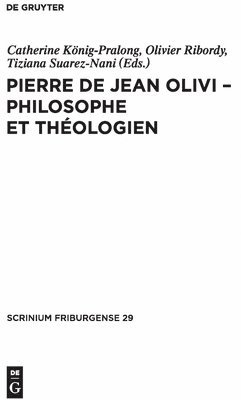
Pierre de Jean Olivi - Philosophe et théologien
Av Tiziana Suarez-Nani, Olivier Ribordy m. fl.
E-bok, 2010
2168 kr
Lägg i varukorg
Petrus Johannis Olivi (ca. 1248-1298) gilt heute als einer der Hauptakteure des intellektuellen Lebens der zweiten Hälfte des 13. Jahrhunderts. Die hier zusammengestellten Beiträge (in französischer und italienischer Sprache) präsentieren auf der einen Seite eine Untersuchung der Unternehmungen …
Représentations et conceptions de l’espace dans la culture médiévale. Repräsentationsformen und Konzeptionen des Raums in der Kultur des Mittelalters
Colloque Fribourgeois 2009. Freiburger Colloquium 2009
Av Tiziana Suarez-Nani, Martin Rohde
Inbunden, 2011
3119 kr
Lägg i varukorg
This volume contains the records of the international Freiburg Colloquium of the same name which was held by the Medieval Institute of the University of Freiburg from October 19 to 21, 2009. The academic reconstruction of the conception and perception of space in the culture of the Latin Middle …
Représentations et conceptions de l’espace dans la culture médiévale. Repräsentationsformen und Konzeptionen des Raums in der Kultur des Mittelalters
Colloque Fribourgeois 2009. Freiburger Colloquium 2009
Av Martin Rohde, Tiziana Suarez-Nani
E-bok, 2011
2669 kr
Lägg i varukorg
Le présent volume contient les Actes du colloque international sur les " Représentations et conceptions de l''espace dans la culture médiévale " qui s''est déroulé du 19 au 21 octobre 2009 sous les auspices de l''Institut d''Etudes Médiévales de l''Université de Fribourg (Suisse). La participation …
Tempo ed essere nell autunno del medioevo
Il De tempore di Nicola di Strasburgo e il dibattito sulla natura ed il senso del tempo agli inizi del XIV secolo
E-bok, 1989
1581 kr
Lägg i varukorg
Pierre de Jean Olivi - Philosophe Et Théologien
Av Catherine König-Pralong, Olivier Ribordy m. fl.
Inbunden, 2010
2454 kr
Tillfälligt slut
Francisci de Marchia
Quaestiones in secundum librum sententiarum (Reportatio IIA)
Av Franciscus de Marchia, Tiziana Suarez-Nani m. fl.
Inbunden, 2009
565 kr
Tillfälligt slut
Reduced Price!Now only € 40,00 instead of € 80,00This commentary exists in two versions:The major version is contained in 17 manuscripts and the critical edition of it is being prepared by a team of specialists led by Prof. Tiziana Suarez-Nani of the University of Fribourg, Switzerland. A minor …
Francisci de Marchia
Quaestiones in secundum librum sententiarum (Reportatio IIA)
Av Franciscus de Marchia, Tiziana Suarez-Nani m. fl.
Inbunden, 2010
577 kr
Tillfälligt slut
Reduced Price!Now only € 40,00 instead of € 85,00The texts edited in this volume deal with angelology and anthropology, and particularly with the nature and the functions of immaterial substances like angels and the human rational soul. Marchia discusses such controversial issues as universal …
Francisci de Marchia—Quaestiones in secundum librum sententiarum (Reportatio)
Quaestiones 28–49
Av Franciscus de Marchia, Tiziana Suarez-Nani m. fl.
Inbunden, 2013
577 kr
Tillfälligt slut
Reduced Price!Now only € 40,00 instead of € 80,00In the questions contained in this volume, Francis of Marchia explores subjects that earned him his fame in the Middle Ages and in the history of ideas: physics and philosophical psychology. He confronts the key issues in celestial physics, …