Tony Lynch – författare
Visar alla böcker från författaren Tony Lynch. Handla med fri frakt och snabb leverans.
8 produkter
8 produkter
Häftad, Engelska, 2004
468 kr
Skickas inom 7-10 vardagar
A course for intermediate and advanced level students focusing on listening to lectures and note-taking. Study Listening is for intermediate and advanced level students who are planning to study at a university or college where English is the language of instruction, or who need to attend international conferences where English is used. The course focuses on listening to lectures and note-taking. The Second Edition has been comprehensively revised and restructured and now includes eight brand new lectures on academic topics with speakers from six different countries; more focus on six macro-strategies for listening: predicting, monitoring, responding, clarifying, inferencing, evaluating; more post-listening tasks to deal with comprehension problems.
Häftad, Engelska, 2004
558 kr
Skickas inom 10-15 vardagar
Study Speaking is for intermediate level and above students who need to speak English in connection with their academic work. It is intended primarily for use on language programmes preparing learners of English for study at university or college. The course is designed to improve students' speaking skills by: * activating and extending their linguistic competence * increasing their confidence in using spoken English * developing their ability to analyse and evaluate spoken performance * sharpening their strategic competence in face-to-face interaction. Study Speaking is part of a the Study Skills series.
Inbunden, Engelska, 2000
2 184 kr
Skickas inom 10-15 vardagar
Although Green approaches to politics have had some practical successes in a range of different countries, the movement has lacked a fully developed and coherent political theory. In this unique study David Wells and Tony Lynch demonstrate that ecological understanding and environmental concern are not just consistent with notions of social equity and grass-roots democracy, but that a concern for these aims are the logical consequence of what might be called 'political ecology'. They begin with a critique of existing approaches to Green politics, with particular attention to the claims of 'deep ecology' and go on to develop an important examination of the relationship between economic and ecological styles of thinking. They conclude with a 'social commons' inspired revision of Lockean politics. What emerges is an important understanding of the tasks of politics: rather than focusing on 'foreground' issues of individual choice, the central political challenge of our age is with the management and provision of the background conditions (the ecological conditions - understood in the broadest sense) which allows the possibility of a reasonable life. The analysis shows a concern with environmental commons engenders equal concerns for social, economic and cultural commons, develops an account of how such commons can be effectively managed and relates this account to more traditional political themes of democracy, liberty and equity.
Häftad, Engelska, 2025
299 kr
Skickas inom 5-8 vardagar
E-bok
Engelska, 2017774 kr
Läs direkt efter köp
Although Green approaches to politics have had some practical successes in a range of different countries, the movement has lacked a fully developed and coherent political theory. In this unique study David Wells and Tony Lynch demonstrate that ecological understanding and environmental concern are not just consistent with notions of social equity and grass-roots democracy, but that a concern for these aims are the logical consequence of what might be called ''political ecology''. They begin with a critique of existing approaches to Green politics, with particular attention to the claims of ''deep ecology'' and go on to develop an important examination of the relationship between economic and ecological styles of thinking. They conclude with a ''social commons'' inspired revision of Lockean politics. What emerges is an important understanding of the tasks of politics: rather than focusing on ''foreground'' issues of individual choice, the central political challenge of our age is with the management and provision of the background conditions (the ecological conditions - understood in the broadest sense) which allows the possibility of a reasonable life. The analysis shows a concern with environmental commons engenders equal concerns for social, economic and cultural commons, develops an account of how such commons can be effectively managed and relates this account to more traditional political themes of democracy, liberty and equity.
E-bok
PDF, Engelska, 2017774 kr
Läs direkt efter köp
Although Green approaches to politics have had some practical successes in a range of different countries, the movement has lacked a fully developed and coherent political theory. In this unique study David Wells and Tony Lynch demonstrate that ecological understanding and environmental concern are not just consistent with notions of social equity and grass-roots democracy, but that a concern for these aims are the logical consequence of what might be called ''political ecology''. They begin with a critique of existing approaches to Green politics, with particular attention to the claims of ''deep ecology'' and go on to develop an important examination of the relationship between economic and ecological styles of thinking. They conclude with a ''social commons'' inspired revision of Lockean politics. What emerges is an important understanding of the tasks of politics: rather than focusing on ''foreground'' issues of individual choice, the central political challenge of our age is with the management and provision of the background conditions (the ecological conditions - understood in the broadest sense) which allows the possibility of a reasonable life. The analysis shows a concern with environmental commons engenders equal concerns for social, economic and cultural commons, develops an account of how such commons can be effectively managed and relates this account to more traditional political themes of democracy, liberty and equity.
Häftad, Engelska, 2018
355 kr
Skickas inom 10-15 vardagar
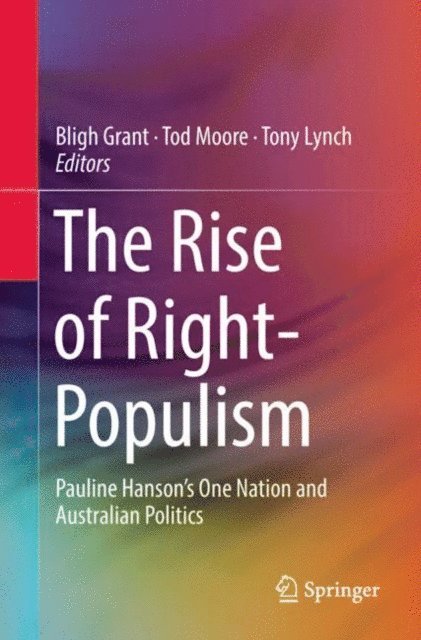
This book is framed by four over-arching narratives of inquiry. While all four are firmly anchored in Australia’s political milieu – and as such are of considerable interest to a range of actors therein (scholars and students, the media, the political class) – they will also be of interest to a global audience. First, ideation. More specifically, what is the nature of populist politics in Australia, why does it consistently resonate with particular electoral demographics, what is the basis of its appeal over and above electoral cycles, and how should we position it in relation to more familiar concepts such as democracy, nationalism and progressive-conservative politics? Second, election. Despite the disparaging tone that the mainstream media can sometimes adopt when discussing electoral outcomes for right-populism and Hanson in particular, why does right-populism consistently resonate with particular electoral demographics, characterizedby various criteria – geographic, social class, gender? How does populism play out in electoral cycles, and how do mainstream political parties capitalize on it for political gain? Third, policy and politics. Much to the disappointment of many, right-populism in Australia generally and PHONP in particular has been influential in policy formulation across a range of domains. These include Indigenous policy and reconciliation, immigration and international relations, industry policy, and the politics of gender. Taking a broader perspective, how does the resurgence of right-populism in Australia today differ from two decades ago, and is the polity, generally speaking, shifting to the right? Fourth, Australia’s right-populism from a comparative international perspective. More specifically, what are the similarities and differences between right-populism in Australia on the one hand and in Europe and the US on the other, and are we justified in concluding, however tentatively, that the rise of right-populism is similar across these polities?
E-bok
Engelska, 2018465 kr
Läs direkt efter köp
This book is framed by four over-arching narratives of inquiry. While all four are firmly anchored in Australia’s political milieu – and as such are of considerable interest to a range of actors therein (scholars and students, the media, the political class) – they will also be of interest to a global audience.
First, ideation. More specifically, what is the nature of populist politics in Australia, why does it consistently resonate with particular electoral demographics, what is the basis of its appeal over and above electoral cycles, and how should we position it in relation to more familiar concepts such as democracy, nationalism and progressive-conservative politics? Second, election. Despite the disparaging tone that the mainstream media can sometimes adopt when discussing electoral outcomes for right-populism and Hanson in particular, why does right-populism consistently resonate with particular electoral demographics, characterizedby various criteria – geographic, social class, gender? How does populism play out in electoral cycles, and how do mainstream political parties capitalize on it for political gain? Third, policy and politics. Much to the disappointment of many, right-populism in Australia generally and PHONP in particular has been influential in policy formulation across a range of domains. These include Indigenous policy and reconciliation, immigration and international relations, industry policy, and the politics of gender. Taking a broader perspective, how does the resurgence of right-populism in Australia today differ from two decades ago, and is the polity, generally speaking, shifting to the right? Fourth, Australia’s right-populism from a comparative international perspective. More specifically, what are the similarities and differences between right-populism in Australia on the one hand and in Europe and the US on the other, and are we justified in concluding, however tentatively, that the rise of right-populism is similar across these polities?