Torsten Müller – författare
Visar alla böcker från författaren Torsten Müller. Handla med fri frakt och snabb leverans.
16 produkter
16 produkter
Del 86 - Travail et Société / Work and Society
Trade Unions in the European Union
Häftad, Engelska, 2023
1 008 kr
Skickas inom 3-6 vardagar
Trade unions have repeatedly been challenged by neoliberal programmes implemented within Member States of theEuropean Union (EU) and at the European level. The twentyseven country chapters at the core of this book chart the features of the neoliberal challenge in the EU Member States and the measures implemented by unions in their attempts to adapt to changed circumstances since 2000. It is clear that union activity, either independently or in conjunction with allies, will be at the centre of revitalization campaigns if the pieces left from the neoliberal challenges are to be picked up and wielded into a coherent response.This book offers a comprehensive comparative overview of the development, structure, and policies of national trade union movements in the EU. It presents an in-depth analysis of the challenges facing these organizations and their strategic and policy responses from 2000 to 2020.
Del 14 - Trade Unions. Past, Present and Future
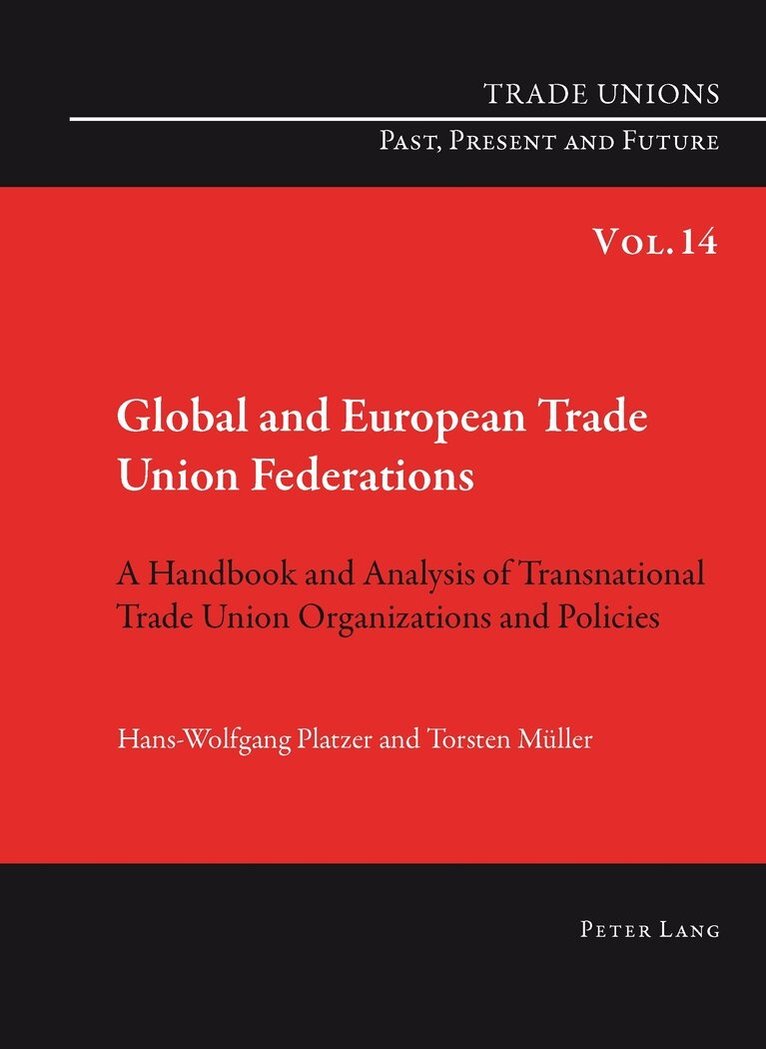
Global and European Trade Union Federations
A Handbook and Analysis of Transnational Trade Union Organizations and Policies- Translated by Pete Burgess
Häftad, Engelska, 2011
1 147 kr
Skickas inom 5-8 vardagar
The continuing advance of globalization, together with deepening European integration, has increased the significance of the transnational level of trade union organization and action. This study offers a comprehensive overview of the development, structure, and policies of global and European trade union federations to serve as a reference work on all the key trade union movements operating globally and in Europe. It presents an in-depth analysis of the challenges facing these organizations and their strategic and policy responses.As a handbook, this volume provides extensive and systematically presented data on transnational sectoral trade union federations. Applying an analogous structure in the presentation of both global and European levels, the study features extensive organizational profiles, portraits, and overviews. This empirical material serves to reveal recent innovations in cross-border policy instruments and strategic approaches since the 1990s. The changing profiles of international trade unions – as measured against a set of functional criteria drawn from political science – and key developments in transnational trade union activity since the start of the new century are also investigated.
Del 19 - Trade Unions. Past, Present and Future
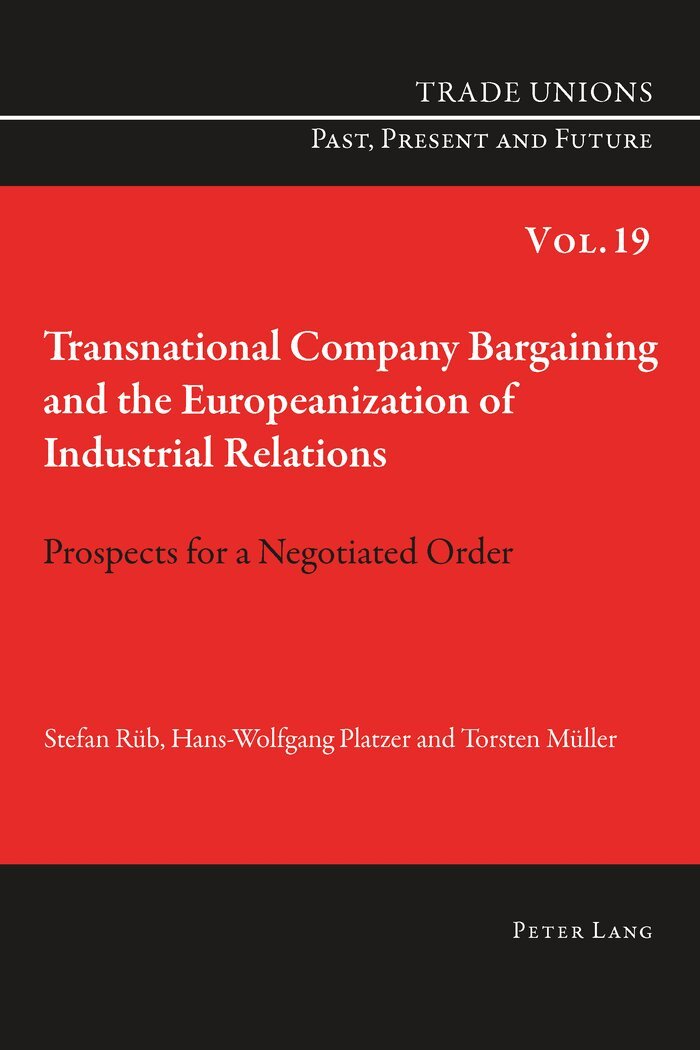
Transnational Company Bargaining and the Europeanization of Industrial Relations
Prospects for a Negotiated Order
Häftad, Engelska, 2013
1 735 kr
Skickas inom 3-6 vardagar
Over the past decade, European company-level employment regulation has emerged: European Works Councils (EWCs) and trade unions have begun to negotiate company-level collective agreements which have a far-reaching impact across borders on issues as diverse as company restructuring, health and safety, and profit-sharing. The negotiating parties have thus begun to fill the gap left by low levels of regulation and little formal structure, necessarily leading them to also bargain about the negotiating process itself.This study is the first to provide a detailed analysis of the process of negotiating European company-level agreements based on ten company case studies as well as a quantitative study of European company-level bargaining in the metalworking industry. The study provides a comprehensive overview of the emerging order of European company-level industrial relations and the strategies and assessments of the key actors, with a particular focus on the emergence of a new and dynamic interplay between EWCs and trade unions at the national and European levels. The findings are also placed in the wider context of political science research into European integration and thus contribute to European governance debates that go beyond the employment and industrial relations field.
Inbunden, Tyska, 2012
360 kr
Skickas inom 5-8 vardagar
The daily work of engineers, for preliminary design and to check plausibility, would be inconceivable without them: design aids for reinforced concrete elements in the form of diagrams and tables. Now newly revised to cover Eurocode 2.
Häftad, Tyska, 2011
782 kr
Skickas inom 3-6 vardagar
Häftad, Tyska, 2011
191 kr
Skickas inom 3-6 vardagar
E-bok
PDF, Engelska, 201375 kr
Läs direkt efter köp
Seminar paper from the year 2012 in the subject Communications - Intercultural Communication, grade: 1,0, LMU Munich, language: English, abstract: One might think that intercultural competency refers especially to sociopolitical aspects. But as a matter of fact, "e;intercultural competence refers to the real world in which we live and act, the world we have created together and continue to re-create daily"e; [Dea06, p. 6], as Dr. Darla K. Deardorff defines it in her work "e;Intercultural Competence - The Key Competence in the 21st Century?"e; Therefore, and that's how she keeps on arguing, "e;the acquisition of intercultural competence is a continual, dynamic process, one that moves through diverse dimensions while developing and enriching itself in an upward spiral"e; [Dea06, p. 6]. That means that it is an ongoing development which is not restricted to any kind of area or group. The premises for intercultural competency are according to Deardorff "e;a general openness for and appreciation of cultural diversity and an ability to encounter and deal with individuals from foreign cultures in an open, curious and unprejudiced manner"e; [Dea06, p. 8]. A cultural education, for example, would promote all these skills. Thus, it is not especially speaking a foreign language, but much more "e;an understanding of others world views; an understanding of the role and impact one's culture has on behavior and communication as well as historical and religious contexts; and a sociolinguistic awareness of the relation between language and meaning in a societal context"e; [Dea06, p. 8], as Deardorff describes it. So, if you do not speak any foreign language, you can still demonstrate intercultural competency by presenting at least one of the mentioned abilities. And always remember, even in silence you are still conveying signals that communicate with others. It is impossible not to communicate. The most important thing, however, is not to be afraid of other cultures or even reject them. Then you will see, on the one hand, that every culture has its beautiful sides and you will get to know great people with ease and, on the other hand, they will appreciate your openness and thoughtfulness immediately. So we can say that intercultural competency is very crucial in our modern world of globalization.
Häftad, Tyska, 2013
377 kr
Skickas inom 3-6 vardagar
Häftad, Tyska, 2013
361 kr
Skickas inom 3-6 vardagar
Häftad, Tyska, 2013
524 kr
Skickas inom 3-6 vardagar
Häftad, Tyska, 2014
377 kr
Skickas inom 3-6 vardagar
Häftad, Tyska, 2014
377 kr
Skickas inom 3-6 vardagar
Häftad, Tyska, 2016
394 kr
Skickas inom 3-6 vardagar
Häftad, Tyska, 2016
539 kr
Skickas inom 3-6 vardagar
Tyska, 2007
190 kr
Skickas inom 3-6 vardagar
Häftad, Tyska, 2003
1 676 kr
Skickas inom 5-8 vardagar