Tridib Banerjee - Böcker
Visar alla böcker från författaren Tridib Banerjee. Handla med fri frakt och snabb leverans.
10 produkter
10 produkter
393 kr
Skickas
652 kr
Tillfälligt slut
1 578 kr
Skickas inom 10-15 vardagar
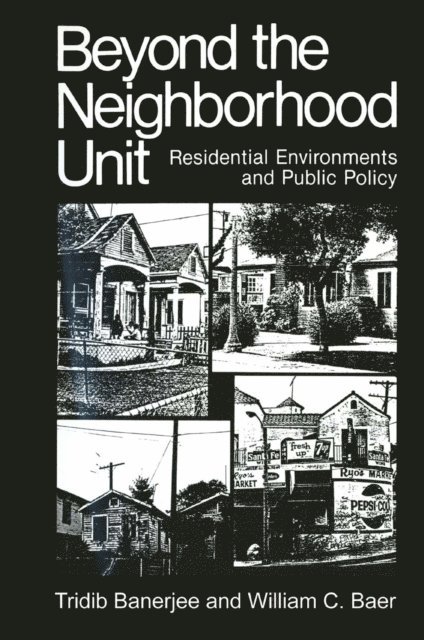
Much of the research on which this book is based was funded almost a decade ago by separate grants from two different agencies of the U. S. Public Health Service, of the then still consolidated Department of Health, Education, and Welfare. The first grant was from the Bureau of Community Environmental Management (Public Health Service Research Grant J-RO J EM 0049-02), and the second from the Center for Studies of Metropolitan Problems of the National Institute of Mental Health (Public Health Service Grant ROJ MH 24904-02). These separate grants were necessary because of budget cuts that truncated our original effort. We were fortunate to receive subsequent assistance from NIMH to conclude the research, as it is doubtful that a project of the scope and intent of our effort--even as completed in abbreviated form-will be funded in the 1980s. The original intent of this project, as formulated by our colleagues Ira Robinson and Alan Kreditor, and as conceptualized earlier by their predeces sors-members of an advisory committee of planners and social scientists ap pointed by the American Public Health Association (APHA)-was to rewrite Planning the Neighborhood, APHA's recommended standards for residential design. In particular, it was proposed that the new study take the point of view of the user in terms of residential standards. Hitherto, the private sector had domi nated these considerations (i. e. , the designer's predilections, the requirements of builders and material suppliers, and lenders' needs for mortgage security).
Urban Design
2013
21 855 kr
Skickas inom 7-10 vardagar
This new collection traces the notion of urban design, its principals and criteria with a focus on key areas such as the new urban developments of Dubai and Shanghai. This set of volumes will appeal to those interested in Urban Geography and cities and their infrastructure.
3 264 kr
Skickas inom 10-15 vardagar
Today the practice of urban design has forged a distinctive identity with applications at many different scales – ranging from the block or street scale to the scale of metropolitan and regional landscapes. Urban design interfaces many aspects of contemporary public policy – multiculturalism, healthy cities, environmental justice, economic development, climate change, energy conservations, protection of natural environments, sustainable development, community liveability, and the like. The field now comprises a core body of knowledge that enfolds a right history of ideas, paradigms, principles, tools, research and applications, enriched by electric influences from the humanities, and social and natural sciences.Companion to Urban Design includes more than fifty original contributions from internationally recognized authorities in the field. These contributions address the following questions: What are the important ideas that have shaped the field and the current practice of urban design? What are the major methods and processes that have influenced the practice of urban design at various scales? What are the current innovations relevant to the pedagogy of urban design? What are the lingering debates, conflicts ad contradictions in the theory and practice of urban design? How could urban design respond to the contemporary challenges of climate change, sustainability, active living initiatives, globalization, and the like? What are the significant disciplinary influences on the theory, research and practice of urban design in recent times?There has never before been a more authoritative and comprehensive companion that includes core, foundational and pioneering ideas and concepts of urban design. This book serves as an invaluable guide for undergraduate and postgraduate students, future professionals, and practitioners interested in architecture, landscape architecture, and urban planning, but also in urban studies, urban affairs, geography, and related fields.
1 089 kr
Skickas inom 3-6 vardagar
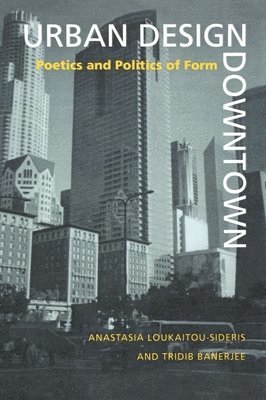
The corporate downtown, with its multitude of social dilemmas and contradictions, is the focus of this well-illustrated volume. How are downtown projects conceived, scripted, produced, packaged, and used, and how has all this changed during the twentieth century? The authors of "Urban Design Downtown" offer a critical appraisal of the emerging appearance of downtown urban form. They explore both the poetics of design and the politics and economics of development decisions. Following a historical review of the various phases of downtown transformation, Anastasia Loukaitou-Sideris and Tridib Banerjee turn to contemporary American downtowns. They examine the phenomenon of public-space privatization, arguing that corporate open spaces are the consumer-oriented result of policies that have promoted downtown renovation and restructuring but at the same time have neglected the cities' existing poverty-stricken cores. The book's case studies of individual West Coast downtown projects capture the essence of late twentieth-century urbanism.This analysis of downtown urban America, which offers extensive insight into the design and development process, will interest architects, city planners, developers, and urban designers everywhere.
663 kr
Skickas inom 10-15 vardagar
The New Companion to Urban Design continues the assemblage of rich and critical ideas about urban form and design that began with the Companion to Urban Design (Routledge, 2011). With chapters from a new set of contributors, this sequel offers a more comparative perspective representing multiple voices and perspectives from the Global South. The essays in this volume are organized in three parts: Part I: Comparative Urbanism; Part II: Challenges; and Part III: Opportunities. Each part contains distinct sections designed to address specific themes, and includes a list of annotated suggested further readings at the end of each chapter. Part I: Comparative Urbanism examines different variants of urbanism in the Global North and the Global South, produced by a new economic order characterized by the mobility of labor, capital, information, and technology. Part II: Challenges discusses some of the contemporary challenges that cities of the Global North and the Global South are facing and the possible role of urban design. This part discusses spatial claims and conflicts, challenges generated by urban informality, explosive growth or dramatic shrinkage of the urban settlement, gentrification and displacement, and mimesis, simulacra and lack of authenticity. Part III: Aspirations discusses some normative goals that urban design interventions aspire to bring about in cities of the Global North and the Global South. These include resilience and sustainability, health, conservation/restoration, justice, intelligence, access and mobility, and arts and culture.The New Companion to Urban Design is primarily intended for scholars and graduate students interested in cities and their built environment. It offers an invaluable and up-to-date guide to current thinking across a range of disciplines including urban design, planning, urban studies, and geography.
3 256 kr
Skickas inom 10-15 vardagar
The New Companion to Urban Design continues the assemblage of rich and critical ideas about urban form and design that began with the Companion to Urban Design (Routledge, 2011). With chapters from a new set of contributors, this sequel offers a more comparative perspective representing multiple voices and perspectives from the Global South. The essays in this volume are organized in three parts: Part I: Comparative Urbanism; Part II: Challenges; and Part III: Opportunities. Each part contains distinct sections designed to address specific themes, and includes a list of annotated suggested further readings at the end of each chapter. Part I: Comparative Urbanism examines different variants of urbanism in the Global North and the Global South, produced by a new economic order characterized by the mobility of labor, capital, information, and technology. Part II: Challenges discusses some of the contemporary challenges that cities of the Global North and the Global South are facing and the possible role of urban design. This part discusses spatial claims and conflicts, challenges generated by urban informality, explosive growth or dramatic shrinkage of the urban settlement, gentrification and displacement, and mimesis, simulacra and lack of authenticity. Part III: Aspirations discusses some normative goals that urban design interventions aspire to bring about in cities of the Global North and the Global South. These include resilience and sustainability, health, conservation/restoration, justice, intelligence, access and mobility, and arts and culture.The New Companion to Urban Design is primarily intended for scholars and graduate students interested in cities and their built environment. It offers an invaluable and up-to-date guide to current thinking across a range of disciplines including urban design, planning, urban studies, and geography.
1 294 kr
Skickas inom 10-15 vardagar
Today the practice of urban design has forged a distinctive identity with applications at many different scales – ranging from the block or street scale to the scale of metropolitan and regional landscapes. Urban design interfaces many aspects of contemporary public policy – multiculturalism, healthy cities, environmental justice, economic development, climate change, energy conservations, protection of natural environments, sustainable development, community liveability, and the like. The field now comprises a core body of knowledge that enfolds a right history of ideas, paradigms, principles, tools, research and applications, enriched by electric influences from the humanities, and social and natural sciences.Companion to Urban Design includes more than fifty original contributions from internationally recognized authorities in the field. These contributions address the following questions: What are the important ideas that have shaped the field and the current practice of urban design? What are the major methods and processes that have influenced the practice of urban design at various scales? What are the current innovations relevant to the pedagogy of urban design? What are the lingering debates, conflicts ad contradictions in the theory and practice of urban design? How could urban design respond to the contemporary challenges of climate change, sustainability, active living initiatives, globalization, and the like? What are the significant disciplinary influences on the theory, research and practice of urban design in recent times?There has never before been a more authoritative and comprehensive companion that includes core, foundational and pioneering ideas and concepts of urban design. This book serves as an invaluable guide for undergraduate and postgraduate students, future professionals, and practitioners interested in architecture, landscape architecture, and urban planning, but also in urban studies, urban affairs, geography, and related fields.
1 578 kr
Skickas inom 10-15 vardagar
Much of the research on which this book is based was funded almost a decade ago by separate grants from two different agencies of the U. S. Public Health Service, of the then still consolidated Department of Health, Education, and Welfare. The first grant was from the Bureau of Community Environmental Management (Public Health Service Research Grant J-RO J EM 0049-02), and the second from the Center for Studies of Metropolitan Problems of the National Institute of Mental Health (Public Health Service Grant ROJ MH 24904-02). These separate grants were necessary because of budget cuts that truncated our original effort. We were fortunate to receive subsequent assistance from NIMH to conclude the research, as it is doubtful that a project of the scope and intent of our effort--even as completed in abbreviated form-will be funded in the 1980s. The original intent of this project, as formulated by our colleagues Ira Robinson and Alan Kreditor, and as conceptualized earlier by their predeces sors-members of an advisory committee of planners and social scientists ap pointed by the American Public Health Association (APHA)-was to rewrite Planning the Neighborhood, APHA's recommended standards for residential design. In particular, it was proposed that the new study take the point of view of the user in terms of residential standards. Hitherto, the private sector had domi nated these considerations (i. e. , the designer's predilections, the requirements of builders and material suppliers, and lenders' needs for mortgage security).