Troy McDaniel - Böcker
Visar alla böcker från författaren Troy McDaniel. Handla med fri frakt och snabb leverans.
8 produkter
8 produkter
545 kr
Skickas inom 3-6 vardagar
1 387 kr
Skickas inom 10-15 vardagar
This book is the first resource to provide in-depth coverage on topical areas of assistive, rehabilitative, and health-related applications for haptic (touch-based) technologies. Application topics are grouped into thematic areas spanning haptic devices for sensory impairments, health and well-being, and physical impairments which are illustrated in this book. A diverse group of experts in the field were invited to contribute different chapters to provide complementary and multidisciplinary perspectives. Unlike other books on haptics, which focus on human haptic perception, specific modalities of haptics (e.g., realistic haptic rendering), or broadly cover the subfields of haptics, this book takes an application-oriented approach to present a tour of how the field of haptics has been advanced with respect to important, impactful thematic focuses.Under Theme 1 “Sensory Impairments”, haptics technologies to support individuals with sensory impairments is presented which includes: Spatial awareness in sensory impairments through touch; Haptically-assisted interfaces for persons with visual impairments; and Enabling learning experiences for visually impaired children by interaction design. Under Theme 2 “Haptics for Health and Well-Being”, haptics technologies aimed at supporting exercise and healthy aging will be covered including: Haptics in rehabilitation, exergames and health; Therapeutic haptics for mental health and well-being; and Applications of haptics in medicine. Under Theme 3 “Haptics for Physical Impairments”, haptics technologies for enhancing the quality of life for individuals with weakened/impaired limbs or neurological diseases impacting movement is targeted including: Assistive soft exoskeletons with pneumatic artificial muscles; Haptics for accessibility in rehabilitative hardware; and intelligent robotics and immersive displays for enhancing haptic interaction in physical rehabilitation environments.Engineers, scientists, and researchers working in the areas of haptics, multimedia, virtual/augmented/mixed-reality, human-computer interaction, assistive technologies, rehabilitative technologies, healthcare technologies, and/or actuator design will want to purchase this book. Advanced level students and hobbyists interested in haptics will also be interested in this book.
963 kr
Skickas inom 10-15 vardagar
This book is the first resource to provide in-depth coverage on topical areas of assistive, rehabilitative, and health-related applications for haptic (touch-based) technologies. Application topics are grouped into thematic areas spanning haptic devices for sensory impairments, health and well-being, and physical impairments which are illustrated in this book. A diverse group of experts in the field were invited to contribute different chapters to provide complementary and multidisciplinary perspectives. Unlike other books on haptics, which focus on human haptic perception, specific modalities of haptics (e.g., realistic haptic rendering), or broadly cover the subfields of haptics, this book takes an application-oriented approach to present a tour of how the field of haptics has been advanced with respect to important, impactful thematic focuses.Under Theme 1 “Sensory Impairments”, haptics technologies to support individuals with sensory impairments is presented which includes: Spatial awareness in sensory impairments through touch; Haptically-assisted interfaces for persons with visual impairments; and Enabling learning experiences for visually impaired children by interaction design. Under Theme 2 “Haptics for Health and Well-Being”, haptics technologies aimed at supporting exercise and healthy aging will be covered including: Haptics in rehabilitation, exergames and health; Therapeutic haptics for mental health and well-being; and Applications of haptics in medicine. Under Theme 3 “Haptics for Physical Impairments”, haptics technologies for enhancing the quality of life for individuals with weakened/impaired limbs or neurological diseases impacting movement is targeted including: Assistive soft exoskeletons with pneumatic artificial muscles; Haptics for accessibility in rehabilitative hardware; and intelligent robotics and immersive displays for enhancing haptic interaction in physical rehabilitation environments.Engineers, scientists, and researchers working in the areas of haptics, multimedia, virtual/augmented/mixed-reality, human-computer interaction, assistive technologies, rehabilitative technologies, healthcare technologies, and/or actuator design will want to purchase this book. Advanced level students and hobbyists interested in haptics will also be interested in this book.
Del 12015 - Lecture Notes in Computer Science
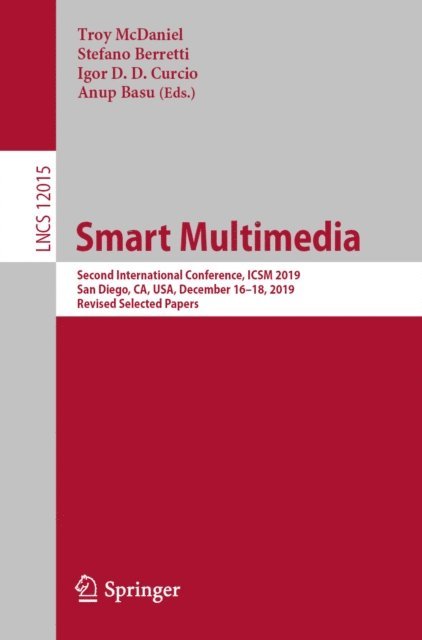
Smart Multimedia
Second International Conference, ICSM 2019, San Diego, CA, USA, December 16–18, 2019, Revised Selected Papers
Häftad, Engelska, 2020
554 kr
Skickas inom 10-15 vardagar
This book constitutes the proceedings of the Second International Conference on Smart Multimedia, ICSM 2019, which was held in San Diego, CA, USA, in December 2019. The 45 papers presented were selected from about 100 submissions and are grouped in sections on 3D mesh and depth image processing;
1 069 kr
Skickas inom 10-15 vardagar
The book Multimedia for Accessible Human Computer Interfaces is to be the first resource to provide in-depth coverage on topical areas of multimedia computing (images, video, audio, speech, haptics, VR/AR, etc.) for accessible and inclusive human computer interfaces. Topics are grouped into thematic areas spanning the human senses: Vision, Hearing, Touch, as well as Multimodal applications. Each chapter is written by different multimedia researchers to provide complementary and multidisciplinary perspectives. Unlike other related books, which focus on guidelines for designing accessible interfaces, or are dated in their coverage of cutting edge multimedia technologies, Multimedia for Accessible Human Computer Interfaces takes an application-oriented approach to present a tour of how the field of multimedia is advancing access to human computer interfaces for individuals with disabilities.Under Theme 1 “Vision-based Technologies for Accessible Human Computer Interfaces”, multimedia technologies to enhance access to interfaces through vision will be presented including: “A Framework for Gaze-contingent Interfaces”, “Sign Language Recognition”, “Fusion-based Image Enhancement and its Applications in Mobile Devices”, and “Open-domain Textual Question Answering Systems”. Under Theme 2 “Auditory Technologies for Accessible Human Computer Interfaces”, multimedia technologies to enhance access to interfaces through hearing will be presented including: “Speech Recognition for Individuals with Voice Disorders” and “Socially Assistive Robots for Storytelling and Other Activities to Support Aging in Place”. Under Theme 3 “Haptic Technologies for Accessible Human Computer Interfaces”, multimedia technologies to enhance access to interfaces through haptics will be presented including: “Accessible Smart Coaching Technologies Inspired by Elderly Requisites” and “Haptic Mediators for Remote Interpersonal Communication”. Under Theme 4 “Multimodal Technologies for AccessibleHuman Computer Interfaces”, multimedia technologies to enhance access to interfaces through multiple modalities will be presented including: “Human-Machine Interfaces for Socially Connected Devices: From Smart Households to Smart Cities” and “Enhancing Situational Awareness and Kinesthetic Assistance for Clinicians via Augmented-Reality and Haptic Shared-Control Technologies”.
1 069 kr
Skickas inom 10-15 vardagar
The book Multimedia for Accessible Human Computer Interfaces is to be the first resource to provide in-depth coverage on topical areas of multimedia computing (images, video, audio, speech, haptics, VR/AR, etc.) for accessible and inclusive human computer interfaces. Topics are grouped into thematic areas spanning the human senses: Vision, Hearing, Touch, as well as Multimodal applications. Each chapter is written by different multimedia researchers to provide complementary and multidisciplinary perspectives. Unlike other related books, which focus on guidelines for designing accessible interfaces, or are dated in their coverage of cutting edge multimedia technologies, Multimedia for Accessible Human Computer Interfaces takes an application-oriented approach to present a tour of how the field of multimedia is advancing access to human computer interfaces for individuals with disabilities.Under Theme 1 “Vision-based Technologies for Accessible Human Computer Interfaces”, multimedia technologies to enhance access to interfaces through vision will be presented including: “A Framework for Gaze-contingent Interfaces”, “Sign Language Recognition”, “Fusion-based Image Enhancement and its Applications in Mobile Devices”, and “Open-domain Textual Question Answering Systems”. Under Theme 2 “Auditory Technologies for Accessible Human Computer Interfaces”, multimedia technologies to enhance access to interfaces through hearing will be presented including: “Speech Recognition for Individuals with Voice Disorders” and “Socially Assistive Robots for Storytelling and Other Activities to Support Aging in Place”. Under Theme 3 “Haptic Technologies for Accessible Human Computer Interfaces”, multimedia technologies to enhance access to interfaces through haptics will be presented including: “Accessible Smart Coaching Technologies Inspired by Elderly Requisites” and “Haptic Mediators for Remote Interpersonal Communication”. Under Theme 4 “Multimodal Technologies for AccessibleHuman Computer Interfaces”, multimedia technologies to enhance access to interfaces through multiple modalities will be presented including: “Human-Machine Interfaces for Socially Connected Devices: From Smart Households to Smart Cities” and “Enhancing Situational Awareness and Kinesthetic Assistance for Clinicians via Augmented-Reality and Haptic Shared-Control Technologies”.
1 900 kr
Skickas inom 7-10 vardagar
This book illustrates how the advanced technology developed for smart cities requires increasing interaction with citizens to motivate and incentive them. Gamification, serious games, machine learning, dynamic interfaces, and social networks are some elements integrated holistically to provide novel solutions to design and develop smart cities.
1 900 kr
Skickas inom 10-15 vardagar
This book illustrates how the advanced technology developed for smart cities requires increasing interaction with citizens to motivate and incentive them. Gamification, serious games, machine learning, dynamic interfaces, and social networks are some elements integrated holistically to provide novel solutions to design and develop smart cities.