Tullio Viola – författare
1 004 kr
Läs direkt efter köp
"I do not think I ever reflect in words: I employ visual diagrams [...]" Diese Selbstbeschreibung von Charles S. Peirce (1839-1914) bildet den Ausgangspunkt für eine neue Sicht auf das Denken des amerikanischen Naturwissenschaftlers, Philosophen und Begründers des Pragmatismus und der Semiotik. Peirce war ein obsessiver Zeichner. Neben einer graphischen Logik entwickelte er eine zeichnerische Praxis, die untrennbar mit seinem Denken verwoben war, in ihrer philosophischen Relevanz aber bislang übersehen wurde. Der Band versammelt konkrete Fallstudien zu zahlreichen hier erstmals publizierten Zeichnungen von Peirce. Auf der Basis dieses Materials fragt er nach der allgemeinen Bedeutung dessen, was es heißt, in Bildern zu denken. Mit Beiträgen von John Michael Krois, Helmut Pape, Sun-Joo Shin, Frederik Stjernfelt u.a.
1 352 kr
Skickas inom 5-8 vardagar
1 364 kr
Läs direkt efter köp
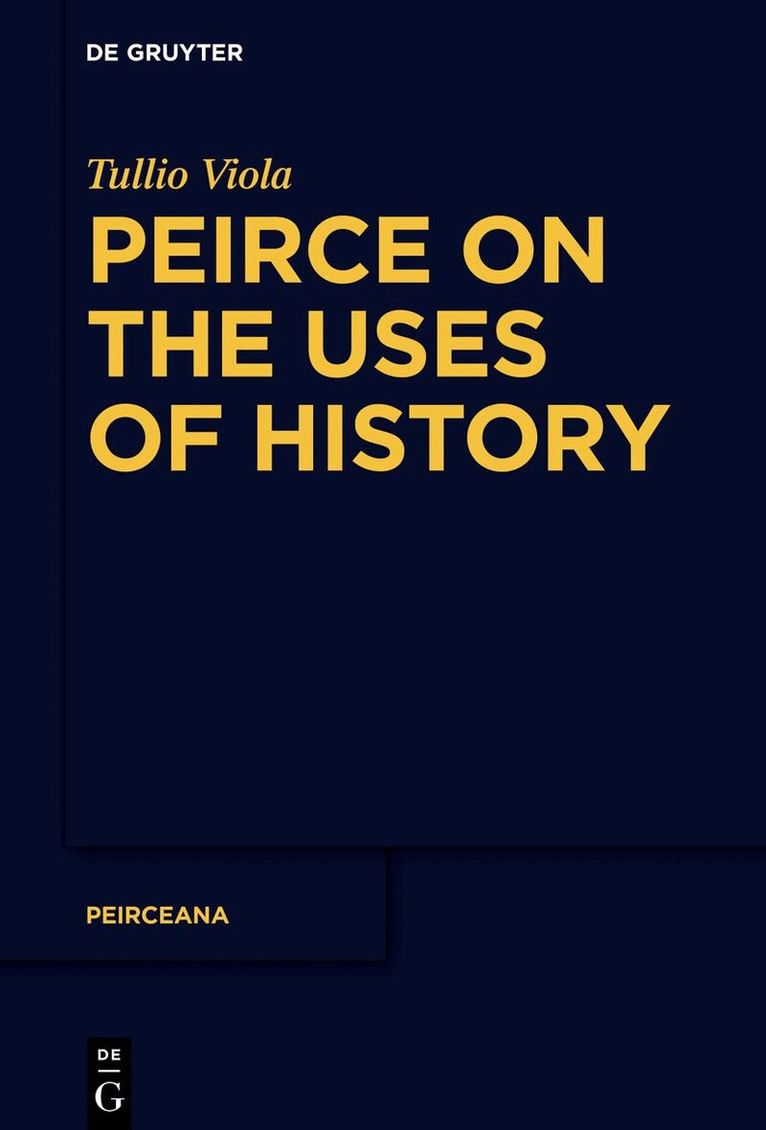
The present book is the first to undertake a systematic study of Peirce’s
conception of historical knowledge and of its value for philosophy. It does
so by both reconstructing in detail Peirce’s arguments and giving a
detailed account of the many ways in which history becomes an object of
explicit reflection in his writings.
The book’s leading idea may be stated as follows: Peirce manages to put
together an exceptionally compelling argument about history’s bearing on
philosophy not so much because he derives it from a well-articulated and
polished conception of the relation between the two disciplines; but on
the contrary, because he holds on to this relation while intuiting that it
can easily turn into a conflict. This potential conflict acts therefore as a
spur to put forth an unusually profound and multi-faceted analysis of
what it means for philosophy to rely on historical arguments.
Peirce looks at history as a way to render philosophical investigations
more detailed, more concrete and more sensitive to the infinite and
unforeseeable nuances that characterize human experience. In this way,
he provides us with an exceptionally valuable contribution to a question
that has remained gravely under-theorized in contemporary debates.
1 364 kr
Läs direkt efter köp
The present book is the first to undertake a systematic study of Peirce’s
conception of historical knowledge and of its value for philosophy. It does
so by both reconstructing in detail Peirce’s arguments and giving a
detailed account of the many ways in which history becomes an object of
explicit reflection in his writings.
The book’s leading idea may be stated as follows: Peirce manages to put
together an exceptionally compelling argument about history’s bearing on
philosophy not so much because he derives it from a well-articulated and
polished conception of the relation between the two disciplines; but on
the contrary, because he holds on to this relation while intuiting that it
can easily turn into a conflict. This potential conflict acts therefore as a
spur to put forth an unusually profound and multi-faceted analysis of
what it means for philosophy to rely on historical arguments.
Peirce looks at history as a way to render philosophical investigations
more detailed, more concrete and more sensitive to the infinite and
unforeseeable nuances that characterize human experience. In this way,
he provides us with an exceptionally valuable contribution to a question
that has remained gravely under-theorized in contemporary debates.
292 kr
Skickas inom 5-8 vardagar
1 623 kr
Skickas inom 5-8 vardagar