Tuncer I. Ören - Böcker
Visar alla böcker från författaren Tuncer I. Ören. Handla med fri frakt och snabb leverans.
2 produkter
2 produkter
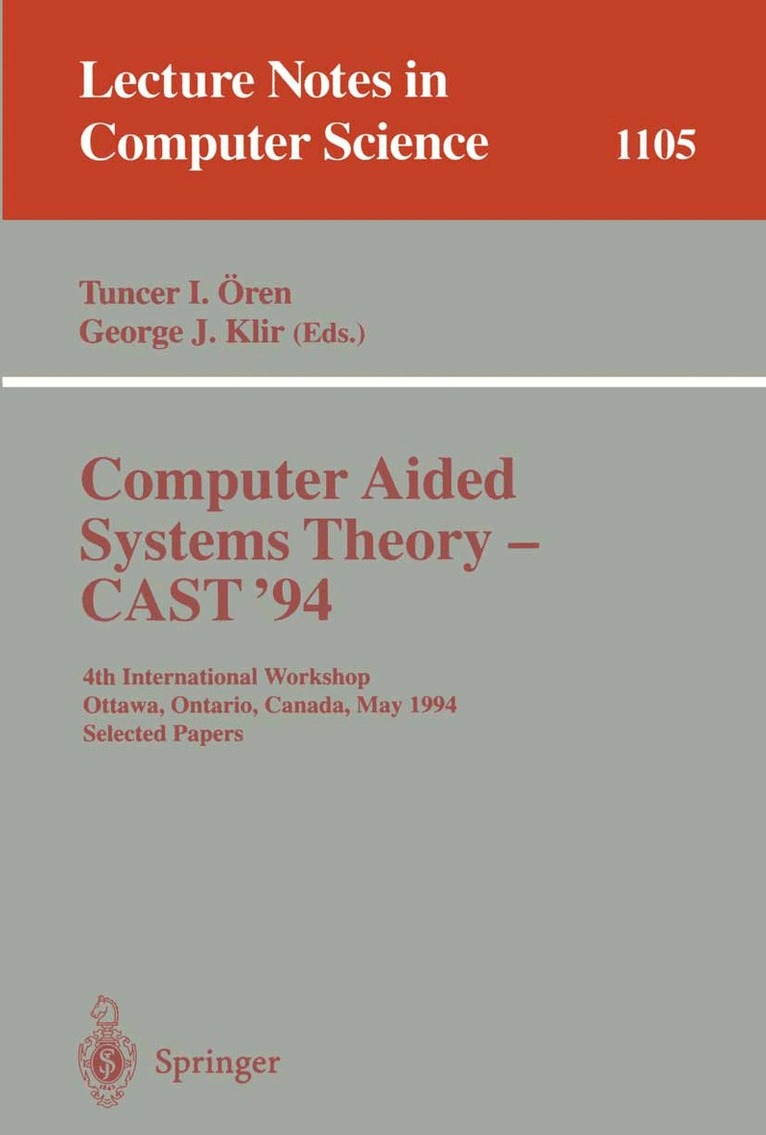
Computer Aided Systems Theory - CAST '94
4th International Workshop, Ottawa, Ontario, May 16 - 20, 1994. Selected Papers
Häftad, Engelska, 1996
552 kr
Skickas inom 10-15 vardagar
This volume presents a collection of revised refereed papers selected from the presentations at the Fourth International Workshop on Computer Aided Systems Theory - CAST '94, held in Ottawa, Ontario, Canada in May 1994.The 31 full papers included in the book were chosen from originally 82 submissions and reflect the state of the art in the area of computer aided systems theory. The volume is divided into sections on foundations, methods, and tools and environments.
1 096 kr
Skickas inom 10-15 vardagar
Simulation, like a gem, is multi-faceted. Several subfields of simulation have emerged based on the characteristics of models used in a simulation study, on the nature and the generation characteristics of model behavior, also on the agent soch as a computer which generates model behavior. For example, one distinguishes: - deterministic simulation, stochastic simulation, stiff simulation based on functional rela- tionships of descriptive vuriables of models used; - combined simulation, continuous simulation, discrete simulation, process simulation, dis- crete event simulation, activity-scanning simulation based on characteristics of descrip- tive variables of modelS; variable topology simulation soch as moving boundary simulation, cellular simulation and fixed topology simulation soch as boundary-value simulation and network simulation (network flow simulation, Petri-net simulation, bond-graph simulation) based on spatial distribution of models; - simulation with fixed organization models (soch as simulation with hierarchical models) and simulation with variable organization models (i.e., autopoietic simulation) soch as metamorphic simulation, simulation with self-organizating models, simulation with self- learning models, evolutionary simulation based on orgCl"lization of component models; - state-maintaining simulation, behaviorally adaptive simulation, goal-seeking simulation, purposive simulation, purposeful simulation, ideal-seeking simulation based on goal(s) to be pursued by the model; - trajectory simulation, stroctural simulation, real-time simulation, predictive simulation, prescriptive simulation, intermittent simulation (such as regenerative simulation, opti- mizing simulation, gaming simulation, conferencing simulation, on-line simulation) based on nature md generation characteristics of model behavior; and - simulators such as aircraft simulator, earthquake simulator where physical analog can be