Tundi S. Agardy – författare
760 kr
Läs direkt efter köp
630 kr
Skickas inom 10-15 vardagar
3 753 kr
Skickas inom 10-15 vardagar
1 052 kr
Läs direkt efter köp
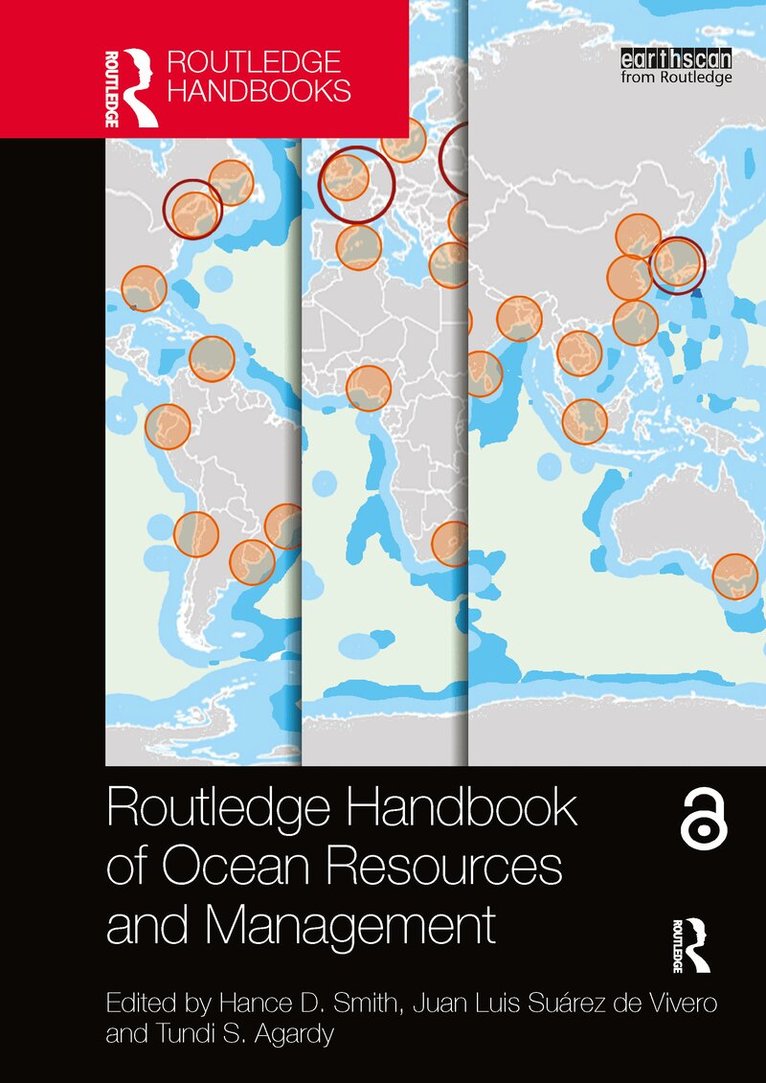
This comprehensive handbook provides a global overview of ocean resources and management by focusing on critical issues relating to human development and the marine environment, their interrelationships as expressed through the uses of the sea as a resource, and the regional expression of these themes. The underlying approach is geographical, with prominence given to the biosphere, political arrangements and regional patterns – all considered to be especially crucial to the human understanding required for the use and management of the world''s oceans.
Part one addresses key themes in our knowledge of relationships between people and the sea on a global scale, including economic and political issues, and understanding and managing marine environments. Part two provides a systematic review of the uses of the sea, grouped into food, ocean space, materials and energy, and the sea as an environmental resource. Part three on the geography of the sea considers management strategies especially related to the state system, and regional management developments in both core economic regions and the developing periphery.
Chapter 23 of this book is freely available as a downloadable Open Access PDF under a Creative Commons Attribution-Non Commercial-No Derivatives 3.0 license. https://www.routledgehandbooks.com/doi/10.4324/9780203115398.ch23
1 052 kr
Läs direkt efter köp
This comprehensive handbook provides a global overview of ocean resources and management by focusing on critical issues relating to human development and the marine environment, their interrelationships as expressed through the uses of the sea as a resource, and the regional expression of these themes. The underlying approach is geographical, with prominence given to the biosphere, political arrangements and regional patterns – all considered to be especially crucial to the human understanding required for the use and management of the world''s oceans.
Part one addresses key themes in our knowledge of relationships between people and the sea on a global scale, including economic and political issues, and understanding and managing marine environments. Part two provides a systematic review of the uses of the sea, grouped into food, ocean space, materials and energy, and the sea as an environmental resource. Part three on the geography of the sea considers management strategies especially related to the state system, and regional management developments in both core economic regions and the developing periphery.
Chapter 23 of this book is freely available as a downloadable Open Access PDF under a Creative Commons Attribution-Non Commercial-No Derivatives 3.0 license. https://www.routledgehandbooks.com/doi/10.4324/9780203115398.ch23
891 kr
Läs direkt efter köp
Our knowledge of the oceans is increasing rapidly, as more powerful tools for exploration and exploitation make it easier to locate valuable resources, such as fish stocks, oil and gas reserves, or sites for wind and hydropower schemes. At the same time competition for space has intensified, affecting marine life and people''s livelihoods. Much has been written about marine management using marine protected areas, but MPAs are only a small subset of spatial management tools available. MPAs and MPA networks are better seen as starting points for more comprehensive spatial management, facilitated by ocean zoning. This logical scaling up from discreet piecemeal protected areas to larger and more systematic planning is happening around the world, but few are aware that we are entering a brave new world in ocean management with zoning at its core.
This book provides guidance on using ocean zoning to improve marine management. It reviews the benefits of ocean zoning in theory, reviews progress made in zoning around the world through a wide range of case studies, and derives lessons learned to recommend a process by which future zoning can be maximally effective and efficient.
Published with MARES, Forest Trends and UNEP
891 kr
Läs direkt efter köp
Our knowledge of the oceans is increasing rapidly, as more powerful tools for exploration and exploitation make it easier to locate valuable resources, such as fish stocks, oil and gas reserves, or sites for wind and hydropower schemes. At the same time competition for space has intensified, affecting marine life and people''s livelihoods. Much has been written about marine management using marine protected areas, but MPAs are only a small subset of spatial management tools available. MPAs and MPA networks are better seen as starting points for more comprehensive spatial management, facilitated by ocean zoning. This logical scaling up from discreet piecemeal protected areas to larger and more systematic planning is happening around the world, but few are aware that we are entering a brave new world in ocean management with zoning at its core.
This book provides guidance on using ocean zoning to improve marine management. It reviews the benefits of ocean zoning in theory, reviews progress made in zoning around the world through a wide range of case studies, and derives lessons learned to recommend a process by which future zoning can be maximally effective and efficient.
Published with MARES, Forest Trends and UNEP
1 004 kr
Skickas inom 10-15 vardagar