Urban Grasjo – författare
430 kr
Läs direkt efter köp
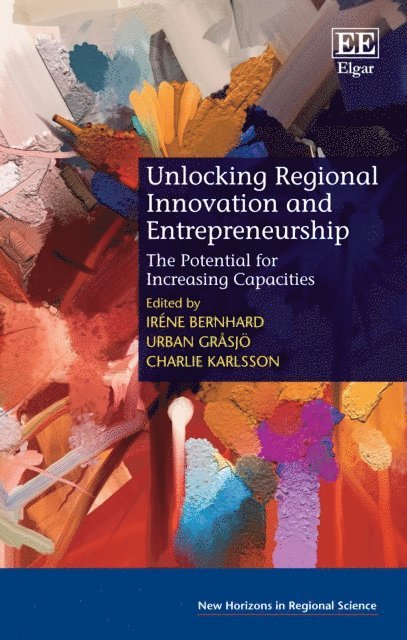
Extending our understanding of the many different ways that innovation and entrepreneurship contribute to economic development and growth in a globalized economy, the expert contributors highlight that the current wave of globalization has been a period of exceptional entrepreneurship both among large multinational firms and among independent entrepreneurs. They demonstrate that location matters for creativity, innovation and entrepreneurship, and clarify that public policy in a globalized economy must stress knowledge and ideas as the source of competitiveness and economic growth.
Both graduates and post graduates, along with university researchers, will find this book to be useful in their studies, particularly those with an interest in innovation and entrepreneurship research, regional economics, economic geography and international economics.
Contributors: M.J.Abellán Madrid, J. Abrahamsson, M. Andersson, S. Anokhin, R. Antonietti, D.B. Audretsch, M. Belitski, H. Boter, A. Broström, M.R. Ferrante, A. García-Tabuenca, N.M.George, U. Gråsjö, K.E. Haynes, V. Jienwatcharamongkhol, C. Karlsson, B. Kianian, T.C. Larsson, R. Leoncini, C.Y. Liu, M. McKelvey, G. Painter, J. Parajuli, V. Parida, C. Suárez Gálvez, M.G.A. Svensson, S. Tavassoli, V. Vanyushyn, Q. Wang, K.I. Westeren, J. Wincent, S. Wixe
443 kr
Läs direkt efter köp
Geography, Open Innovation and Entrepreneurship discusses entrepreneurship from both theoretical and empirical viewpoints to provide readers with a wide range of cutting-edge and compelling studies. The authors highlight the critical importance of open innovation for performance and progress, putting forward determinants of economic growth and development rarely analyzed in standard growth studies.
Researchers and students will find this book useful for innovation and entrepreneurship studies. It is also a helpful tool for policymakers, planners and consultants involved in economic development and regional policies.
Contributors include: F. Armellini, T. Arvemo, I. Bernhard, C. Beaudry, P.-O. Bjuggren, A. Caloffi, N. Carbonara, A.P. Cornett, K. Delbiaggio, M. Elmoznino Laufer, S. Fredin, U. Gråsjö, C.J. Hauser, M. Héroux-Vaillancourt, J.A. Jordaan, A. Johnston, C. Karlsson, M. Kaufmann, P. Lassalle, M. Mahon, V. Monastiriotis, R. Pellegrino, H. Reijonen, R. Righi, S. Rohde, F. Rossi, M. Russo, J. Saastamoinen, T. Tammi, S. Yamamura
430 kr
Läs direkt efter köp
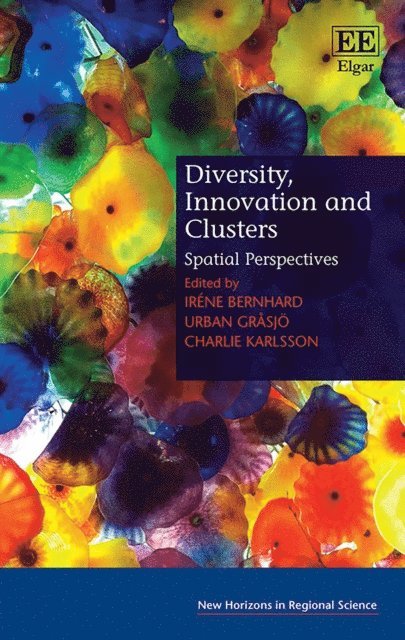
This thought-provoking book addresses the questions regarding diversity, innovation and clusters that require further investigation and analysis. Chapters written by expert contributors bring together cutting-edge theoretical and empirical studies to consider issues such as how spatial diversity affects collaboration, knowledge and innovation; how innovation arises in various locations; how innovative approaches can be identified for local regeneration; and how the growing visibility and importance of start-up companies in the global economy can be analysed.
Diversity, Innovation and Clusters will be a key resource for students and academics researching in the fields of economic geography, regional economics, innovation and entrepreneurship. This book provides insights that will be crucial for providing policy makers, planners and consultants with a more comprehensive decision-making platform by utilising spatial perspectives as a driving force for economic growth and development.
Contributors include: T. Arvemo, D. Bartlett, K. Berg, I. Bernhard, U. Gråsjö, T. Grønning, M. Imase, I. Jonsson, C. Karlsson, N. Kishida, U. Lundh Snis, M. McKelvey, T. Maeno, L. Mósesdóttir, T. Mroczkowski, G.F. Mulligan, M. Okuyama, A.K. Olsson, K. Sakakura, T. Yasui
430 kr
Läs direkt efter köp
Bringing together a wide range of cutting-edge case studies and research on regional potentials, the book explores the need for a focus on the regional inequality aspects of innovating, knowledge and entrepreneurship. Chapters analyse previously underexplored determinants of regional economic growth and development often overlooked in standard growth studies. They offer a deeper understanding of the drivers and implications of sub-national disparities in entrepreneurship and innovation in both developed and developing countries.
Scholars and researchers of innovation, entrepreneurship, regional economics and spatial planning will appreciate the blend of empirical and theoretical viewpoints in the book. It will also be a useful tool for policymakers, planners and consultants involved in economic development and regional policies on different scales.