Van de Velde Freek Van de Velde – författare
Visar alla böcker från författaren Van de Velde Freek Van de Velde. Handla med fri frakt och snabb leverans.
4 produkter
4 produkter
E-bok
PDF, Engelska, 20161 317 kr
Läs direkt efter köp
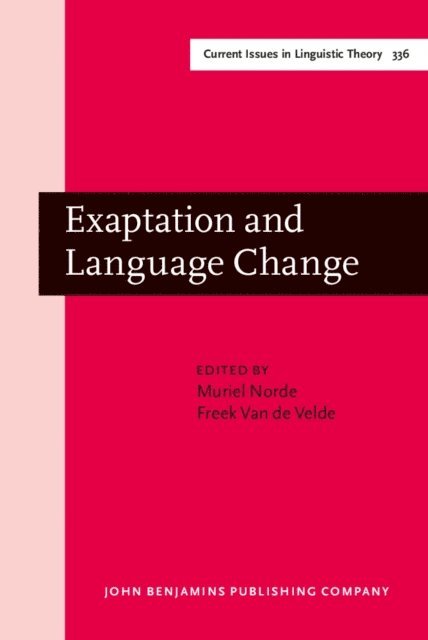
This volume is the first collection of papers that is exclusively dedicated to the concept of exaptation, a notion from evolutionary biology that was famously introduced into linguistics by Roger Lass in 1990. The past quarter-century has seen a heated debate on the properties of linguistic exaptation, its demarcation from other processes of linguistic change, and indeed the question of whether it is a useful concept in historical linguistics at all. The contributions in the present volume reflect these diverging points of view. Along with a comprehensive introduction, covering the history of the notion of exaptation from its conception in the field of biology to its adoption in linguistics, the book offers extensive discussion of the concept from various theoretical perspectives, detailed case studies as well as critical reviews of some stock examples. The book will be of interest to scholars working in the fields of evolutionary linguistics, historical linguistics, and the history of linguistics.
E-bok
PDF, Engelska, 20151 195 kr
Läs direkt efter köp
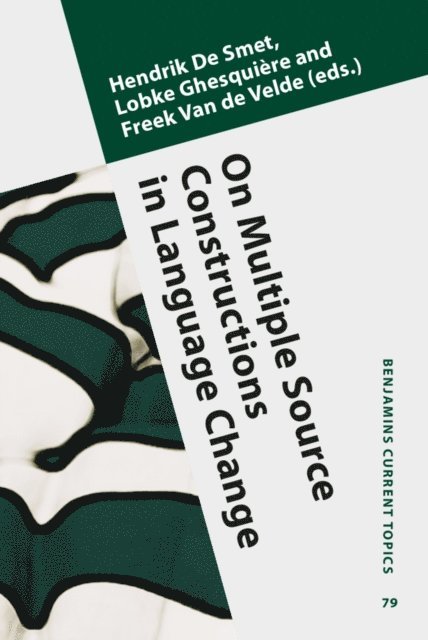
In much writing on language change, there is a tacit assumption that change operates on a single source construction to produce an innovative target construction. This volume challenges this assumption, by showing that many changes involve interactions between multiple source constructions. In fact, the involvement of multiple source constructions is unexceptional. The phenomenon is observed in phonology, morphology, syntax and semantics. It is seen in language-internal change as well as in contact-induced change. Interactions may obtain between independent but historically related constructions as well as between historically unrelated constructions. The contributions to this volume, on the one hand, present specific case studies on changes involving multiple source constructions, in various domains of grammar and in a variety of languages. On the other hand, they discuss how such changes can be accommodated in current theoretical models of language.Originally published in Studies in Language Vol. 37:3 (2013).
E-bok
PDF, Engelska, 20141 117 kr
Läs direkt efter köp
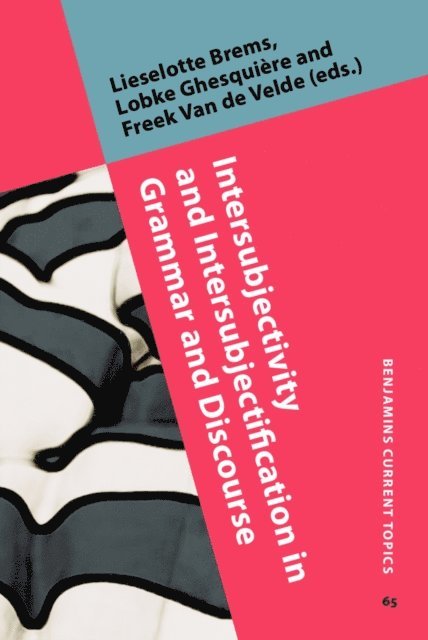
Recent years saw a growing interest in the study of subjectivity, as the linguistic expression of speaker involvement. Intersubjectivity, defined by Traugott as "the linguistic expression of a speaker/writer''s attention to the hearer/reader", on the other hand, has so far received little explicit attention in its own right, let alone systematic definition and operationalization. Intersubjectivity and seemingly related notions such as interpersonal meaning, appraisal, stance and metadiscourse, frequently appear in cognitive-functional accounts, as well as historical and more applied approaches. These domains offer (partly) conflicting uses of ''intersubjectivity'', differ in the overall scope of the concept and the phenomena it may cover.This book brings together contributions from a variety of different approaches, with the aim of disentangling the current web of intertwined notions of intersubjectivity. Rather than focusing on the potentially conflicting views, the volume aspires to resolve some of the conceptual puzzle by cross-fertilization between the different views, and spark discussion on how to operationalize ''intersubjectivity'' in linguistic research. Originally published in English Text Construction 5:1 (2012).
E-bok
PDF, Engelska, 20141 305 kr
Läs direkt efter köp
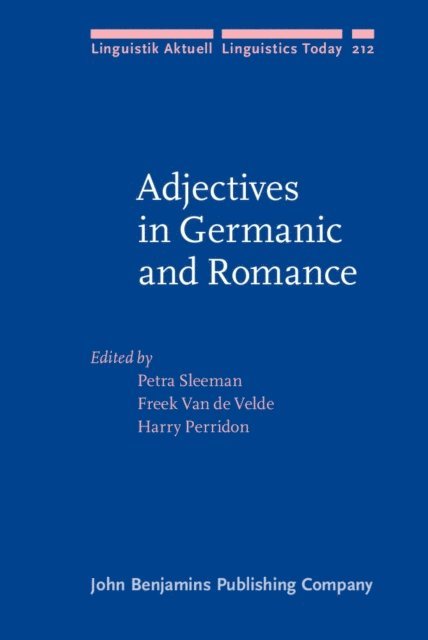
Although the Germanic and Romance languages are two branches of the same language family and although both have developed the adjective as a separate syntactic and morphological category, the syntax, morphology, and interpretation of adjectives is by no means the same in these two language groups, and there is even variation within each of the language groups. One of the main aims of this volume is to map the differences and similarities in syntactic behavior, morphology, and meaning of the Germanic and Romance adjective and to find an answer to the following question: Are the (dis)similarities the result of autonomous developments in each of the two branches of the Indo-European language family, or are they caused by language contact?