Vasudevan Lakshminarayanan – författare
2 150 kr
Skickas inom 3-6 vardagar
Publisher's Note: Products purchased from Third Party sellers are not guaranteed by the publisher for quality, authenticity, or access to any online entitlements included with the product.
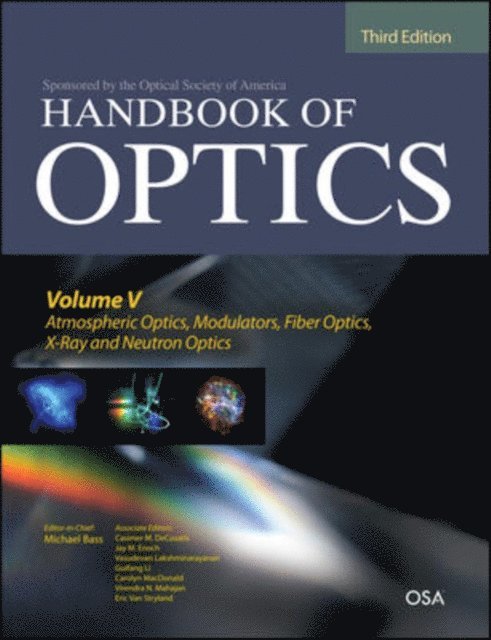
The most comprehensive and up-to-date optics resource available
Prepared under the auspices of the Optical Society of America, the five carefully architected and cross-referenced volumes of the Handbook of Optics, Third Edition, contain everything a student, scientist, or engineer requires to actively work in the field. From the design of complex optical systems to world-class research and development methods, this definitive publication provides unparalleled access to the fundamentals of the discipline and its greatest minds.
Individual chapters are written by the world's most renowned experts who explain, illustrate, and solve the entire field of optics. Each volume contains a complete chapter listing for the entire Handbook, extensive chapter glossaries, and a wealth of references. This pioneering work offers unprecedented coverage of optics data, techniques, and applications.
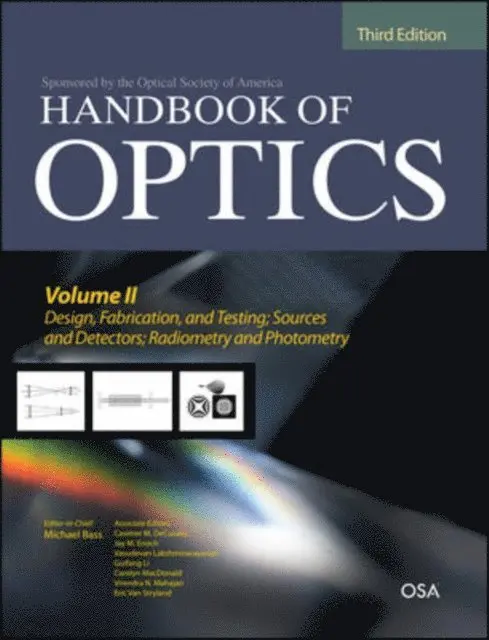
Volume II covers design, fabrications, testing, sources, detectors, radiometry, and photometry.
2 150 kr
Skickas inom 3-6 vardagar
Publisher's Note: Products purchased from Third Party sellers are not guaranteed by the publisher for quality, authenticity, or access to any online entitlements included with the product.
The most comprehensive and up-to-date optics resource available
Prepared under the auspices of the Optical Society of America, the five carefully architected and cross-referenced volumes of the Handbook of Optics, Third Edition, contain everything a student, scientist, or engineer requires to actively work in the field. From the design of complex optical systems to world-class research and development methods, this definitive publication provides unparalleled access to the fundamentals of the discipline and its greatest minds.
Individual chapters are written by the world's most renowned experts who explain, illustrate, and solve the entire field of optics. Each volume contains a complete chapter listing for the entire Handbook, extensive chapter glossaries, and a wealth of references. This pioneering work offers unprecedented coverage of optics data, techniques, and applications.
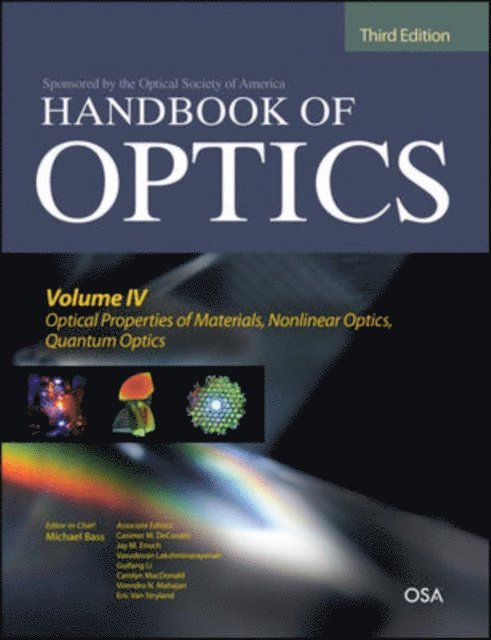
Volume IV covers optical properties of materials, nonlinear optics, and quantum optics.
2 129 kr
Läs direkt efter köp
The most comprehensive and up-to-date optics resource available
Prepared under the auspices of the Optical Society of America, the five carefully architected and cross-referenced volumes of the Handbook of Optics, Third Edition, contain everything a student, scientist, or engineer requires to actively work in the field. From the design of complex optical systems to world-class research and development methods, this definitive publication provides unparalleled access to the fundamentals of the discipline and its greatest minds.
Individual chapters are written by the world''s most renowned experts who explain, illustrate, and solve the entire field of optics. Each volume contains a complete chapter listing for the entire Handbook, extensive chapter glossaries, and a wealth of references. This pioneering work offers unprecedented coverage of optics data, techniques, and applications.
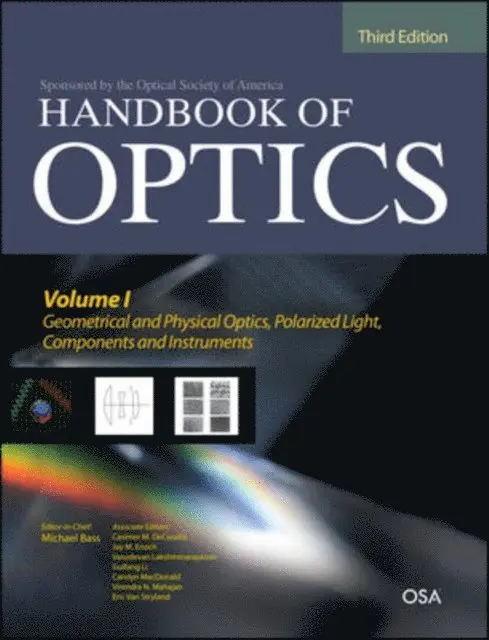
Volume I covers geometrical and physical optics, polarized light, components, and instruments.
2 002 kr
Läs direkt efter köp
The most comprehensive and up-to-date optics resource available
Prepared under the auspices of the Optical Society of America, the five carefully architected and cross-referenced volumes of the Handbook of Optics, Third Edition, contain everything a student, scientist, or engineer requires to actively work in the field. From the design of complex optical systems to world-class research and development methods, this definitive publication provides unparalleled access to the fundamentals of the discipline and its greatest minds.
Individual chapters are written by the world''s most renowned experts who explain, illustrate, and solve the entire field of optics. Each volume contains a complete chapter listing for the entire Handbook, extensive chapter glossaries, and a wealth of references. This pioneering work offers unprecedented coverage of optics data, techniques, and applications.
Volume II covers design, fabrications, testing, sources, detectors, radiometry, and photometry.
2 925 kr
Läs direkt efter köp
Prepared under the auspices of the Optical Society of America, the five carefully architected and cross-referenced volumes of the Handbook of Optics, Third Edition, contain everything a student, scientist, or engineer requires to actively work in the field. From the design of complex optical systems to world-class research and development methods, this definitive publication provides unparalleled access to the fundamentals of the discipline and its greatest minds.
Individual chapters are written by the world''s most renowned experts who explain, illustrate, and solve the entire field of optics. Each volume contains a complete chapter listing for the entire Handbook, extensive chapter glossaries, and a wealth of references. This pioneering work offers unprecedented coverage of optics data, techniques, and applications.
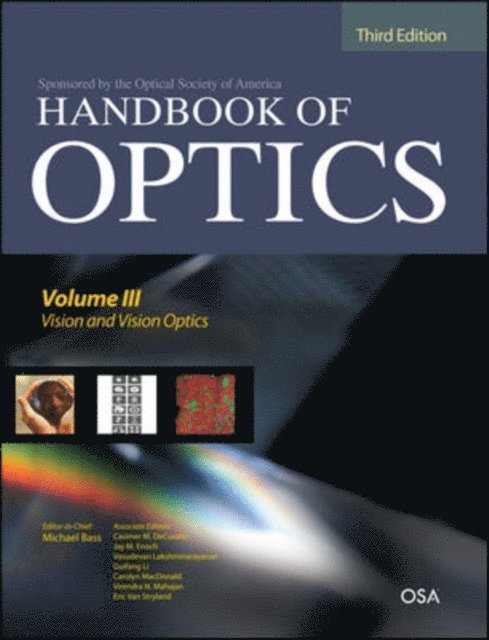
Volume III, all in full color, covers vision and vision optics.1 932 kr
Läs direkt efter köp
The most comprehensive and up-to-date optics resource available
Prepared under the auspices of the Optical Society of America, the five carefully architected and cross-referenced volumes of the Handbook of Optics, Third Edition, contain everything a student, scientist, or engineer requires to actively work in the field. From the design of complex optical systems to world-class research and development methods, this definitive publication provides unparalleled access to the fundamentals of the discipline and its greatest minds.
Individual chapters are written by the world''s most renowned experts who explain, illustrate, and solve the entire field of optics. Each volume contains a complete chapter listing for the entire Handbook, extensive chapter glossaries, and a wealth of references. This pioneering work offers unprecedented coverage of optics data, techniques, and applications.
Volume IV covers optical properties of materials, nonlinear optics, and quantum optics.
1 932 kr
Läs direkt efter köp
The most comprehensive and up-to-date optics resource available
Prepared under the auspices of the Optical Society of America, the five carefully architected and cross-referenced volumes of the Handbook of Optics, Third Edition, contain everything a student, scientist, or engineer requires to actively work in the field. From the design of complex optical systems to world-class research and development methods, this definitive publication provides unparalleled access to the fundamentals of the discipline and its greatest minds.
Individual chapters are written by the world''s most renowned experts who explain, illustrate, and solve the entire field of optics. Each volume contains a complete chapter listing for the entire Handbook, extensive chapter glossaries, and a wealth of references. This pioneering work offers unprecedented coverage of optics data, techniques, and applications.
Volume V covers atmospheric optics, modulators, fiber optics, and x-ray and neutron optics.
600 kr
Skickas inom 10-15 vardagar
1 037 kr
Skickas inom 10-15 vardagar
2 942 kr
Läs direkt efter köp
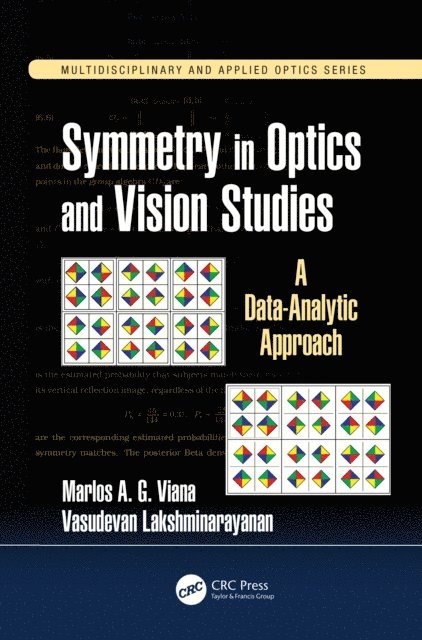
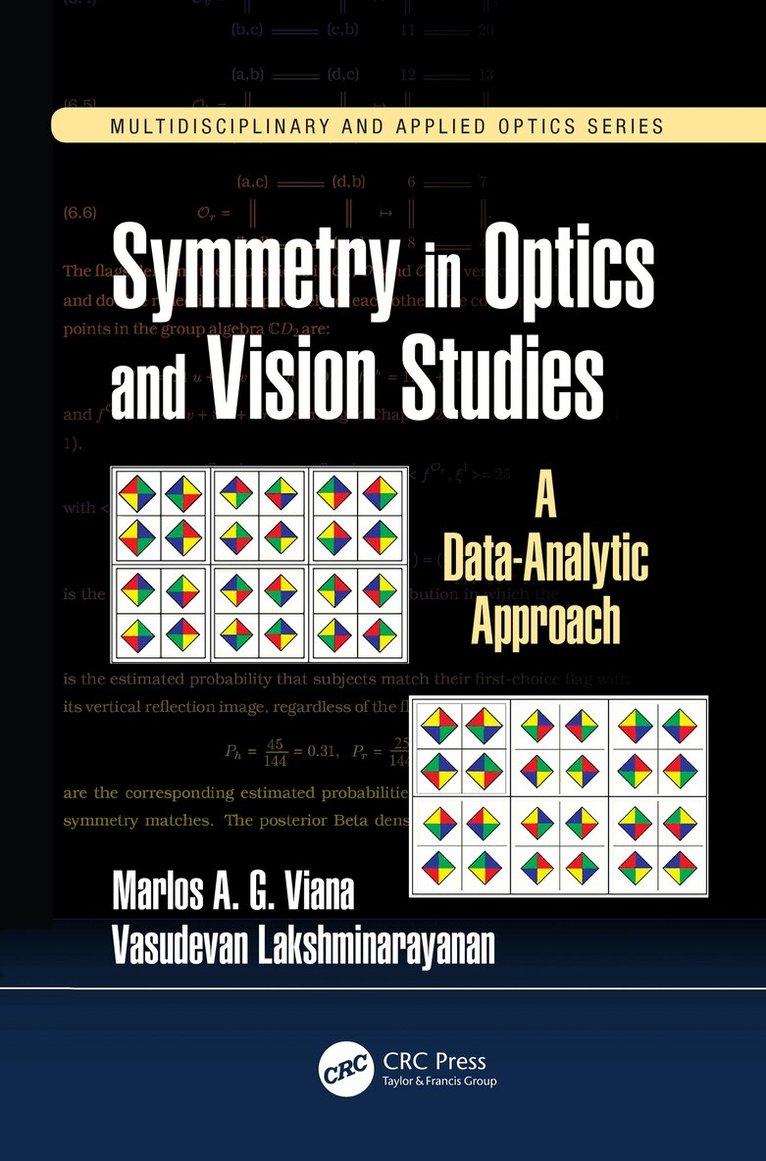
This book presents an introduction to the foundations, interpretations, and data-analytic applications of symmetry studies with an emphasis on applications in optical sciences. Symmetry studies connect group theoretic and statistical methods for data summary and inference. Readers should have an understanding of calculus and linear algebra as well as introductory statistics. The book reviews finite group theory in the introductory chapters. Computational tools used in the text are available for download in the form of Mathmaticaâ notebooks or R scripts. This book:
Demonstrates the usefulness of a unified view of algebra and symmetry studies to address data-analytic questions in optics and vision science
Offers a brief review of finite group theory and elements of multivariate analysis
Includes various examples from diverse areas of optical science
1 581 kr
Skickas inom 5-8 vardagar
410 kr
Skickas inom 5-8 vardagar
2 102 kr
Läs direkt efter köp
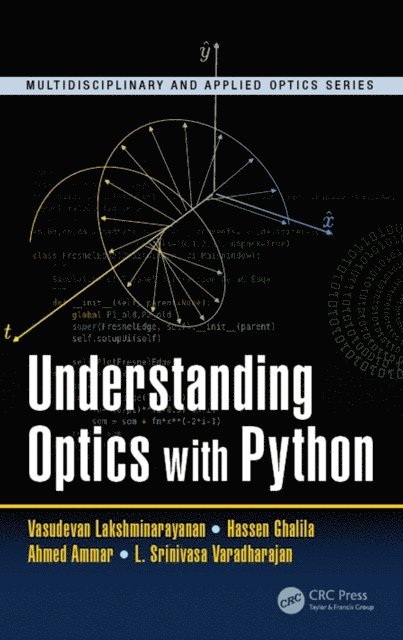
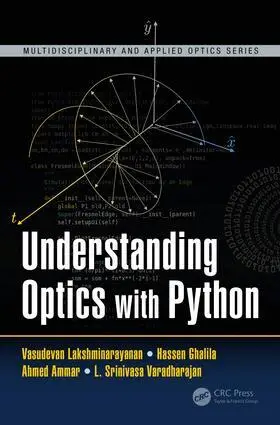
Optics is an enabling science that forms a basis for our technological civilization. Courses in optics are a required part of the engineering or physics undergraduate curriculum in many universities worldwide. The aim of Understanding Optics with Python is twofold: first, to describe certain basic ideas of classical physical and geometric optics; second, to introduce the reader to computer simulations of physical phenomena. The text is aimed more broadly for those who wish to use numerical/computational modeling as an educational tool that promotes interactive teaching (and learning). In addition, it offers an alternative to developing countries where the necessary equipment to carry out the appropriate experiments is not available as a result of financial constraints. This approach contributes to a better diffusion of knowledge about optics. The examples given in this book are comparable to those found in standard textbooks on optics and are suitable for self-study. This text enables the user to study and understand optics using hands-on simulations with Python. Python is our programming language of choice because of its open-source availability, extensive functionality, and an enormous online support. Essentials of programming in Python 3.x, including graphical user interface, are also provided. The codes in the book are available for download on the book’s website.
Discusses most standard topics of traditional physical and geometrical optics through Python and PyQt5
Provides visualizations and in-depth descriptions of Python’s programming language and simulations
Includes simulated laboratories where students are provided a "hands-on" exploration of Python software
Coding and programming featured within the text are available for download on the book’s corresponding website.
"Understanding Optics with Python by Vasudevan Lakshminarayanan, Hassen Ghalila, Ahmed Ammar, and L. Srinivasa Varadharajan is born around a nice idea: using simulations to provide the students with a powerful tool to understand and master optical phenomena. The choice of the Python language is perfectly matched with the overall goal of the book, as the Python language provides a completely free and easy-to-learn platform with huge cross-platform compatibility, where the reader of the book can conduct his or her own numerical experiments to learn faster and better."— Costantino De Angelis, University of Brescia, Italy
"Teaching an important programming language like Python through concrete examples from optics is a natural and, in my view, very effective approach. I believe that this book will be used by students and appreciated greatly by instructors. The topic of modelling optical effects and systems where the students should already have a physical background provides great motivation for students to learn the basics of a powerful programming language without the intimidation factor that often goes with a formal computer science course." — John Dudley, FEMTO-ST Institute, Besançon, France
1 136 kr
Läs direkt efter köp
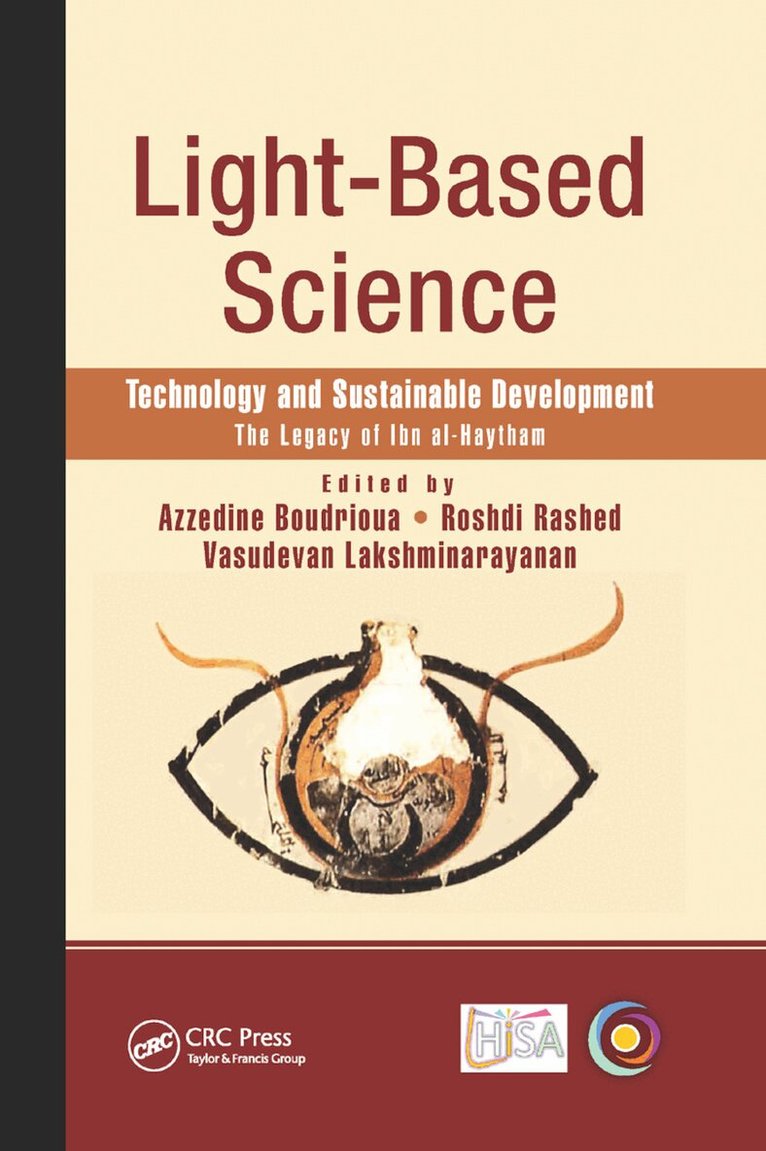
This book discusses light-based science, emphasizing its pervasive influence in science, technology, policy, and education. A wide range of contributors offers a comprehensive study of the tremendous, and indeed foundational, contributions of Ibn al Haytham, a scholar from the medieval period. The analysis then moves into the future development of light-based technology. Written as a multi-disciplinary reference book by leading scholars in the history of science and /or photonics, it covers Ibn al Haytham’s optics, LED lighting for sustainable development, global and atomic-scale time with new light sources, advanced technology, and vision science. Cutting-edge optical technologies and their global impact is addressed in detail, and the later chapters also explore challenges with renewable energy, the global impact of photonics, and optical and photonic education technology. Practical examples and illustrations are provided throughout the text.
3 362 kr
Läs direkt efter köp
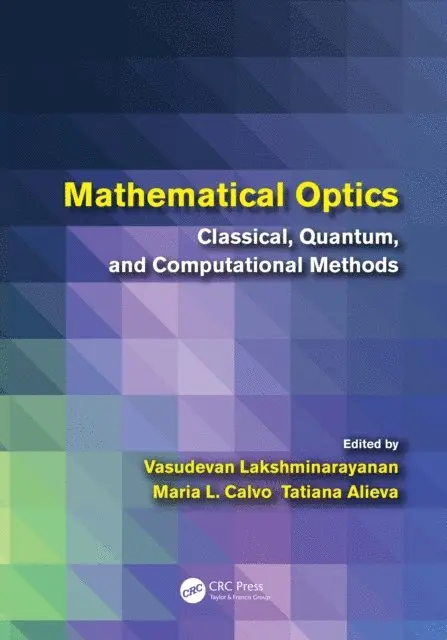
Going beyond standard introductory texts, Mathematical Optics: Classical, Quantum, and Computational Methods brings together many new mathematical techniques from optical science and engineering research. Profusely illustrated, the book makes the material accessible to students and newcomers to the field.
Divided into six parts, the text presents state-of-the-art mathematical methods and applications in classical optics, quantum optics, and image processing.
Part I describes the use of phase space concepts to characterize optical beams and the application of dynamic programming in optical waveguides. Part II explores solutions to paraxial, linear, and nonlinear wave equations. Part III discusses cutting-edge areas in transformation optics (such as invisibility cloaks) and computational plasmonics. Part IV uses Lorentz groups, dihedral group symmetry, Lie algebras, and Liouville space to analyze problems in polarization, ray optics, visual optics, and quantum optics. Part V examines the role of coherence functions in modern laser physics and explains how to apply quantum memory channel models in quantum computers. Part VI introduces super-resolution imaging and differential geometric methods in image processing.
As numerical/symbolic computation is an important tool for solving numerous real-life problems in optical science, many chapters include Mathematica® code in their appendices. The software codes and notebooks as well as color versions of the book’s figures are available at www.crcpress.com.
706 kr
Läs direkt efter köp
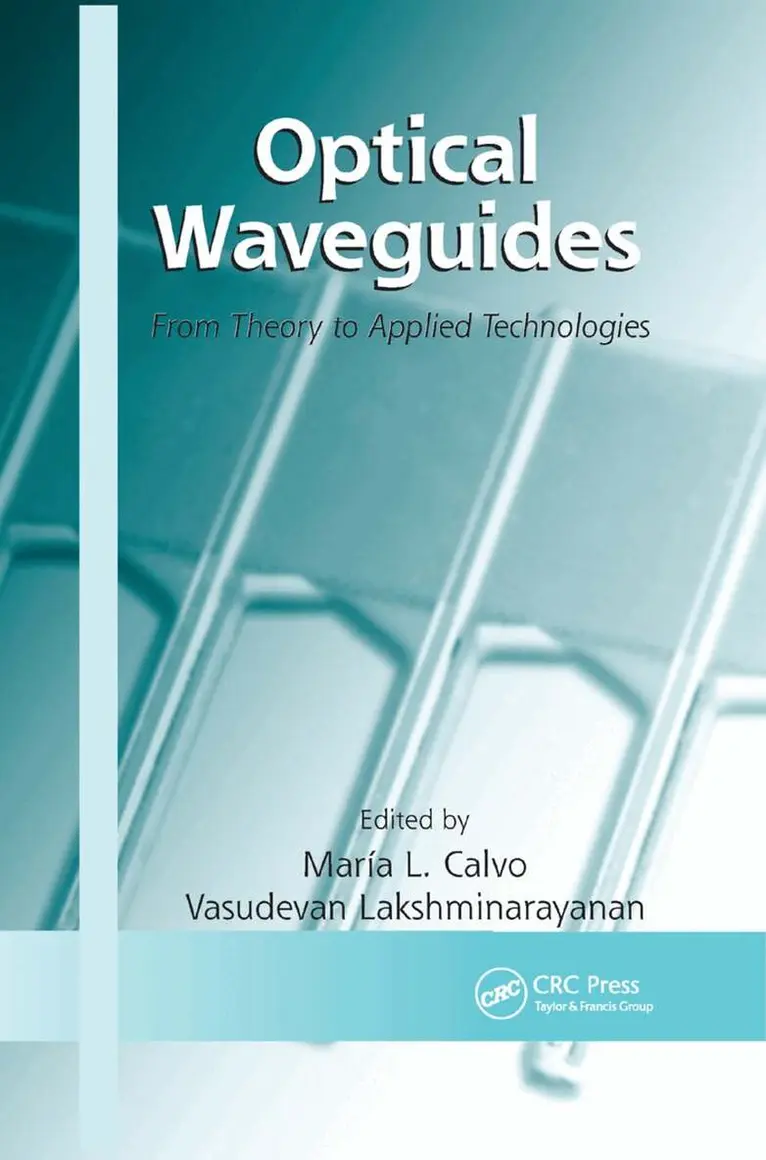
Although the theory and principles of optical waveguides have been established for more than a century, the technologies have only been realized in recent decades. Optical Waveguides: From Theory to Applied Technologies combines the most relevant aspects of waveguide theory with the study of current detailed waveguiding technologies, in particular, photonic devices, telecommunication applications, and biomedical optics.
With self-contained chapters written by well-known specialists, the book features both fundamentals and applications. The first three chapters examine the theoretical foundations and bases of planar optical waveguides as well as critical optical properties such as birefringence and nonlinear optical phenomena. The next several chapters focus on contemporary waveguiding technologies that include photonic devices and telecommunications. The book concludes with discussions on additional technological applications, including biomedical optical waveguides and the potential of neutron waveguides.
As optical waveguides play an increasing part in modern technology, photonics will become to the 21st century what electronics were to the 20th century. Offering both novel insights for experienced professionals and introductory material for novices, this book facilitates a better understanding of the new information era—the photonics century.
706 kr
Läs direkt efter köp
Although the theory and principles of optical waveguides have been established for more than a century, the technologies have only been realized in recent decades. Optical Waveguides: From Theory to Applied Technologies combines the most relevant aspects of waveguide theory with the study of current detailed waveguiding technologies, in particular, photonic devices, telecommunication applications, and biomedical optics.
With self-contained chapters written by well-known specialists, the book features both fundamentals and applications. The first three chapters examine the theoretical foundations and bases of planar optical waveguides as well as critical optical properties such as birefringence and nonlinear optical phenomena. The next several chapters focus on contemporary waveguiding technologies that include photonic devices and telecommunications. The book concludes with discussions on additional technological applications, including biomedical optical waveguides and the potential of neutron waveguides.
As optical waveguides play an increasing part in modern technology, photonics will become to the 21st century what electronics were to the 20th century. Offering both novel insights for experienced professionals and introductory material for novices, this book facilitates a better understanding of the new information era—the photonics century.
2 830 kr
Skickas inom 10-15 vardagar
3 362 kr
Läs direkt efter köp
Going beyond standard introductory texts, Mathematical Optics: Classical, Quantum, and Computational Methods brings together many new mathematical techniques from optical science and engineering research. Profusely illustrated, the book makes the material accessible to students and newcomers to the field.
Divided into six parts, the text presents state-of-the-art mathematical methods and applications in classical optics, quantum optics, and image processing.
Part I describes the use of phase space concepts to characterize optical beams and the application of dynamic programming in optical waveguides. Part II explores solutions to paraxial, linear, and nonlinear wave equations. Part III discusses cutting-edge areas in transformation optics (such as invisibility cloaks) and computational plasmonics. Part IV uses Lorentz groups, dihedral group symmetry, Lie algebras, and Liouville space to analyze problems in polarization, ray optics, visual optics, and quantum optics. Part V examines the role of coherence functions in modern laser physics and explains how to apply quantum memory channel models in quantum computers. Part VI introduces super-resolution imaging and differential geometric methods in image processing.
As numerical/symbolic computation is an important tool for solving numerous real-life problems in optical science, many chapters include Mathematica® code in their appendices. The software codes and notebooks as well as color versions of the book’s figures are available at www.crcpress.com.
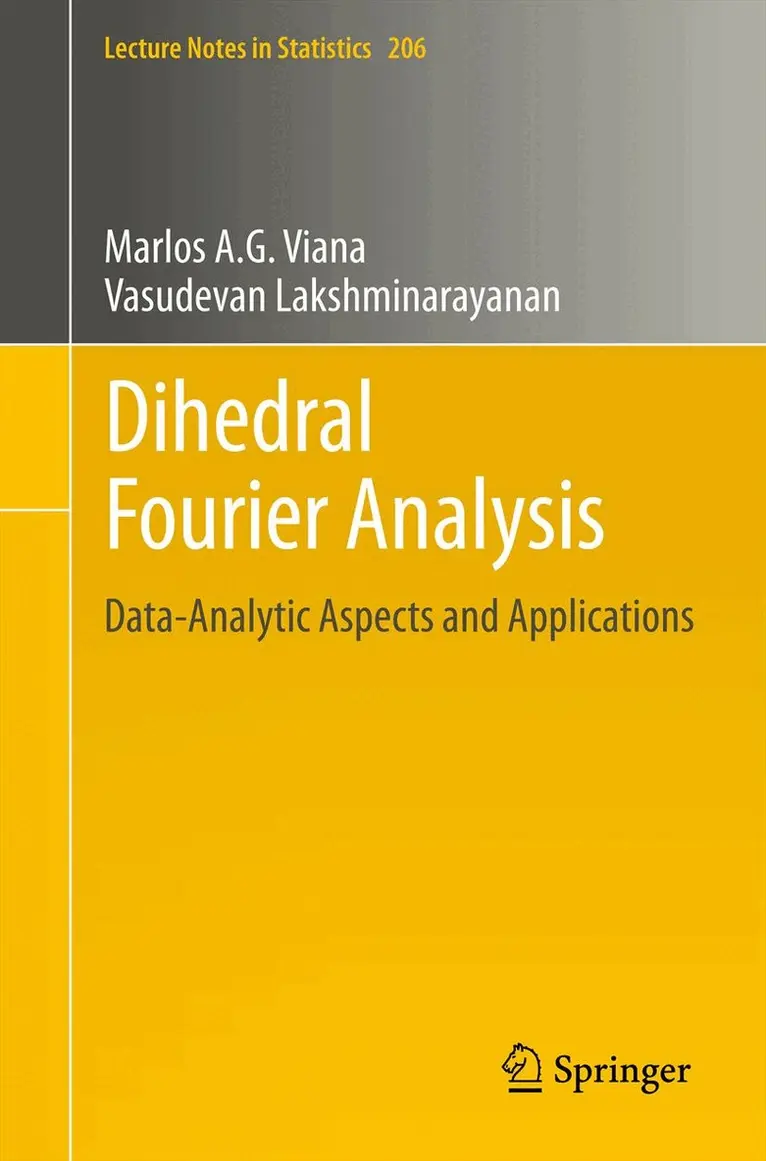
Dihedral Fourier Analysis
Data-analytic Aspects and Applications
1 084 kr
Skickas inom 10-15 vardagar
1 416 kr
Läs direkt efter köp
Dihedral Fourier Analysis introduces the theory and applications necessary to study experimental data indexed by, or associated with, the points in a dihedral symmetry orbit.
This book looks at experimental data and analytical models indexed by certain dihedral rotations and reversals realized as vector fields. Its particular relevance as a research tool in areas such as optical and molecular biology statistics appears when formulated within the context of symmetry studies, which formally connects algebraic and statistical reasoning together in one methodology for data summary and inference.
Chapter 1 presents an overview of the theory and methods of dihedral analysis. It introduces data sets and examples defining and connecting the algebraic notions of symmetry with those of statistical summaries and inference. Chapter 2 includes the required algebraic aspects and data-analytic results. Chapters 3-6 offer applications of the methods presented in the text. This book is intended for data analysts of both theoretical and applied interests.
2 477 kr
Skickas inom 10-15 vardagar
2 942 kr
Läs direkt efter köp
This book presents an introduction to the foundations, interpretations, and data-analytic applications of symmetry studies with an emphasis on applications in optical sciences. Symmetry studies connect group theoretic and statistical methods for data summary and inference. Readers should have an understanding of calculus and linear algebra as well as introductory statistics. The book reviews finite group theory in the introductory chapters. Computational tools used in the text are available for download in the form of Mathmaticaâ notebooks or R scripts. This book:
Demonstrates the usefulness of a unified view of algebra and symmetry studies to address data-analytic questions in optics and vision science
Offers a brief review of finite group theory and elements of multivariate analysis
Includes various examples from diverse areas of optical science
2 435 kr
Skickas inom 10-15 vardagar
2 186 kr
Läs direkt efter köp
Optics is an enabling science that forms a basis for our technological civilization. Courses in optics are a required part of the engineering or physics undergraduate curriculum in many universities worldwide. The aim of Understanding Optics with Python is twofold: first, to describe certain basic ideas of classical physical and geometric optics; second, to introduce the reader to computer simulations of physical phenomena. The text is aimed more broadly for those who wish to use numerical/computational modeling as an educational tool that promotes interactive teaching (and learning). In addition, it offers an alternative to developing countries where the necessary equipment to carry out the appropriate experiments is not available as a result of financial constraints. This approach contributes to a better diffusion of knowledge about optics. The examples given in this book are comparable to those found in standard textbooks on optics and are suitable for self-study. This text enables the user to study and understand optics using hands-on simulations with Python. Python is our programming language of choice because of its open-source availability, extensive functionality, and an enormous online support. Essentials of programming in Python 3.x, including graphical user interface, are also provided. The codes in the book are available for download on the book’s website.
Discusses most standard topics of traditional physical and geometrical optics through Python and PyQt5
Provides visualizations and in-depth descriptions of Python’s programming language and simulations
Includes simulated laboratories where students are provided a "hands-on" exploration of Python software
Coding and programming featured within the text are available for download on the book’s corresponding website.
"Understanding Optics with Python by Vasudevan Lakshminarayanan, Hassen Ghalila, Ahmed Ammar, and L. Srinivasa Varadharajan is born around a nice idea: using simulations to provide the students with a powerful tool to understand and master optical phenomena. The choice of the Python language is perfectly matched with the overall goal of the book, as the Python language provides a completely free and easy-to-learn platform with huge cross-platform compatibility, where the reader of the book can conduct his or her own numerical experiments to learn faster and better."— Costantino De Angelis, University of Brescia, Italy
"Teaching an important programming language like Python through concrete examples from optics is a natural and, in my view, very effective approach. I believe that this book will be used by students and appreciated greatly by instructors. The topic of modelling optical effects and systems where the students should already have a physical background provides great motivation for students to learn the basics of a powerful programming language without the intimidation factor that often goes with a formal computer science course." — John Dudley, FEMTO-ST Institute, Besançon, France
2 661 kr
Skickas inom 10-15 vardagar
1 177 kr
Läs direkt efter köp
This book discusses light-based science, emphasizing its pervasive influence in science, technology, policy, and education. A wide range of contributors offers a comprehensive study of the tremendous, and indeed foundational, contributions of Ibn al Haytham, a scholar from the medieval period. The analysis then moves into the future development of light-based technology. Written as a multi-disciplinary reference book by leading scholars in the history of science and /or photonics, it covers Ibn al Haytham’s optics, LED lighting for sustainable development, global and atomic-scale time with new light sources, advanced technology, and vision science. Cutting-edge optical technologies and their global impact is addressed in detail, and the later chapters also explore challenges with renewable energy, the global impact of photonics, and optical and photonic education technology. Practical examples and illustrations are provided throughout the text.
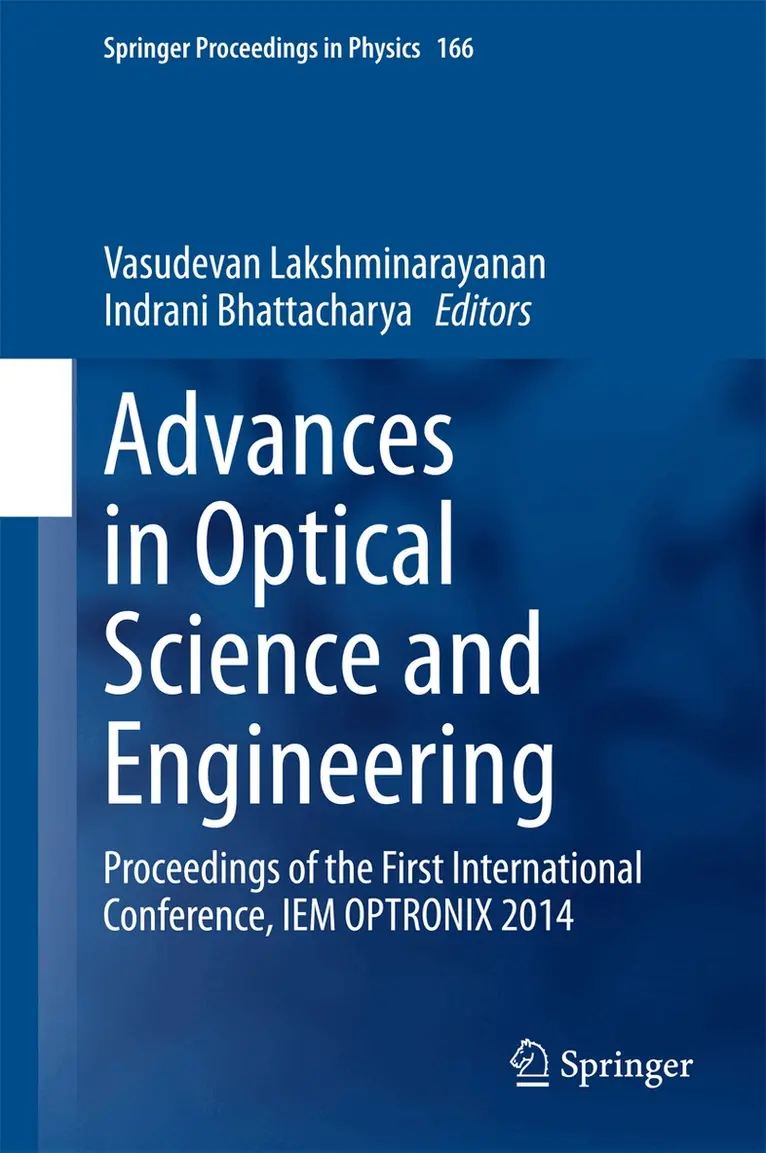
Advances in Optical Science and Engineering
Proceedings of the First International Conference, IEM OPTRONIX 2014
2 160 kr
Skickas inom 10-15 vardagar
2 840 kr
Läs direkt efter köp
The Proceedings of First International Conference on Opto-Electronics and Applied Optics 2014, IEM OPTRONIX 2014 presents the research contributions presented in the conference by researchers from both India and abroad. Contributions from established scientists as well as students are included. The book is organized to enable easy access to various topics of interest.
The first part includes the Keynote addresses by Phillip Russell, Max Planck Institute of the Light Sciences, Erlangen, Germany and Lorenzo Pavesi, University of Trento, Italy.
The second part focuses on the Plenary Talks given by eminent scientists, namely, Azizur Rahman, City University London, London; Bishnu Pal, President, The Optical Society of India; Kamakhya Ghatak, National Institute of Technology, Agartala; Kehar Singh, Former Professor, India Institute of Technology Delhi; Mourad Zghal, SUPCOM, University of Carthage, Tunisia; Partha Roy Chaudhuri, IIT Kharagpur; S K. Bhadra, CSIR-Central Glass and Ceramic Research Institute, Kolkata; Sanjib Chatterjee, Raja Ramanna Centre for Advanced Technology, Indore; Takeo Sasaki, Tokyo University, Japan; Lakshminarayan Hazra, Emeritus Professor, University of Calcutta, Kolkata; Shyam Akashe, ITM University, Gwalior and Vasudevan Lakshminarayanan, University of Waterloo, Canada.
The subsequent parts focus on topic-wise contributory papers in Application of Solar Energy; Diffraction Tomography; E.M. Radiation Theory and Antenna; Fibre Optics and Devices; Photonics for Space Applications; Micro-Electronics andVLSI; Nano-Photonics, Bio-Photonics and Bio-Medical Optics; Non-linear Phenomena and Chaos; Optical and Digital Data and Image Processing; Optical Communications and Networks; Optical Design; Opto-Electronic Devices; Opto-Electronic Materials and Quantum Optics and Information Processing.
2 862 kr
Skickas inom 5-8 vardagar